
Gritty surveillance video shows a bearded man walking through a subway car before abruptly cutting to well-lit, Spanish-speaking news influencer Alcibiades Onofre in front of what looks like a studio set. Dressed in a suit and tie, Onofre speaks to the audience: “Sniffing his hands after sexually assaulting a man on the New York subway, this Middle Eastern man was caught on camera and is now behind bars.” Onofre ends the minute-long TikTok newscast saying that he’s verified this news, but fails to provide any further context.
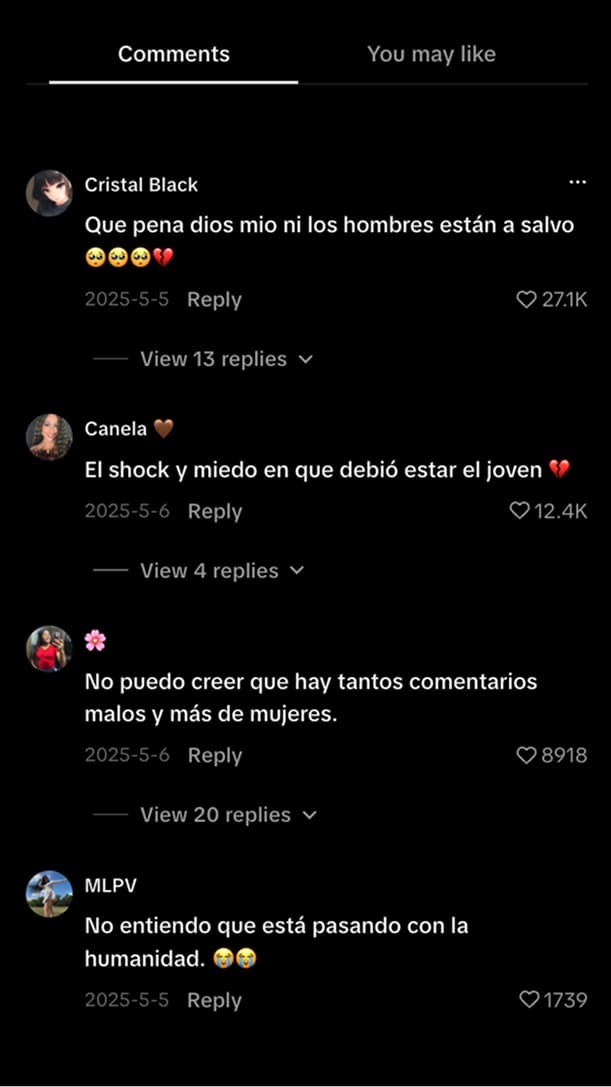
Onofre’s video has garnered more than 19 million views, was shared more than 39,500 times and solicited more than 8,000 comments.
“What a shame, my God, not even men are safe 🥺🥺🥺💔,” one commenter said in Spanish.
This is just one of 207 videos that Onofre’s channel posted on TikTok in 2025 about alleged crimes committed largely in the U.S. by individuals or gangs. An analysis of Onofre’s account shows that these crime-related videos represent 60% of his most popular content. According to a months-long data analysis by Documented, Onofre has one of the more popular TikTok accounts that posts a lot of content related to New York and issues related to immigrant communities. He is part of a growing number of popular news influencers — or “newsfluencers” — on the platform, whom Spanish-speaking New Yorkers are increasingly turning to for their news.
Mixed in with Onofre’s stories about immigration policy changes and natural disasters are lurid descriptions of crimes being committed by immigrants in the U.S. and people living in Latin American countries. As a whole, Onofre’s videos paint a picture of American cities under threat of immigrant thieves, sexual predators and murderers. These sorts of videos, framed as urgent, and essential, are flooding TikTok feeds. They are being shared on the app and in family group chats and are shaping New Yorkers' perceptions of immigrants, particularly those who are new to the city.
An increasing number of Americans are getting their news from TikTok newsfluencers like Onofre. According to a 2025 Pew Research Center poll, more than half of all adults living in the U.S. currently receive news from social media influencers, with one in five U.S. adults receiving news from TikTok specifically — a sharp uptick from just 3% five years prior. No other social media platform experienced that steep of an increase, according to Pew’s calculations.
TikTok plays an especially key role in the lives of Spanish-speaking Latinos, according to a 2025 report from the Digital Democracy Institute of the Americas, an institution that researches public opinion and investigates narratives circulating online to deepen understanding of Latinos. Latino interviewees and survey respondents said that TikTok was their “go-to daily platform,” especially for younger Latinos between the ages 18 and 35. Only Instagram was more popular than TikTok among all those interviewed by Digital Democracy Institute.
TikTok has also had an outsized influence on recent migration patterns to New York City, according to Documented reporting from the past several years. About 237,000 asylum seekers arrived in New York City between 2022 and 2025, many of whom had gotten the idea to migrate to the city on TikTok, used smugglers they found on the platform, and then looked for information to navigate their new lives on the app.
Because of this, Documented sought to better understand the information being spread on the platform and its downstream impacts on immigrants in the United States. Documented was given exclusive access to a trove of TikTok data from New York University's Center for Social Media, AI, and Politics, and our analysis found that the most popular accounts among New York City’s Spanish-speaking immigrant communities featured newsy content from not only news influencers (as opposed to traditional media accounts), but also from what are known as “content farms”: accounts that publish unvetted and low-quality videos that are increasingly AI-generated.
New York’s Spanish-speaking populations also often consume immigration-specific content, such as how-to videos on navigating asylum or visa application processes. But while many of these videos were produced originally by immigration lawyers endeavoring to help new clients, many are ultimately ripped off and reposted by copycat accounts that are not held to the same ethical standards as practicing attorneys. As a result some viewers were misinformed, misled and in some cases swindled out of hundreds if not thousands of dollars.
Using NYU’s provided TikTok data, Documented ran an analysis on 10,000 videos — a collective snapshot of the 500 most watched TikTok videos with Spanish language hashtags related to immigration and New York each month over a 20-month period — and looked for accounts that had the highest number of videos in the sample. Onofre’s TikTok account, @alcibiadesonofretv, was by far the most watched account in the sample. Six of the most popular accounts, including Onofre’s account, branded themselves as being news outlets or reporters — and one belonged to who appears to be Onofre’s brother.
To get a more granular look at what kind of content Onofre was showing to his audience, Documented produced and examined transcripts of 342 of Onofre’s videos, which represent one year’s worth of videos from his account in our sample. The videos included a mix of general news about immigration policies, immigration enforcement raids and natural disasters, but the largest portion was about crime. Onofre mentions the policía (police) in a quarter of his videos and víctima (victim) in 19% of them.
From Chilean migrants robbing homes in California to an Ecuadorian man luring an 11-year-old girl into his van with candy, the alleged crimes Onofre details in his videos are often committed by immigrants in the U.S. These purported crimes include theft, murder, sexual assault and child abuse, though several videos also mention stories of crimes being committed in other countries that may be of interest to a Latino audience, including Mexico, Ecuador or Venezuela.
Documented reached out to Onofre for comment but did not hear back by the time of publication.

Meta Narratives
Onofre’s tactics are nothing new. Stories that paint migrants as criminals or as a source of community insecurity are common tropes that have consistently garnered high levels of engagement, Roberta S. Braga, founder and executive director of Digital Democracy Institute of the Americas, told Documented.
“The two biggest meta narratives that we've identified are, one, that immigrants are a threat to the country or society, and that's a meta narrative that gets repeated not just in the United States every year, but also in different countries in Latin America and the world,” she said. “And then the other meta narrative is that there's an immigration crisis.”
Over the course of the Digital Democracy Institute’s research, Braga said the organization has found that narratives about immigration that are false or misleading tend to get repeated the most.
There are many reasons for this overemphasis on crime. For one, TikTok and other social platforms “reward sensation and they reward co-opting people's emotions,” said Jaime Longoria, a Senior Research Manager at the Disinfo Defense League, an organization that studies and combats online racialized disinformation.
“So the content that's inevitably going to be produced by influencers who have audiences that are expecting news content from them aren't necessarily being fed to them because they're informative,” Longoria said. “It's being fed to them because they're profitable for the platform and for the influencer or actor.”
In the current moment, Longoria added, these storylines can also help some immigrants draw a line between themselves and the kinds of “criminal immigrants” whom they perceive should be subject to deportation.
“I think, the crime content is popular because it does help people who would consider themselves non-criminal immigrants to ‘other’ this class of immigrants,” Longoria said. This “allows them to believe that they likely will not face any immigration enforcement because they are not like this class.”
Experts worry that this overemphasis on individual crime can worsen existing negative stereotypes about new immigrants.
Rightward Shifts
Several leaders in Queens who work with immigrants have told Documented that long-term and more established Spanish-speaking immigrants have formed negative opinions of newcomers and often associate them with crime. They also mentioned that the way new immigrants are portrayed on social media exacerbates this kind of pre-existing bias.
There are clear rightward shifts on TikTok and the Latino communities, Carina Kaufman-Gutierrez, who was the co-director of the Street Vendor Project explained to Documented before joining the Mayor Zohran Mamdani’s administration. She is the executive director of New York City’s Office of Street Vendor Services.
One video that stuck out to Kaufman-Gutierrez was an AI-generated video that made the rounds on social media. It featured Flushing Meadows Corona Park being overrun with vendors and rats, with a voice overstating that these squalid conditions were the reason that ICE agents were targeting Queens. (Documented was able to review the video, but it has since been deleted).
Videos like this, Kaufman-Gutierrez added, become “an outlet for a lot of people to be like, ‘We're not like them. You know, go back to the old country. Stop bringing your ways here.”
This kind of misinformation and disinformation can rack up more than online engagement — it can have real-life consequences, too. One study found that misinformation about immigrants can lead people to support anti-immigrant policies — and also found that accurate information could improve views of immigrants. Another study from Switzerland found that disproportionate coverage of crimes committed by immigrants led to an increase of voters supporting a ban on minarets — structures that are usually attached to mosques. False claims about migrants eating pets in Springfield, Ohio, also led to 33 bomb threats in the city.
While Americans’ trust in traditional news media continues to reach new lows, more people are turning to news influencers because they feel they can count on them — a person — over institutions, according to a poll from Pew. Furthermore, a 2026 survey from the Reuters Institute and Oxford University showed that respondents found creators more entertaining, easier to understand and more relatable than traditional news outlets.
Longoria noted that people will seek out influencers who project legitimacy and who may also deliver a kind of ‘raw’ truth that they believe they might not receive from traditional news organizations.
That’s not to say that news influencers don’t borrow visual parlance from legacy media. Onofre’s videos, for instance, often show him wearing a crisp suit in a studio-like setting, like a traditional news anchor. He has also been, on occasion, out in the field, microphone in hand. He speaks with a tone of authority and continuously emphasizes how hard he works on verifying his information.
News influencers “are able to really leverage these parasocial relationships that some like a news anchor probably can't,” Longoria said. But unlike traditional journalists, news influencers often don’t hold to the same ethical rules that newsrooms generally abide by, including being held accountable for mistakes.
Onofre’s TikTok bio reads: “I don't care if they get angry about me saying things as they are.”
Under the Cover of News
Onofre's videos, featuring a formula of direct-to-camera, seemingly off–the-cuff “confessional style” reporting mixed with a tailored, all-business look, consistently perform well. It’s no wonder then that other creators, chasing that same kind of high engagement, are mimicking this style even in cases where the information they present might be misleading or completely fabricated.
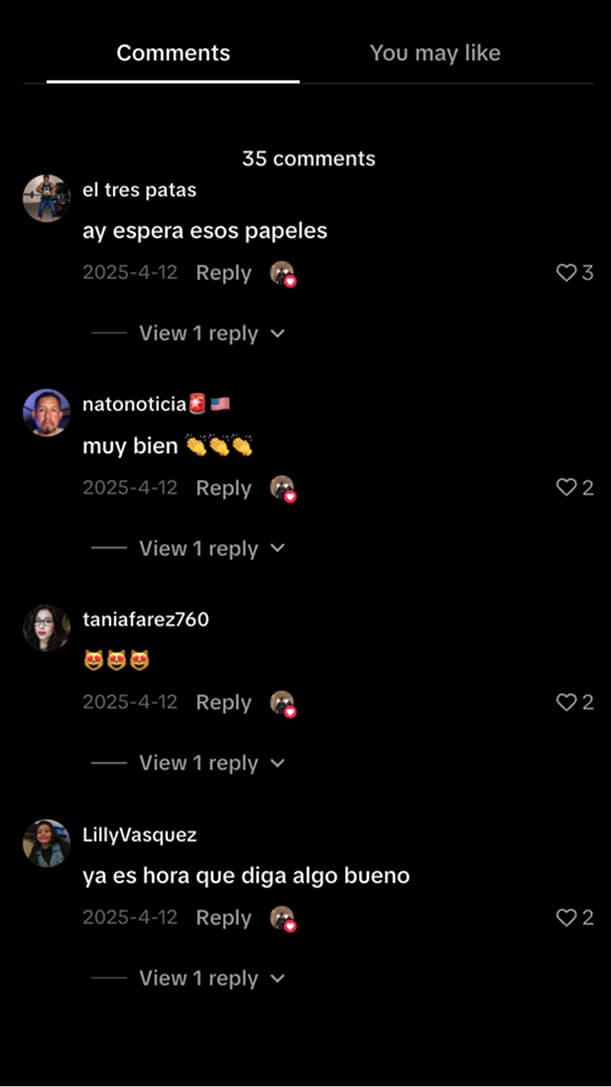
TikToker @edwin1contreras, who is in Documented’s most-watched sample, is one such creator. One video within our sample begins with a high-voltage, animated plea in Spanish — “Listen to breaking news,” or “share this news” — before tossing to another creator announcing that President Donald Trump plans to give papers to all migrant farm workers and hotel staff members. That account uses the likenesses of other popular Spanish-language TikTokers in its videos as well.
Other accounts in our sample share fully fabricated, AI-generated footage framed as legitimate local news for immigrants in New York City. @noticiasmundiales1.0 posted two videos that reported incidents where a person labeled as an “American woman” berates a Latina woman in a public space in the city — a McDonald’s or the subway — and threatens to call ICE on her (the account became inactive after Documented reached out to TikTok for comment). In each post, the American woman delivers the same exact monologue, with the same accent, in Spanish. Both videos carry the hallmarks of AI, including oddly shaped fingers and interactions between people who don’t make eye contact and who are awkwardly too close to one another.
Creators may be using AI to run entire accounts within this immigrant news ecosystem. Three of the top ten profiles in our most-watched sample were accounts that produce videos that appear to be auto-generated through editing software that automatically assembles videos from images and footage, and that increasingly feature what appears to be AI-generated content (one, @global.alerts, was recently deactivated). These three accounts racked up between 44 and 73 million total views each across all of their videos and had hundreds of thousands of followers at the time of Documented’s reporting.
“Latinos tell us they think they are seeing more AI-generated content on their feeds, like on Instagram and TikTok, than ever before,” Braga said, adding that respondents know that this content is polluting their feeds. Braga also said that Latino survey participants seemed to have good instincts in regards to maintaining a healthy distrust of this kind of content, and that they reported researching deeper into an issue if something piqued their interest.
“Algorithms reward conflict, they reward confrontation, they reward incredibly emotional content, things that are shocking and novel, things that are visually compelling,” Braga said. “That's where AI kind of comes in as the amplification of that really sensationalized stuff, and erasing the more nuanced, stabilizing, humanizing information because that stuff isn't inherently engaging.”
While it is clear to most consumers that AI-generated videos may not be trustworthy, the sheer volume and speed at which these videos are produced can lead people to believe in their messaging over time — a phenomenon Longoria called the illusory truth effect.
“The more familiar or the more repeat exposure that you have to something, the more likely you're able to believe that it's true,” he said. Creators can leverage the power of AI to flood platforms with content showing the same messaging again and again. What makes these videos dangerous, Longoria explained, is that they are often based on a kernel of truth — something that speaks to the personal experience of audiences and thus sticks with them.
“AI is a factor in terms of the speed of mis- and disinformation and the spread of mis- and disinformation, and to some extent, I do believe it plays into making people be convinced,” Longoria said. “But there is still part of the narratives that needs to ring true to someone's experience, lived experience, so that it's accepted.
“The repetition really is, I think, the dangerous part.”
METHODOLOGY:
- Documented worked with the NYU Center for Social Media, AI, and Politics to access an exclusive collection of tens of millions of TikTok video URLs from a large-scale representative sample of TikToks posted since October 2024. With access to this database, Documented was able to extract videos from a 20-month period — from November 2024 to July 2026 — and build a sample of roughly 10,000 of the most watched videos related to immigrant issues in New York City. This sample totaled over 12,400 minutes, the equivalent of about nine straight days of nonstop TikTok video content, which together amassed 1.6 billion views.