

There is no earthly reason that you should particularly care who the Comptroller General of the United States is. But you might want to know why there’s a fight over who the next one will be.
That’s because the Government Accountability Office — the agency the Comptroller General runs — has traditionally been our best window into how immigration enforcement agencies are actually spending — and, often, wasting or misusing — the money Congress sends them. And with ICE still having a $91 billion windfall sitting on the books unspent for mass deportation, that’s a lot of potential for waste or misuse.
The GAO is basically an auditor for the federal government. It looks at how agencies are doling out contracts, planning budgets, and spending money. They routinely release reports to the public about what government agencies are doing badly and how they can do better. (GAO is a reporter’s best friend; they do all the research for us and we can read and write up the results.) It’s traditionally scrupulously nonpartisan; the current acting Comptroller General is a career civil servant, and her predecessor just wrapped up a 15-year term under presidents of both parties.

So even under a unified Republican government over the last two years, when Congress handed a quarter-trillion dollars to DHS to carry out President Trump’s mass deportation campaign, the GAO was scrutinizing how that money was being budgeted and spent.
Between the One Big Beautiful Bill Act of 2025 and another package in 2026, Congress authorized ICE to spend about $115 billion before October 2029 — over $28 billion a year on average. That’s an enormous amount for an agency whose budget was a third of that the year prior: under $10 billion in 2024.
And, in general, when people get a ton more money than they’re used to having, they aren’t the best about spending it wisely. They may make grandiose plans and spend lots of money to get started on them, only to change course and give up the spent money for lost. They might negotiate less with contractors to drive down costs than they should; spend money on flashy toys; or write checks to people who turn out to be untrustworthy.
The GAO has been particularly interested in ICE’s efforts to expand immigration detention — a necessary complement to its policy of arresting people regardless of criminal history and rarely releasing anyone on bond, as well as something that has to happen if ICE is ever going to scale up deportations to the administration’s desired 1 million a year.
In early 2026, ICE trumpeted a new plan to consolidate detention by holding people in large warehouses, making it much easier to process and deport them. ICE bought 11 warehouses, spending over a billion dollars on them. Then, for some reason — maybe partially because communities were beginning to organize against ICE operating detention warehouses in their towns — ICE cooled on the plan. It intends to sell most of the warehouses off.
It’s unlikely to break even on the resales, though. A new GAO report, released Thursday, found that the government overpaid for those warehouses by a combined $532 million. Seven of the warehouses were bought for more than double their assessed value.
The GAO report highlights that ICE hasn’t learned its lesson from the implosion of the warehouse plan, either. It hasn’t revised its budget to reflect whatever it has in mind now after selling the warehouses off. Despite its lack of an apparent spending plan ICE continued to buy facilities — it bought a detention center in Washington from the private-prison company GEO Group this week for $453 million. The GAO warns that ICE is setting itself up to pay for more expensive facilities — for example, it’s signed new contracts that require it to pay for a minimum number of beds per day, then allowed those beds to go unfilled — and potentially waste money with unnecessarily inflated costs from contractors and vendors.
Knowing how ICE is spending its money — and how much it has left — is especially important information for the new Democratic Congress to have when it is seated in January. Congress will face two different questions about ICE funding: how big a budget to give ICE in annual appropriations bills (where Congress sets budgets for each executive-branch department and agency); and whether to try to take back some of the windfall Congress sent ICE over the last two years that ICE hasn’t yet spent.
Even with no additional funding from Congress, ICE could still spend that $28 billion a year the previous Congress promised it through 2029. That’s why the second question — clawing back unspent funds — is so important.
For all of ICE’s spending sprees, in fact, it still hasn’t spent most of the money Congress authorized it to spend. A new analysis from my colleagues at the American Immigration Council shows that ICE still has $91 billion of its money from the 2025 and 2026 bills sitting in its metaphorical bank — money that hasn’t yet been committed for a specific purpose, like a signed contract. And legally speaking, before money is committed, Congress has the power to take some of it back. For example, in 2025, Congress passed a “rescission” package that took back much of the USAID budget the previous Congress had approved.
Unfortunately, such a bill would still need to be signed by President Trump — who is, given all evidence from the past decade, highly unlikely to agree to spend less on deportations. So ICE is still likely to have a lot of money to play with.
This is why the person running the GAO for the next few years is so important.
Traditionally, GAO leadership is kept at arm’s length from the White House. Instead of being appointed anew under each president, the Comptroller General serves a single 15-year term.
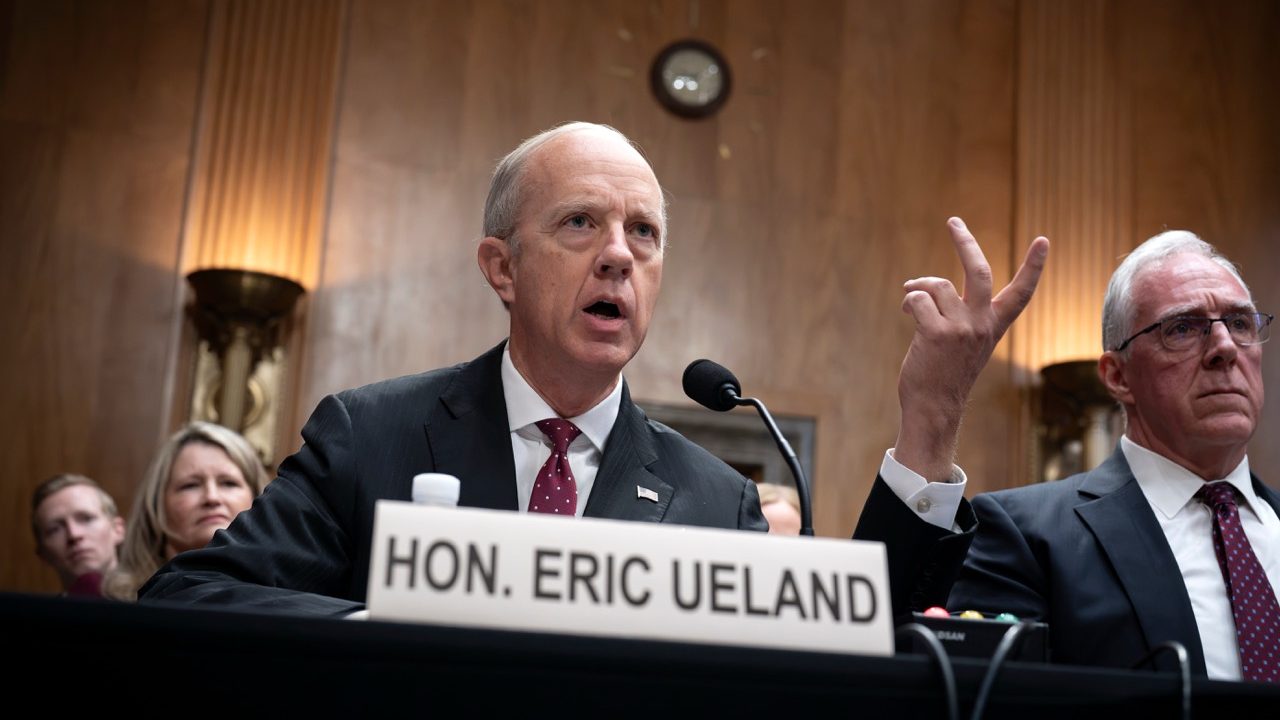
Under federal law, Congressional leadership is supposed to give the president three candidates, and the president picks one to nominate. That didn’t happen this time; President Trump just sent Congress a nomination for Eric Ueland.
Ueland is currently an official at the White House Office of Management and Budget — which has repeatedly been found in violation of federal laws about allocating spending appropriated by Congress, and whose current head has said he doesn’t think the GAO should exist.
During his nomination hearing this week, the nominee told senators he’d remain independent of the White House, and would be committed to the GAO’s mission. While I would never accuse anyone of perjuring themselves before the United States Senate, it is safe to say that I, personally, am skeptical that the report the GAO just released would have come out in the same form under a Comptroller General Ueland.
If the GAO stops informing the public about how those $91 billion are being spent, Congress can try to use its investigative powers to fill the vacuum. It would be much more efficient — and, potentially, effective — for Congress to condition ICE’s next budgets on greater transparency; it’s thanks to Congressional requirements that ICE reports how many people are in detention on a regular basis, for example. But money that’s already been appropriated can’t retroactively get strings attached. So the windfall given to ICE by the outgoing Congress could remain shrouded in mystery as it’s slowly spent down.