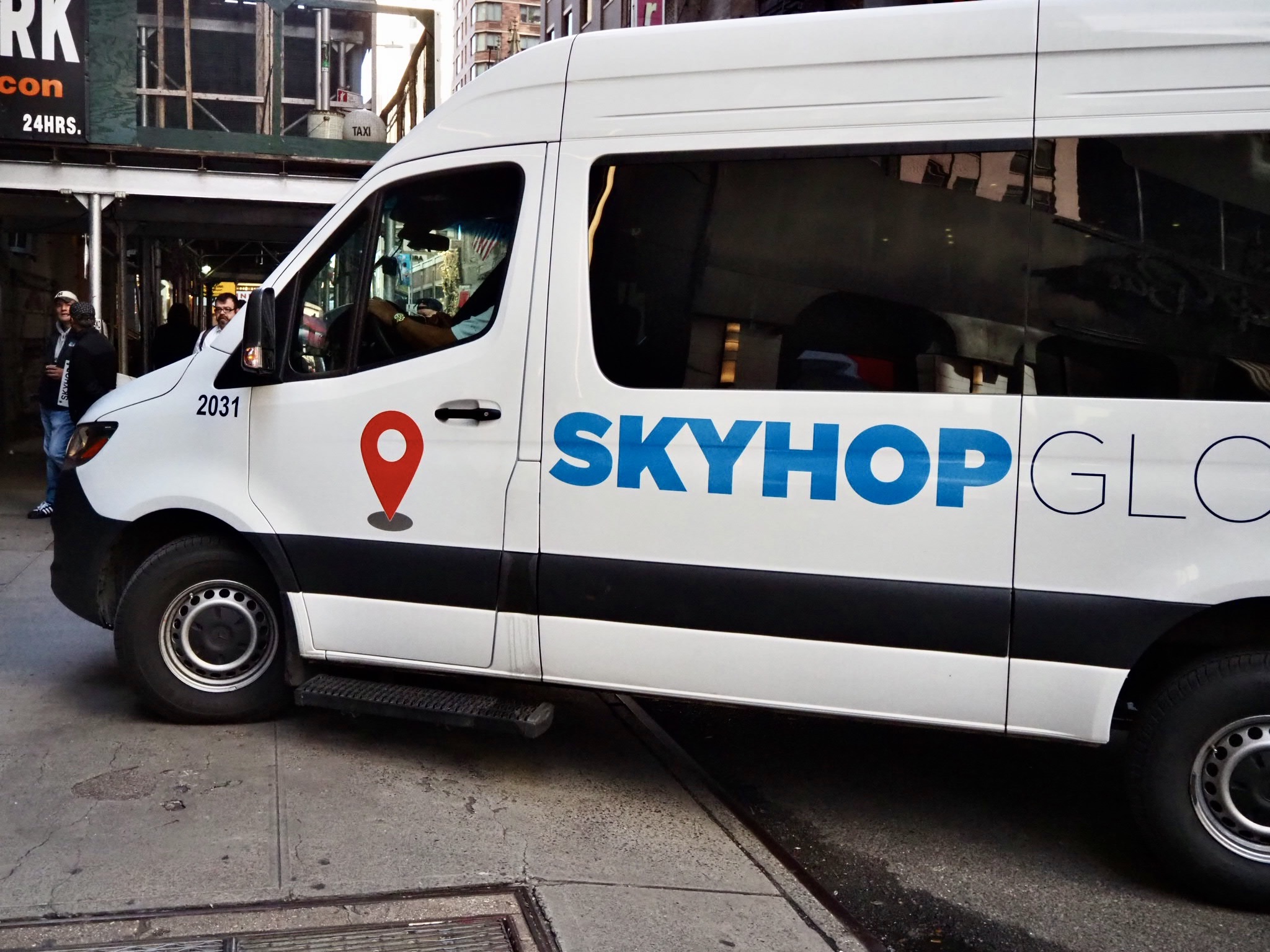


It’s 6 a.m. on a chilly October day, and outside the Hyatt Regency Hotel in Times Square, a few dozen workers already stand with picket signs in hand.
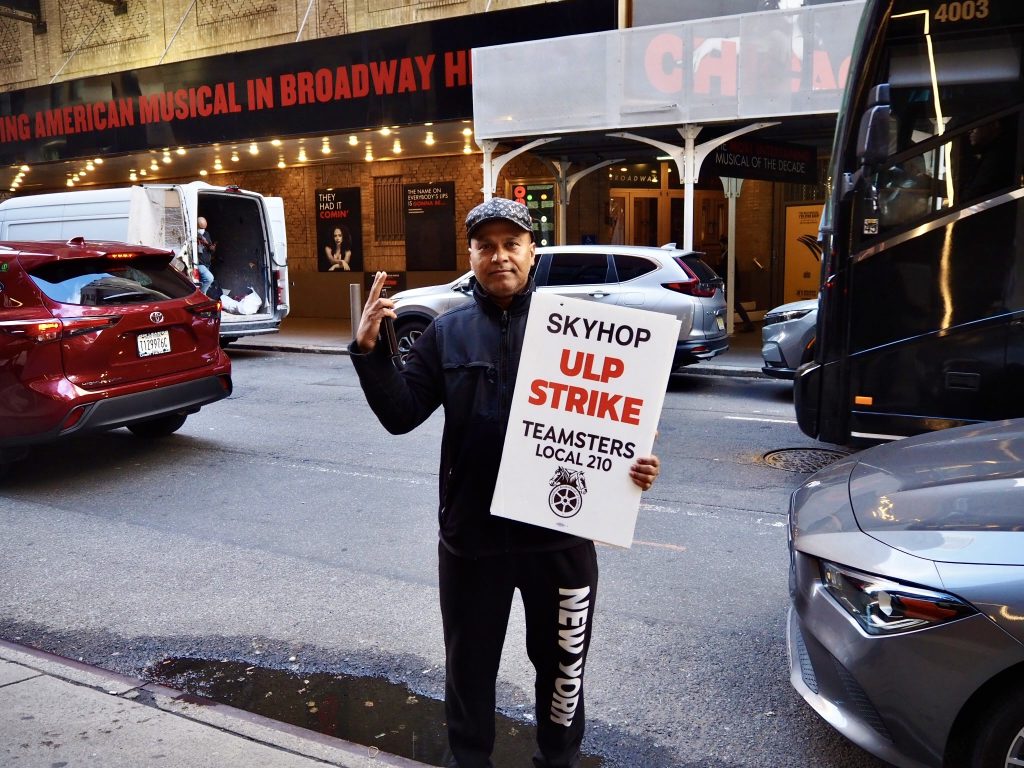
Gathered under the shadow of a giant inflatable rat known as Scabby, the workers are all striking drivers for SkyHop Global, an airport transportation company. With signs in hand, they wait to picket SkyHop vans driven by replacement workers who, throughout the day, pick up and drop off airline staff.
It’s a scene that has played out countless times since the workers first went out on strike right before Thanksgiving two years ago, on Nov. 24, 2024. Although a majority of the 60 workers, mostly immigrants, voted to join Teamsters Local 210 on May 10, 2024, they have fought an uphill battle to get management to the negotiating table.

Since they went on strike, workers have alleged retaliation, intimidation, and surveillance from management, which has so far refused to recognize the workers’ union. Many, struggling to pay their bills, have been forced to take second jobs like driving for Uber, while others have not found any jobs at all.
As the workers prepare to spend yet another Thanksgiving on the picket line — in what is now the nation’s longest ongoing strike — they hope their struggle is not forgotten.
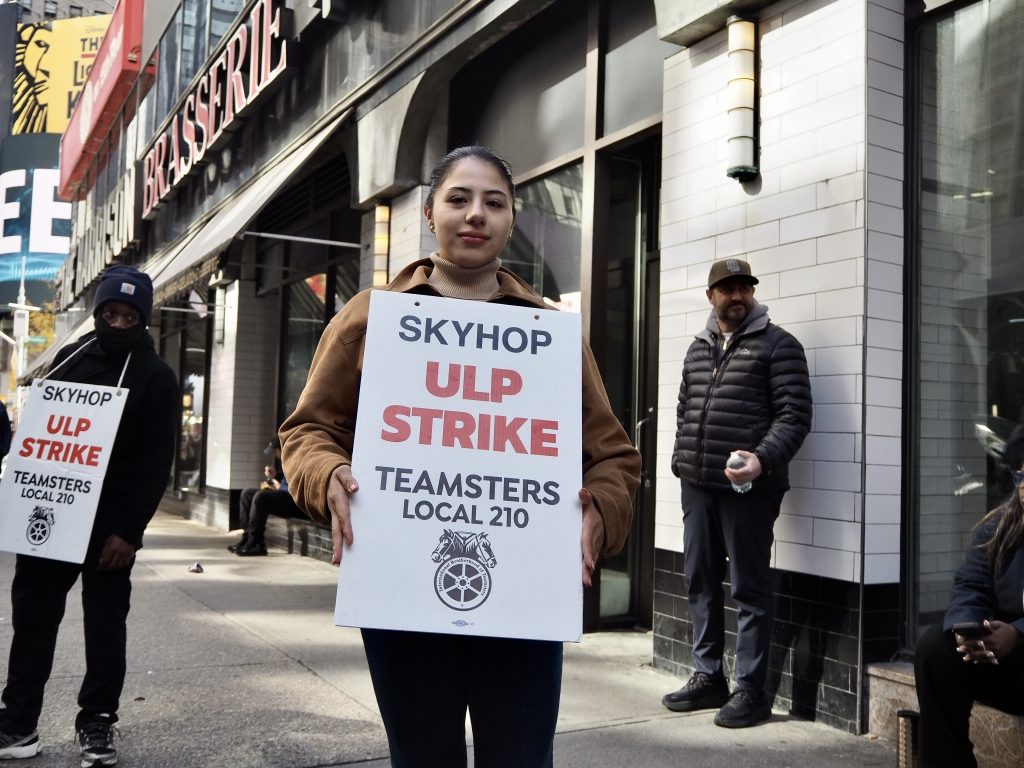
“No, I won’t cross the picket line because this is for our benefit,” said Ana Solorzano, a 26-year-old SkyHop driver originally from Ecuador.
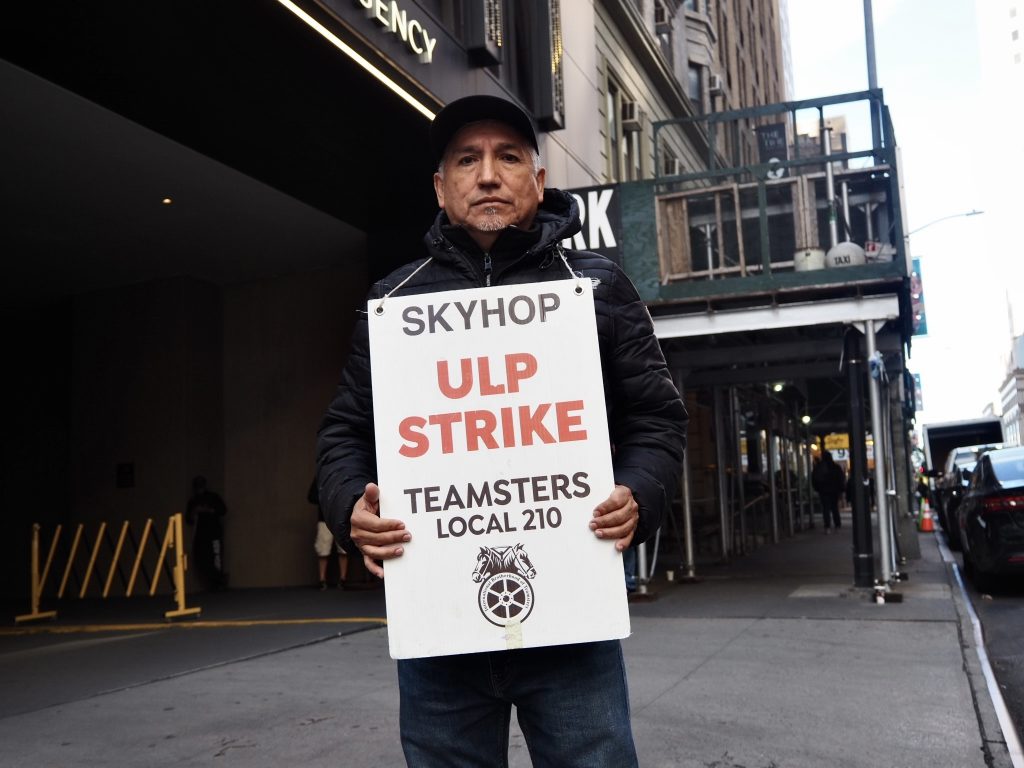
Edison Bonifas, a 57-year-old immigrant from Ecuador, says he has struggled to support his wife and four kids since he first walked off the job. Initially, he thought the strike would last only a few weeks. But as the strike enters its third year, making ends meet has become increasingly difficult. Although he’s tried getting another job, he hasn’t had any luck.
“The thing is, we’re waiting and waiting,” he told Documented at the rally on Oct. 21. “It’s basically hard right now because there are no jobs.”
What keeps him from crossing the picket line is his desire to secure health insurance, one of the key demands of the union. With a sick wife, it’s a demand that hits close to home.
“You know, you cannot live in New York City if you don’t have a medical,” he said.
SkyHop Global provides ground transportation for airline crew members between airports and hotels. Since the strike, several airlines have terminated contracts with SkyHop in the New York market; it currently only transports crew for Delta Air Lines.
Since its founding in 2014, the company has grown its operations to 33 airports across the country, including LaGuardia and JFK Airports. It now operates 200 passenger transport vans and employs 300 drivers, and is estimated to have generated over $70 million in revenue, according to court documents.
Surveillance and Retaliation
Instead of negotiating with the union to get drivers like Bonifas back to work, SkyHop has chosen to bust any efforts to unionize. On Aug. 31, the National Labor Relations Board (NLRB) General Counsel published an investigation that found SkyHop had violated the National Labor Relations Act when it “unlawfully tried to stop its employees from unionizing” and “violated the Act with complete disregard for its employees and their rights.”
According to the report, SkyHop management discharged at least 14 employees between 2024 and 2025 who were suspected of supporting the union effort. SkyHop also allegedly engaged in a widespread campaign of interrogations, surveillance, and retaliation.
The General Counsel report noted that one of the ways SkyHop surveilled workers was through the use of a fleet management technology called Samsara.. Through cameras installed in each SkyHop van, Samsara generates safety scores for each driver on a 100-point scale. When there is a driver infraction, such as using a phone while driving or not wearing a seat belt, Samsara would alert management, which would then adjust a driver’s safety score and create a record for potential discipline. The General Counsel’s report found that SkyHop adjusted Samsara during the height of the 2024 union drive to target employees suspected of supporting the union, with certain minor infractions weighted more or less heavily to target specific workers.
“They just fire you for anything,” Amar Hemraj, a 32-year-old Guyanese driver, told Documented. “If you don’t wear that seatbelt, they can write you up for that.”
While driving for SkyHop before he went on strike, Hemraj says that he knew his every move was being recorded.
“It was an invasion of privacy, you know, like let’s say I’m on the phone with my wife, and we’re discussing something personal,” he said. “We weren’t feeling safe. We weren’t feeling job security.”
In addition to surveillance through Samsara, the General Counsel observed that the company would conduct “ride-alongs” where management would ride with drivers on the job to gauge their union stance. Managers allegedly kept a detailed spreadsheet that listed workers who were for or against the union. Detailed group text messages obtained by Documented via court documents show that SkyHop management coordinated to identify and interrogate pro-union employees.
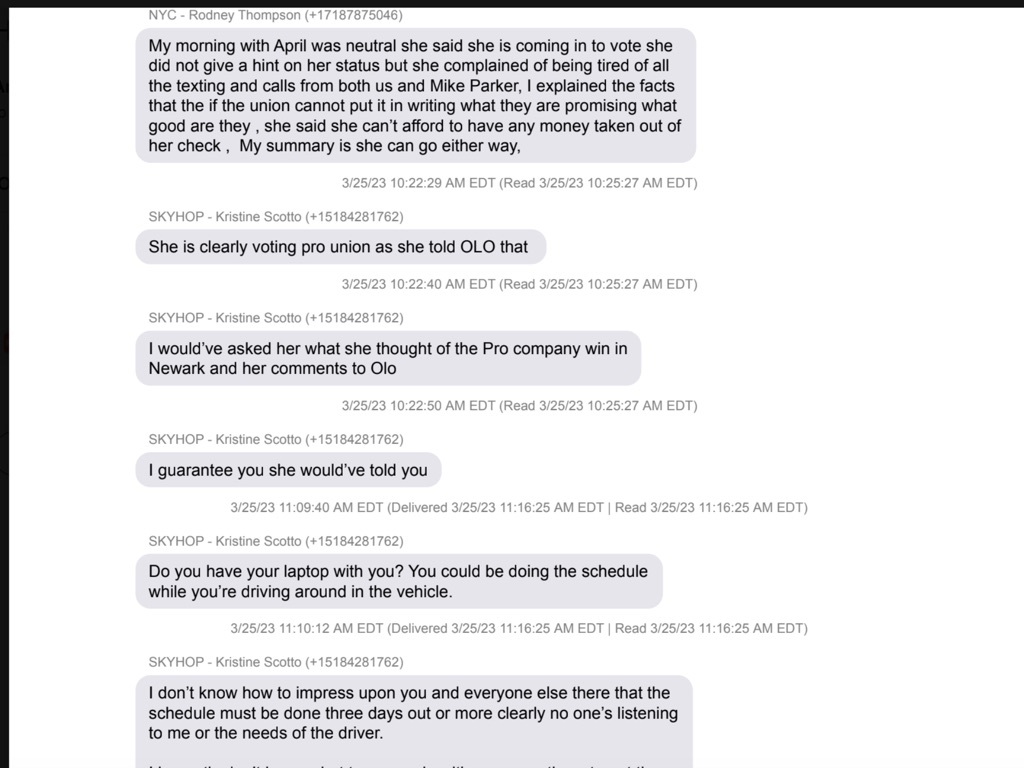
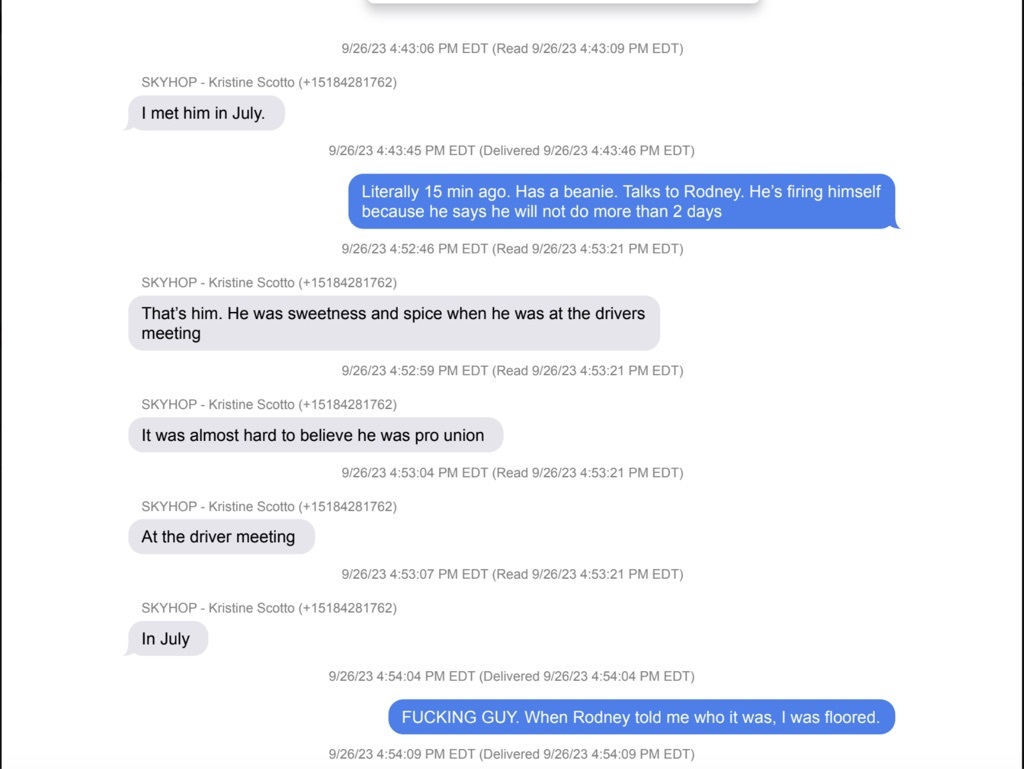
Many of the group chat messages show the company’s co-founder and CEO, Kristine Scotto, directly asking managers if they thought certain workers were pro-union or not.
Neither Scotto nor SkyHop responded to Documented’s request for comment via phone and email.
‘Go Join Them’
The General Counsel’s report also found that those fired by SkyHop were disciplined disproportionately to their alleged infractions, and that discipline was related to their union activity.
One of the fired workers was Mamunur Rahid, a 47-year-old driver from Bangladesh. Despite having a driver score of 94 out of 100, Rahid was terminated in August 2025 after a minor fender bender. According to the NLRB General Counsel report, Rahid testified that prior to being fired, he was repeatedly asked to sign a petition opposing the union and that he would receive a $3 per hour raise if he signed. Although he did not join the strike, he was a supporter of the union and refused to sign the letter opposing the union.
“I only understood one thing that one of my neighbors told me that it is good to have a union job, and that’s why I did not want to separate from the Union,” he told the NLRB.
When he was fired, his manager allegedly told him he should “go join them,” meaning the striking workers. The General Counsel found that his firing was retaliation for not signing the documents.
Despite the findings of the General Counsel, the NLRB has not yet made a ruling. The NLRB could compel SkyHop to rehire Rahid or the other fired workers, or force the company to the negotiating table.
While the case works its way through the NLRB, for workers like Solorzano, the strike has already had a transformative effect on her life. Never having participated in anything political before, she knows how important solidarity is.
“I’m 26 years old, and I’m with people from different countries who are also part of this,” she said. “I’m friends with them, and I hear about their situation, and also I see my situation.”