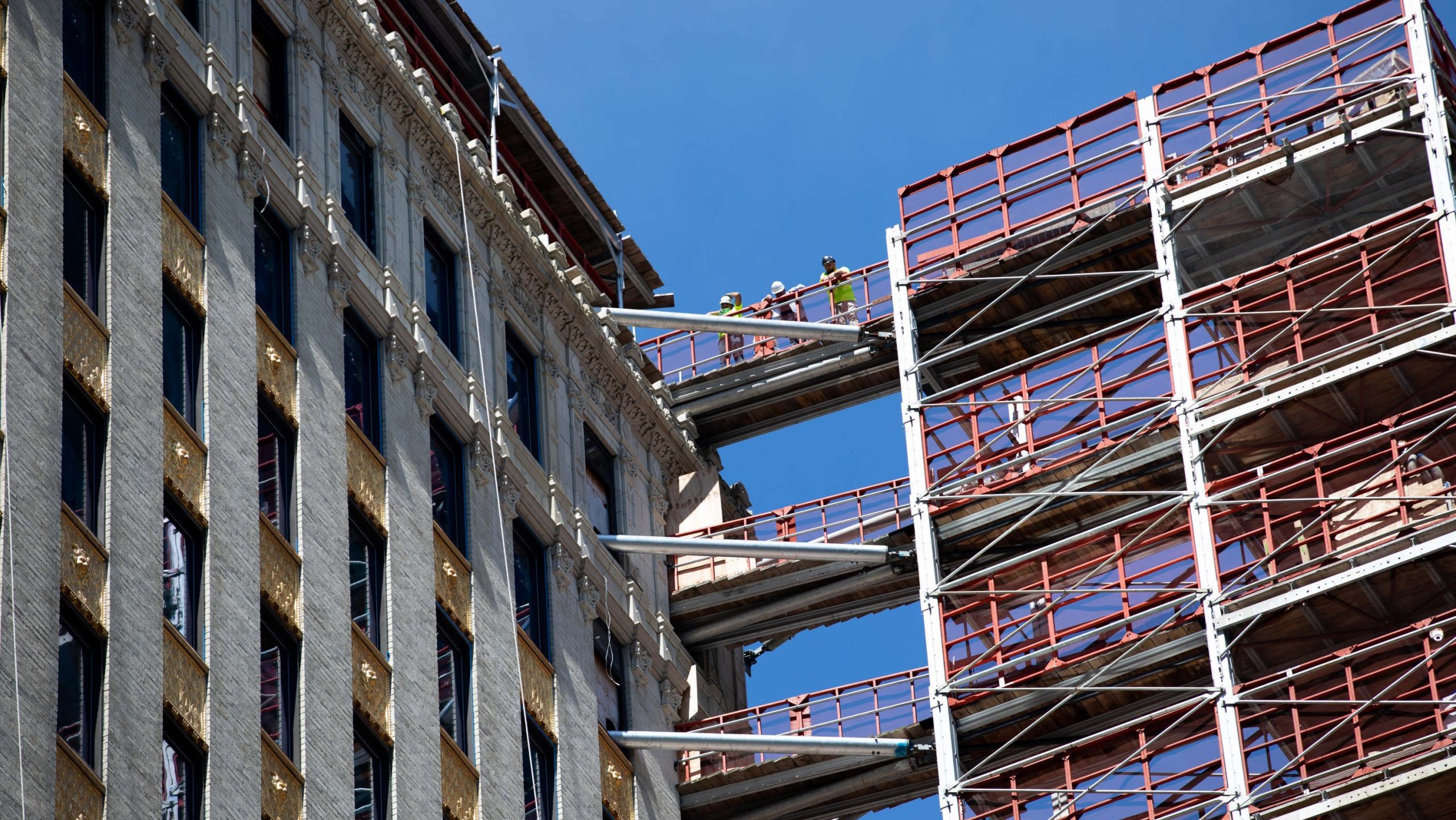


Construction companies have increasingly relied on third-party labor brokers as a steady source of cheap labor. Now unions and safety advocates are raising concerns that these labor brokers, also called “body shops,” are violating city laws and driving down construction safety across the city.
In information shared exclusively with Documented by the New York Department of Consumer and Worker Protection (DCWP), the agency has received a total of 137 complaints against construction labor providers in the past five years, with complaints rising steadily each year since 2022. Many of the complaints allege that a company was operating without a license or had improper signage for worker safety.
Labor brokers allow contractors to outsource the labor liability to third parties, who often pay lower wages than what unionized workers would earn, cut back on safety equipment, and drive down the wages for all workers across the industry. These third-party subcontractors have been known to expose immigrants or formerly incarcerated to unsafe working conditions, as Documented previously reported.

In 2021, with the support of trade unions, the city passed Local Law 150 to regulate the growing labor broker industry. Local Law 150 requires labor brokers to be licensed and to display signs explaining workers’ rights in multiple languages. Workers are also entitled to receive their schedule at least 24 hours before they are scheduled to work.
Until Local Law 150, workers had no way of reporting workplace abuses. It was also difficult to track how many labor brokers were operating across the five boroughs. But since the law took effect, complaints against labor brokers have skyrocketed, according to the DCWP data.
Last month, 40 construction workers filed an expansive class-action lawsuit in the New York Supreme Court alleging that two labor brokers, Marin Workforce Inc. and Apex Labor Solutions, engaged in widespread violations of Local Law 150 and retaliation against workers who spoke about poor labor conditions.
Documented spoke to five workers, four of whom spoke on the condition of anonymity for fear of retaliation, who described instances of unsafe working conditions, sexual harassment, and failing to receive written notice of an assignment 24 hours ahead of their scheduled job.
Several workers told Documented that if they complained to management about their schedule or working conditions, they were threatened with suspension.
“I immigrated from Haiti for a better life,” said Jerry Toussaint, 30, who has lived in the U.S. for three years, in a statement to Documented. “Working for labor brokers Marin and Apex, I felt that no matter how hard I worked, they still didn’t respect my rights as a worker or give me a fair day’s pay for building affordable housing in New York City.”
Construction trade unions are calling for increased enforcement of labor brokers as well as a ban on labor brokers from operating at construction sites that receive city tax breaks.
“Marin and Apex have proven time and time again that their preferred business model is worker exploitation, especially for justice-affected, immigrant, and low-wage workers of color,” said Justice Favor, field representative with the union Mason Tenders District Council, which is organizing body shop workers, in a statement to Documented.
DCWP confirmed it is currently investigating two licensed construction labor providers, but declined to comment on the specific case, saying it cannot share the details of those ongoing investigations.
Representatives for Marin Workforce Inc. and Apex Labor Solutions did not respond to Documented’s requests for comment.
Operating Without a License
Many of the 137 complaints the DCWP received in the last five years allege that their workplaces did not display proper signs in multiple languages explaining workers’ rights, or that a labor provider was operating without a license.
There are currently 37 construction labor providers licensed to operate within the city, with an unknown number operating without a license.
Labor brokers found operating without a license can face a $500 fine for each day they operate illegally. For failing to post the proper signs, they can face a civil penalty of $250 for a first violation, and $500 for each subsequent violation.
In addition to DCWP enforcement, Local Law 150 also gives workers a right to sue their employers for up to $1,000 in damages or more if they are found to have been retaliated against in the workplace.
Of the complaints the DCWP has received over the past five years, the agency says it has enforced 12 violations amounting to a little over $43,000 in penalties.
Three of the biggest cases, according to DCWP, involved settlements with Quality Facility Solutions Corp., Tradesmen International, LLC, which were both filed in February, and Marin Workforce Inc., which was filed in November 2025.
Quality Facility Solutions Corp. and Tradesmen International each received a total of five violations, including filing an improper license and falsifying statements to DCWP. Marin Workforce received two violations for failing to provide workers with the proper written notices.
“Proper licenses and clear information about worker rights are critical on construction sites,” said Sophie Ota, DCWP’s director of communication, in a statement to Documented. “DCWP reminds construction labor providers of their obligations under City law and reiterates that our department will not hesitate to hold violators to account. Our city has zero tolerance for companies that flout Local Law 150 and put worker safety at risk.”