

Willian Yacelga Benalcazar, an asylum seeker from Ecuador, knew the risks of attending his immigration court hearing at 26 Federal Plaza.
He and his wife had seen the news reports and viral videos of Immigration and Customs Enforcement agents arresting immigrants like him attending routine appearances. But he knew he had to go, determined to follow the rules he’d been following for over two years.
“We risked it anyway,” Yacelga, 41, said in Spanish. “It wasn’t right to not go, because if the country’s doors had opened for us, it was for us to do things the right way.”

The couple’s worst fear was realized. Five months ago, Yacelga was detained and went willingly after the agents threatened to arrest his wife, as well, he recounted. The couple thought they caught a break two months later, when a federal judge ordered that Yacelga was entitled to a bond hearing in immigration court — a proceeding that’s become effectively eliminated for many immigrants under the Trump administration.
But the judge denied bond on surprising legal grounds: Yacelga was deemed an “extreme flight risk” not because of his immigration circumstances – but, in part, because he would have to return for future court dates to 26 Federal Plaza, the scene of his arrest.
The judge found that Yacelga’s “impulse to flee would be irresistible,” said Bryanna Rainwater, Yacelga’s attorney at the Legal Aid Society. The judge believed that because Yaclega had been arrested at the lower Manhattan courthouse, he “would not want to return to court again.”
“It was absurd [to be called a flight risk], because if I hadn’t wanted to go I wouldn’t have gone in the first place,” Yacelga told Documented over Zoom from a detention center in Eloy, Arizona.
As immigration arrests and detentions have exploded during Donald Trump’s mass deportation effort, the administration has also fought to abolish bond hearings for any immigrant who crossed a border without a valid visa or status, with bond releases dropping by 85 percent from April 2025 to February 2026. For the individuals fortunate enough to get to stand before a judge and argue their case for freedom, release has been thwarted in recent weeks by what local lawyers consider surprising or nonsensical reasons, despite evidence to the contrary.
Other eyebrow-raising reasons that detained immigrants have been labeled flight risks include clients not having enough letters of support, having too many letters of support, not providing enough evidence that letter writers are U.S. citizens, and having a fear of deportation. One American Immigration Lawyers Association member witnessed a hearing where a person was deemed a flight risk due to merely having U.S. citizen family members because the judge thought that could motivate them not to show up to their hearings.
So even though federal judges have ordered thousands of additional bond hearings since October, those who face judges at immigration court are seeing the goal post shifting once again, said Vanessa Dojaquez-Torres, practice and policy counsel at the American Immigration Lawyers Association.
“Once all these people started going back to court, this is when we started seeing these unusual denials based on flight risk,” said Dojaquez-Torres.
For Delaney Rohan, a supervising attorney in the immigration law unit at the Legal Aid Society, the pattern doesn’t seem random. “It’s pretty clear to me that they’re under some sort of instruction or directive to find flight risk wherever they possibly can,” said Rohan. “And that’s pretty troubling.”
Officials at the Executive Office of Immigration Review (EOIR), which runs the immigration courts and oversees immigration judges, did not return a request for comment.
The stakes for detainees denied bond are high: For Yacelga, it has meant declining health, mounting household bills, and a deportation order to a country not his own. That means he may never see his children again.
“This is the hardest thing that has happened to me. I’ve never been separated from my children and now look, I’ve been here so long that I see them on the screen and they’re bigger,“ he said, tears welling in his eyes. “They ask me, ‘When are you getting out?’ I don’t know, I don’t know, nobody knows.”
Vanishing bond hearings
Bond hearings were once a mainstay in immigration court cases for non-citizens who weren’t considered dangerous or flight risks. But now, few of the tens of thousands of people in detention are even eligible for the hearings after the federal government issued a memo in June 2025 that took away the right to bond for any immigrant who had crossed the border without a valid visa.
Since then, the policy has been the center of numerous court battles, confusing both judges and lawyers alike. Meanwhile, the government fired dozens of judges with high asylum grant rates and replaced them with temporary judges who often did not have an immigration law background. Many were hired after a recruiting campaign looking for “deportation” judges.
But the impact of the administration’s tough stance is clear: while about 2,400 people were released on bond each month by immigration judges last year, only 326 people were released on bond in February, according to an analysis by Mobile Pathways
Meanwhile, people currently in immigration detention around the country suffer in conditions that have been called human rights abuses by the American Civil Liberties Union and Amnesty International, including the facility where Yacelga is detained. It’s a system that many advocates say is created to force immigrants to self-deport.
Even before the Trump administration eliminated eligibility for millions of immigrants in the U.S., winning the right to freedom from detention was always difficult. To qualify for bond in the first place, a person cannot have been convicted of certain serious violent and drug-related crimes. And in immigration court, the burden is on immigrants to prove they are neither a flight risk or a danger to their community, unlike in criminal court where the burden is on the government.
Multiple New York immigration lawyers say it’s now exponentially harder.
Rohan said that the burden on clients to prove they aren’t a flight risk has increased to “astronomical degrees,” and the requirements are “increasingly draconian, increasingly stringent,” even where there would have never been an issue in the past.
“If it’s your burden to prove a negative, then there’s always going to be something missing,” he said.
In one case in New Jersey, a judge denied bond because there weren’t any letters of support for one New Yorker written by U.S. citizens – even though there were. When an attorney corrected the judge to say that wasn’t true, the judge instead moved to deny bond based on the fact that “there was no evidence they were U.S. citizens,” according to Daniel Espinoza, an attorney with the New York Immigrant Family Unity Project who witnessed the hearing.
Another client from the organization faced a judge who said he had his “own definition of flight risk.”
Lawyers on the ground aren’t the only ones who have apparently noticed a shift. Some federal judges overseeing petitions for habeas corpus – a legal tool used to challenge detention – also have, according to multiple immigration experts. In five decisions reviewed by Documented, a federal judge has expressed a lack of trust in the bond process — with one even willing to grant discovery to find out whether lawyers are right in thinking the process is rigged.
“Systemically denying a meaningful opportunity for release on a bond, when Congress has determined that detention is not mandatory, makes detention de facto mandatory,” said Judge Clay D. Land in the Middle District of Georgia. “Such a systemic denial, if proven, not only disrespects Congress and the Constitution, but it also violates this Court’s previous order.”
For Rainwater, Yacelga’s attorney, the impact of sustained detention on her clients cannot be overstated. Detained immigration cases get expedited, meaning counsel has less time to prepare a case. Those who are detained often experience health complications, and both they and their families suffer under extreme economic and psychological burdens — all navigated thousands of miles away from their loved ones.
“My client was the main breadwinner for his family, two children who are elementary school age, and it has really negatively impacted their family,” said Rainwater.
Sonia’s fight
Yacelga and his family had come to New York in August of 2023, after the family fled problems in their hometown of Quito, Ecuador — including having their lives threatened, according to Yacelga and his wife, Sonia, 36.
Before his detention, Yacelga worked long hours as a deliverista, and even learned some Chinese to communicate with his employers, he said. He made enough to move the family from a shelter to an apartment in Jamaica, Queens.
On his day off, or in the afternoons when he returned from work, Yacelga was a devoted dad, bringing his 8-year-old son to the park to learn soccer or going on adventures on the subway with his 13-year-old daughter. The family would sometimes eat traditional Ecuadorian food at Gata Golosa in Queens.
It wasn’t as comfortable as when they lived in Ecuador, but at least they weren’t in danger, he said.
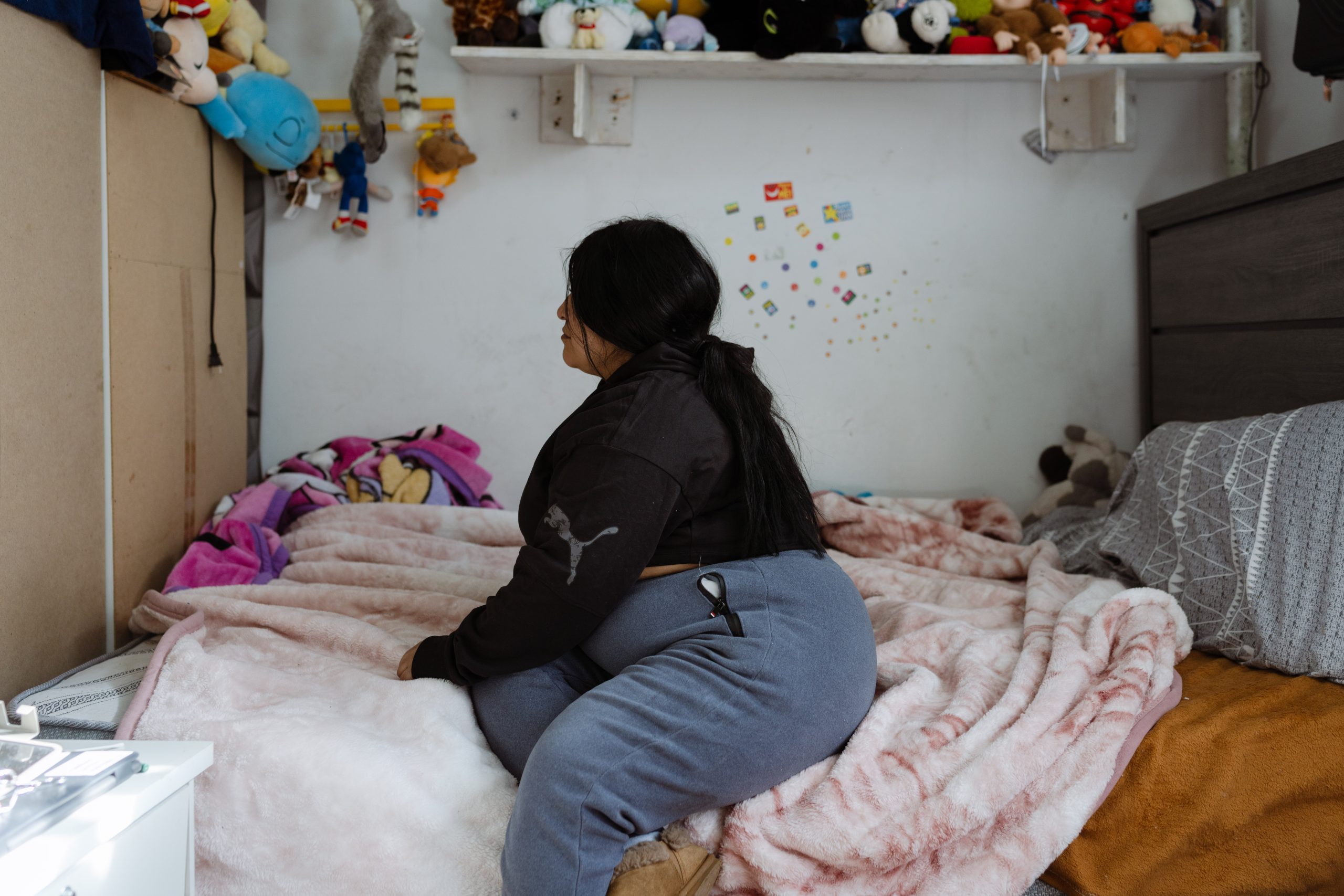
Since his arrest, the family’s circumstances have turned dire: they are four months behind on rent, and have run out of savings. Sonia hasn’t been able to find work partially due to her long check-ins every eight days, mandated by immigration authorities.
Yacelga reported to Documented that after over five months in detention, his hair is falling out, and he is wracked by pain in his head and ear which keeps him from sleeping. He has developed bumps on his elbows, and his feet constantly hurt.
Yacelga has suffered so much —with both mental and physical health concerns— that in January he opted to give up on fighting his immigration case and agreed to be deported. That result, advocates say, is the administration’s end game.
Sonia worries deeply about her husband. However, she worries equally for her children — and she’s promised Yacelga that she will stay and fight for a better, safer life for them.
“This [system] is separating families. My children are not going to see their father again.” Sonia said.
Her 8-year-old asks constantly for his father, cries, and begs to stay home from school. Her daughter cries at night. Instead of going outside with family, they stay inside, on their phones or sleeping.
And her children have also told her they are afraid to return to Ecuador.
“So I said ‘We have to fight to the very end as long as we can, to the very end,’” Sonia told Documented.
Yacelga told Documented from his detention center that he had tried to do things the proper way when he came to this country — and do them better every day. But ultimately, he feels like he found out that it didn’t matter. And even though he agreed to leave the country nearly four months ago, he’s still detained in Arizona.
“They’re with their guns and we’re just hiding behind rocks, we can’t defend ourselves,” Yacelga said. “I think I did nothing wrong. … If I could speak to the president, I would tell him to forgive me for coming to this country, but to let me go free.”