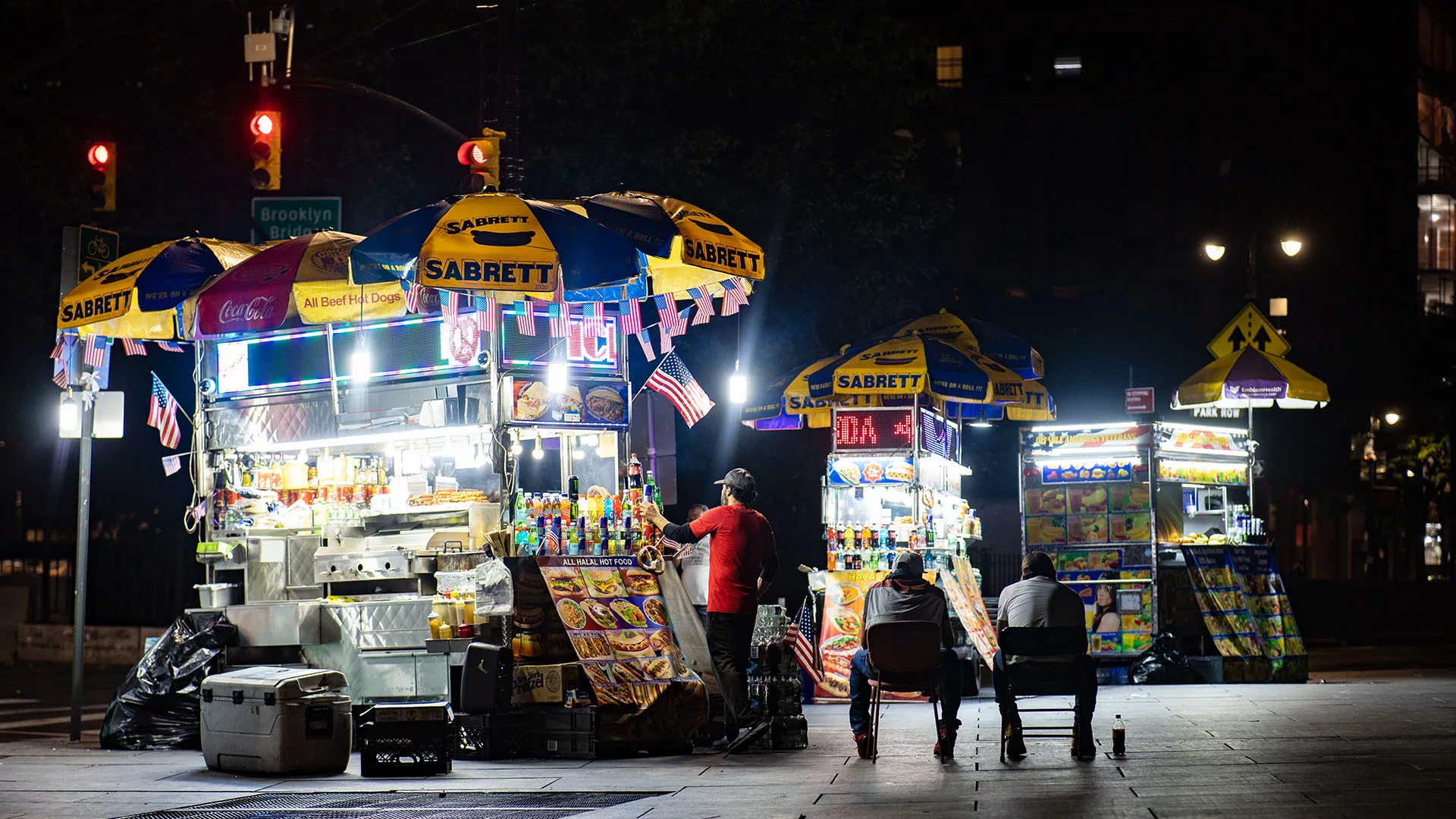


With the election of Mayor Zohran Mamdani and the City Council’s recent passage of new vendor-friendly laws, New York’s roughly 23,000 street vendors expected a long-awaited reprieve from what they viewed as heavy-handed enforcement by the NYPD.
But recently released city data shows that in the first three months of 2026, the New York City Police Department’s issuing of criminal summons actually increased, compared to the same period the year before. This is despite Mamdani’s voiced support for decriminalizing street vending and a slew of new vendor reform laws that took effect in March and aimed to eliminate the NYPD’s issuing criminal summonses for offenses such as standing within 10 feet of a crosswalk or not displaying a permit.
In the first quarter of this year, the NYPD issued at least 564 criminal summonses for vending-related offenses, according to recently released data. During the same time period in 2025, the NYPD issued just 504 vending-related criminal summonses along the same categories.

Most of the vending-related criminal summonses issued in the first three months of 2026 were for minor offenses like blocking a crosswalk, for which the NYPD issued 48 criminal summonses, or for failing to display their permits, for which the NYPD issued 38 criminal summonses, according to the data. Vendors who operated in areas with place-and-time restrictions were issued 30 criminal summonses in the first three months of the year.
To be sure, the new law didn’t take effect until March 9. And of the 564 criminal summonses issued, 189 were for failing to have a license, a violation the NYPD can issue criminal summonses for. But many of the others should have been considered civil, not criminal, offenses, per the new laws.
Criminal summonses for most vending violations were supposed to be a thing of the past. Last September, the City Council passed Local Law 122, which decriminalized many street vending violations like being too close to the curb. The bill, which passed with a veto-proof majority, came alongside a suite of new laws reducing criminal misdemeanor penalties to civil penalties for licensed vendors, and reducing criminal misdemeanor penalties to violations for unlicensed vendors.
But in the weeks before the new law took effect on March 9, the NYPD continued its enforcement actions against vendors unabated, as Documented earlier reported. And in the weeks after the law came into effect, The City Reporter found that the NYPD was still issuing criminal summonses to vendors.
These criminal summons are particularly burdensome to immigrants, who make up the vast majority of New York’s street vendor workforce. Vendors issued a criminal summons must appear in criminal court, which can lead to a criminal record that could jeopardize their immigration status. If they miss their court date, a warrant could be issued for their arrest.
The NYPD has continued to issue criminal summonses to street vendors in recent months, long after the new laws took effect, advocates like the Street Vendor Project told Documented.
On June 11, Monir, a 34-year-old Egyptian immigrant, was operating his halal cart in Midtown Manhattan when he was issued two criminal summonses for operating near a fire hydrant, according to tickets viewed by Documented. Although he disputes that he was even near a hydrant, under Local Law 122, he should have only been issued a civil summons.
“Why did they write me criminal tickets?” he told Documented in Arabic. “The criminal tickets should not be issued to vendors. We’re not criminals.”
Since 2023, the New York Department of Sanitation’s Office of Street Vendor Enforcement has been tasked as the primary agency to enforce vending laws. But Monir said that the NYPD has been issuing him both criminal and civil summonses.
“I feel that I’m being harassed and targeted by these cops,” he said. “They come every day, and sometimes it’s the same people. I would tell them, ‘Come on, guys, leave me alone. I just got a ticket like a couple hours ago.”
A spokesperson for the NYPD defended the agency’s ability to issue criminal summonses as a response to community complaints.
“The NYPD continues to enforce quality of life complaints based on 311 and community feedback, which include complaints about unlicensed vending,” the NYPD spokesperson said in a statement to Documented. “While the law passed in September 2025 did eliminate some criminal penalties for vending-related offenses, it does not prohibit the use of criminal court summonses as an enforcement tool in connection with unlicensed vending.”
Cassio Mendoza, Deputy Press Secretary for the Mayor’s Office of Economic Justice, added that the mayor’s office was also looking into the matter.
“The Mamdani administration is meeting directly with vendors to hear from them about their experience and to address concerns raised by street vendors on vending enforcement,” Mendoza said in a statement to Documented. “As we roll out the first expansion of licenses in more than 50 years, the administration will continue to solicit feedback directly from vendors to inform the City’s policies moving forward.”
Mohamed Attia, managing director of the Street Vendor Project, criticized the NYPD’s behavior.
“When the New Yorker’s elected representatives pass a law to protect immigrants and treat our city’s smallest businesses fairly, the NYPD shouldn’t be allowed to just ignore it,” he told Documented in a statement. “With millions of dollars dedicated for civilian agencies to conduct enforcement included in this year’s budget—the time is now for City Hall to remove street vending enforcement from the NYPD.”
Attia also disagreed with the NYPD’s justification.
“Relying on 311 complaints to justify the continued use of criminal summonses for unlicensed street vending is not just disingenuous, it needlessly puts the 96% of street vendors who are immigrants at risk,” he said.
Upon hearing about the NYPD’s policy of continuing to issue criminal summonses despite city law, City Councilmember Shekar Krishnan, who was the lead sponsor of Local Law 122, called for an investigation.
“We passed historic legislation that ensures vendors no longer face jail time or the threat of deportation for simple vending violations,” he told Documented in a statement. “It’s deeply troubling that the NYPD continues to issue criminal summonses and perpetuates fear among vendors.”
“We’ll be investigating their protocol further to ensure we’re keeping our vendors safe,” Krishnan said.