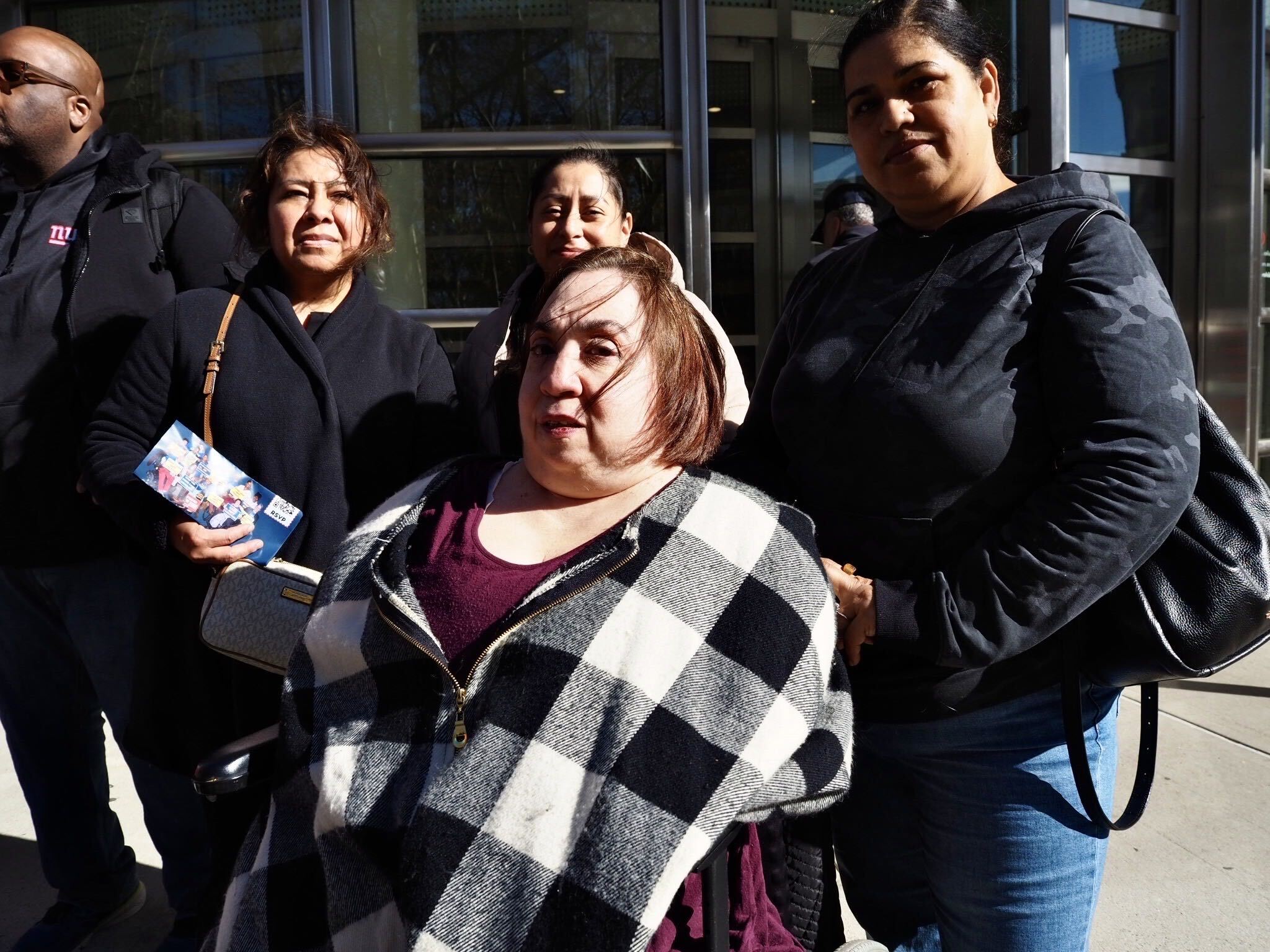


Home care workers and disabled care recipients packed a courtroom at Brooklyn’s Theodore Roosevelt United States Courthouse on Tuesday, ready to hear some good news. Judge Lara K. Eshkenazi of the U.S. District Court for the Eastern District of New York certified a $162 million wage-theft class-action settlement between roughly 200,000 personal care assistants and the home care agency Public Partnerships LLC (PPL). It’s the largest single wage theft settlement in New York state history.
The settlement followed a case first filed on April 25 by attorneys with the Legal Aid Society and Katz Banks Kumin LLP, alleging that PPL failed to pay tens of thousands of home care workers in the Consumer-Directed Personal Assistance Program (CDPAP) for all hours worked.
Under CDPAP, homebound people on Medicaid are able to hire a home care assistant of their choosing, such as a trusted friend or relative, instead of using private agencies. PPL, which was selected in 2025 by New York State as the fiscal intermediary to handle all CDPAP payments statewide, was then tasked with administering Medicaid payments to the home care assistants.

In addition to unpaid wages, the class-action suit alleged that PPL violated that state’s Worker Wage Parity Law, which requires that home care agencies provide workers with either health care or a supplemental payment that would cover health care.
The lawsuit alleged that PPL instead enrolled workers in a health plan that provided only limited health coverage. A New York Focus investigation found that PPL would divert 40 cents per hour out of every NYC-area home care worker’s paycheck into a health plan that failed to cover most medical expenses. When workers failed to use the health care plan, PPL would pocket the money, according to the lawsuit.
Roughly 200,000 workers will be compensated as part of the settlement, with those impacted to begin receiving an automatic lump-sum payment early next year via direct deposit or check by mail. Workers who were employed by PPL between 2025 and 2026 could receive an average payment of $680. Additionally, PPL will also end its health plan, with workers now being able to receive a supplemental payment. The company denied any wrongdoing as part of the settlement.
Since the 1990s, CDPAP has allowed disabled individuals on Medicaid to choose their own trusted personal home caregiver rather than using a private home care agency or nursing facility, which can both increase independence and reduce costs. The program provides home care to nearly 300,000 people across the state, and employs almost 400,000 workers.
But beginning last year, in an effort to rein in the program’s escalating $9 billion budget, the state consolidated CDPAP under the umbrella of a single statewide fiscal intermediary, PPL, to administer the program. Before the consolidation, hundreds of independent home care agencies administered CDPAP, many in immigrant communities.
Shortly after PPL took over administration of CDPAP, workers began to report widespread mispayments. According to the New York Caring Majority, an organization that represents home care workers and recipients, as many as 150,000 workers and 90,000 consumers have left the CDPAP program since PPL took over, driven by mispayments. Documented was among the first to report widespread issues facing workers under the CDPAP transition.
“For home care workers, older adults, and people with disabilities, the $162 million settlement is an important step toward justice,” Ilana Berger, political director for New York Caring Majority, said in a statement shared with Documented. “But a settlement alone cannot restore trust, guarantee workers are paid what they are owed, or ensure accountability going forward. New York must do more to protect workers and consumers, restore choice in CDPAP, and ensure that public funds support the care and workers they are intended to serve.”
Despite the settlement, PPL faces three other class action lawsuits alleging many of the same wage theft claims for workers across New York. In June, the U.S. Department of Justice filed a lawsuit against PPL, claiming the company colluded with the New York Department of Health in “an unlawful scheme” to take over the CDPAP program. Both cases are still pending.
“PPL continues to categorically deny the allegations in this lawsuit, and our decision to settle was in no way an admission of fault or liability,” Meg Fitzgerald, a spokesperson for PPL, told Documented in a statement. “Rather, it was a practical decision to avoid the expense, disruption, and uncertainty of continued litigation. With this matter now behind us, we remain focused on supporting the hundreds of thousands of New Yorkers who rely on CDPAP to receive care in their homes and communities.”
Outside the courthouse on Tuesday, both caregivers and patients celebrated the settlement. Geri Mariano, 59, who is disabled and relies on home care, said it gives her some hope.
“Maybe our newly reelected governor and state legislators see that PPL was not the answer,” Mariano told Documented. “Workers are still being hurt, and when workers are hurt, consumers are hurt because if they stop wanting to work, then what happens to us? I don’t want to go into a nursing home.”
Madhuri McClenry, who has been Mariano’s home care worker for 12 years, said she has had issues getting paid since PPL took over management of CDPAP.
“It’s kind of a nightmare for me,” McClenry, a 56-year-old immigrant from India, told Documented. “It’s always short on pay, and very confusing. We never had this confusion before, and everything is so chaotic.”
Despite her issues with PPL, McClenry said she refuses to quit due to the close bond she has developed with Mariano
“If I work private, I will make more money, but I don’t want to leave her,” she said.