





On an afternoon in July 2025, H.L. stood outside Yong Fa Supermarket in Queens, clutching a white plastic bag filled with $100,000 in cash. Just minutes earlier, she had received a message from an unknown number with instructions on where to go.
Soon after, a Chinese man approached her. She had never seen him before, but she knew he was the person she had been told to meet when he pulled out a one-dollar bill displaying an 11-character serial number that matched a code she had received days earlier from “Mike,” a man she had been speaking with for more than eight months.
That brief exchange — no names, no receipts, just a coded signal — marked one of several cash handoffs that would ultimately cost H.L., who is in her 50s and moved to the U.S. from China in 2016, nearly everything she had.

Over a period of three months, H.L. handed over $130,000 in cash to three different strangers sent by Mike. The money came largely from the sale of her home in Flushing. The scammers first contacted her by sending a message while pretending to be someone she knew named Mike.
She assumed it was the Mike she had briefly worked with in the past. At the time, she didn’t realize that pretending to be someone the victim knows is a common tactic scammers use to start a conversation with a stranger.
This brief exchange eventually turned into months of conversations over text. Mike gained her trust and convinced her that investing in cryptocurrency was a promising opportunity to build a better life. By the time she realized something was wrong, it was too late.
“He kept asking whether I had more money to invest, even after I told him I needed to save some for my family’s emergencies,” H.L., who asked to be identified only by her initials to protect her privacy, said in Mandarin. “I started to feel uneasy.”
After she refused to send more money, his tone shifted. The daily messages grew infrequent. The warmth disappeared. In a few months, he stopped responding altogether.
H.L. is one of many Chinese victims in the United States targeted by so-called “pig butchering” scams — confidence schemes named because they lure victims into romantic entanglements or lucrative business ploys over long periods of time before they steal from them, like fattening up a pig before slaughter. These long-running investment frauds often involve cryptocurrency, which is difficult to trace or recoup lost funds. They originated in China in recent years and have since spread globally during the pandemic.
Her case also reveals a newer and more troubling evolution: These scams are no longer confined to screens. They are increasingly playing out on the streets of immigrant neighborhoods, where cash is collected in person, making the crimes even harder to trace and easier to repeat. More and more immigrants have become victims of these fraud schemes, in part due to limited English proficiency and less familiarity with the evolving landscape of online fraud in China, experts told Documented.
It’s unclear how many victims of pig butchering are from the Chinese community, as the FBI told Documented that it does not collect demographic data on victims of cybercrimes.
Still, experts say the scam has been widespread in the Chinese American community.
“When we first started seeing pig butchering, the victims I was seeing were all Chinese Americans, and they were being reached out to in their home language,” said Erin West, the founder of Operation Shamrock, a private-sector nonprofit dedicated to exposing and combatting scam networks.
READ MORE: How to Protect Yourself From Rising ‘Pig Butchering’ Scams
From Screens to Doorsteps
“Pig butchering” scams typically begin with a simple message, often a wrong number or a friendly greeting. From there, fraudsters cultivate relationships over weeks or months, building trust before introducing investment opportunities in cryptocurrency or foreign exchange trading.
The term comes from the idea of “fattening” a pig before slaughter: Victims are gradually lured with attention, affection, and the illusion of romance or financial success before they are drained of their savings.
In recent years, these scams have expanded rapidly, fueled by the growth of social media platforms, encrypted messaging apps, cryptocurrency markets, and AI technology, which has allowed the fraud to operate at immense scale. According to data from the FBI’s Internet Crime Complaint Center, or IC3, cryptocurrency investment scams, most commonly “pig butchering” schemes, siphoned more than $7.2 billion from victims in 2025, with over 61,000 complaints filed. Complaints increased by nearly 50% from 2024, with total losses increasing by 25%, according to the FBI.
In 2025, New York ranked fourth nationwide in both the number of internet crime complaints filed, with 45,255 reports, and total reported losses, which reached $1.2 billion. Investment-related scams accounted for the largest share of those losses: 3,289 victims reported losing a combined $747.1 million.
According to the New York Attorney General’s Office, which tracks cryptocurrency-related scams, including many so-called pig butchering schemes, complaints have risen sharply in recent years. From 2020 to 2025, the number of crypto scam complaints received by the office increased more than tenfold, from 29 complaints in 2020 to 422 in 2025.
The true scale of pig butchering scams is likely far greater than the reported figures suggest.
“We believe fraud in general is under-reported either due to shame, or victims not realizing they are being scammed,” an FBI spokesperson told Documented in a statement, adding that the agency’s Internet Crime Complaint Center only releases data of what is reported to the FBI.
In 2026, the FBI’s Operation Level Up, alerted 1,800 victims nationwide to ongoing scams, preventing an estimated $119.3 million in losses. About 79% did not realize they were being scammed. Of those contacted, 538 were New York residents.
Identifying scams and tracking down stolen assets can often be difficult, as internet frauds often rely on money mules or couriers who are themselves recruited through encrypted messaging apps and the dark web to move or launder the illegally obtained funds.
“Some money mules know they are supporting criminal enterprises; others are unaware they are helping criminals to profit,” the FBI spokesperson said.
West, the Operation Shamrock founder, said she has also observed a growing network of couriers involved in pig butchering scams. “We are seeing a high volume of couriers, often Chinese nationals that are connected to Chinese money laundering operations that exist in the United States already,” West said. She said two major hubs for these operations are Flushing, Queens, and Monterey Park, Los Angeles, where couriers are dispatched across the county to collect cash from victims in person before the money is moved through laundering networks.
One of these such couriers was the man H.L. met last July and handed a bag with $100,000.
A Relationship Built on Trust
H.L. first received a message in August 2024. Written in Chinese, it read: “Hi, how have you been? Work must be tiring, don’t push yourself too hard.”
“I thought it might be someone I knew,” she recalled. “I had changed my phone before, so I thought maybe I lost some contacts.”
The sender introduced himself as Mike. At first, the conversations were casual. They talked about daily life, shared photos, and reminisced about experiences in China. Mike claimed he had lived in the same region of southern China as H.L. before moving to the United States.
Over time, he revealed more about his life story. He said his father had died in a workplace accident, his wife had passed away from cancer, and his business in China had collapsed. But he presented himself as resilient, someone who had rebuilt his life from scratch in the United States and now ran a successful logistics company in California.
“He seemed like a hardworking person who had gone through a lot,” H.L. said. “I admired that.”
For months, Mike did not push any financial agenda. He checked in regularly, offered encouragement, and gradually became a constant presence in her life. Only later did he begin to mention cryptocurrency trading as a side income.
“You should learn new skills,” he told her.
At first, H.L. was cautious. “I told him I wasn’t interested,” she said.
Mike didn’t insist. Instead, he continued building the relationship — until, eight months later, he introduced what he described as a reliable investment opportunity.
To gain her trust, he even created a cryptocurrency wallet for her and deposited $10,000 into it. After one trade, he showed her a 2% return.
“It looked real,” H.L. said.
When she tried to set up her own account, she struggled with the technical steps. That’s when Mike provided an alternative: she could give cash to an “acceptor,” someone who would handle the transaction for her.
Soon, he began arranging in-person pickups.
H.L. said Mike sent three different individuals to collect cash from her, both in New York and Florida, where she primarily worked. “He told me they had services all over the world,” she said. “Wherever you live, they can send someone to pick up the cash.”
At one point, when she said she had no more money to invest, Mike encouraged her to sell her apartment in Flushing. “He told me it was a chance to ‘trade a small home for a bigger one,’” she said.
Believing in both the relationship and the promised returns, she agreed. But the dream of financial security and a better future quickly unraveled.

After she handed over nearly all the proceeds from the sale, Mike’s behavior changed. The affectionate messages became transactional. Conversations centered on whether she could invest more.
Eventually, he disappeared. H.L. last heard from Mike in the fall of 2025.
H.L.’s experience reveals just a small part of a vast transnational criminal network behind cryptocurrency investment scams. In recent years, cases in states like California and Texas have shown that couriers, often directed through messaging apps, are dispatched across the United States to collect cash from victims, then pass it along to other intermediaries or move it overseas.
Last October, U.S. authorities seized $15 billion in cryptocurrency tied to Chinese-Cambodian businessman Chen Zhi, chairman of Prince Holding Group and an adviser to Cambodian Senate President Hun Sen. The U.S. Department of Justice said Chen and 118 affiliated companies are under investigation for their alleged roles in large-scale online fraud and crypto-related scams. In January 2026, Chen was arrested in Cambodia and later extradited to China.
Prince Group, which was described as one of Asia’s largest transnational criminal organizations, allegedly operated global scam networks targeting victims, including in the United States, according to the DOJ prosecutors. The schemes relied in part on local networks, including one in Brooklyn that helped launder millions of dollars from more than 250 victims.
Authorities say the operation depended on trafficked workers forced to carry out scams in heavily secured compounds in Cambodia, often under threats of violence. Chen is accused of overseeing these compounds, tracking profits, managing large-scale “phone farms,” and directing or participating in violent punishment against workers who resisted.
According to the Department of Justice, Prince Group associates employed sophisticated cryptocurrency laundering techniques to obscure the origin of illicit funds. These methods involved breaking large sums into smaller transactions across numerous digital wallets before consolidating them again, making it difficult to trace the money.
Some funds were routed through cryptocurrency exchanges or converted into traditional currency, while others were stored in private wallets controlled directly by Zhi Chen. Authorities also allege that the group operated cryptocurrency mining businesses funded entirely by money stolen from victims.
Chinese authorities have identified Huione, a Cambodia-based company, as part of a broader money laundering network connected to Prince Group, allegedly used by online scammers and other criminal operations, according to The New York Times.
From Queens to Cambodia: The Money Trail
Jen Liu is another Queens resident who lost nearly $100,000 to a man who called himself Jason Chen. Chen messaged her on WeSing, a popular Chinese-language karaoke app before the pig butchering began, she said.
Liu, a single mother raising four children while working full-time, said singing was one of the few ways she could temporarily escape the pressures of daily life. She would upload recordings of her songs and listen to others on the platform. Using a complex scheme, the scammers managed to gain her trust and stole her hard-earned savings, including money she had borrowed from colleagues and family members.
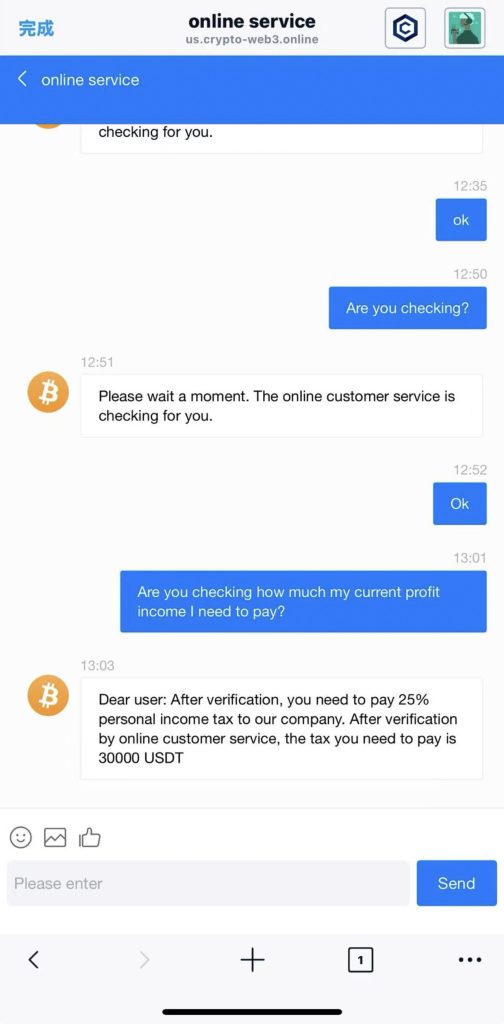
An investigation by Documented into wallet addresses associated with Liu’s transactions, conducted with assistance from the International Consortium of Investigative Journalists and cybersecurity investigator Jonathan Williams of OakThorn Investigations, found that many of the funds could be traced to services linked to Huione Pay, the company that allegedly is involved in money laundering activities tied to Prince Group.
Weeks later, in October last year, Liu noticed that Chen, who had disappeared after she confronted him and told him she knew he was a scammer, had changed his WhatsApp profile and was active again. She sent him a message: “You’re never going to have a good ending in this life.”
The reply was chilling.
“The one who deceived you was dealing with overseas Chinese.” the archived message, which was viewed by Documented, read. “I’m fucking with the Americans. Stop messaging me. It’s a different person now. Do you get it or not?!”
In the same month, the U.S. Treasury’s Financial Crimes Enforcement Network (FinCEN) finalized a rule last October cutting Huione Group off from the U.S. financial system, citing its role in laundering proceeds from cybercrime and cryptocurrency investment scams, including “pig butchering” schemes.
Barriers to Justice
Despite crackdowns on alleged facilitators of international fraud schemes like Huione, and a record $15 billion forfeiture action tied to the Prince Holding Group, it is still extremely difficult for victims to recover their losses.
Language barriers, the complexity of cryptocurrency transactions, and the cross-border nature of the crimes all create obstacles. Many victims struggle to navigate reporting systems or receive little follow-up after filing complaints, according to S.L., a Queens resident who founded the Chinese American Anti-Fraud Alliance, a support network for victims of cybercrimes in his community. He asked to be identified only by his initials for fear of retribution by some of the criminal groups his organization names.
After being scammed, H.L. went to her local police precinct in Flushing. She was given instructions in English directing her to report the case to the FBI.
“I couldn’t understand it,” she said.
With help from S.L. and the volunteer network at the Chinese American Anti-Fraud Alliance, she eventually filed a report with the FBI. Still, months later, she has yet to receive any updates.
Advocates say this lack of response can deepen the trauma. “Victims feel like they are being pushed around from one agency to another,” S.L. said. “It creates a sense of helplessness.”
S.L. said he receives at least one complaint a week from someone in his community who has been a victim of a scam or fraud.
“These are just the people who managed to find me,” he said. “There are many more who don’t know where to go or are too ashamed to speak out.” He said his organization helps victims with support, translating documents, and raising awareness of scams within the community.
“We have to rely on each other,” he said. “Otherwise, many people won’t even know what happened to them.”
West, the Operation Shamrock founder, said that language barriers and limited access to information are preventing immigrant communities from being notified about the prevalence of pig butchering scams or how they may be targeted.
“The information about the threat wasn’t getting out in those communities,” West said. “I think language is an issue … I think that we don’t always do very well at integrating our immigrant communities, and I think that makes them particularly vulnerable in these situations.”
She added that undocumented immigrants in particular may be reluctant to report scams out of fear of interacting with law enforcement, while others may come from cultures where people are less likely to trust the police. The shame associated with being scammed can further discourage victims from coming forward.
“It’s difficult to engage a population that is new to a country and get them to feel comfortable sharing really vulnerable and intimate information,” West said. “There’s a lot of shame that goes along with this crime … And unfortunately, we just don’t even have any idea how big this problem is, and we’re only starting to understand that it’s much bigger than we thought.”
She encouraged anyone who has been scammed to report the crime to the FBI’s Internet Crime Complaint Center, noting that victims who do not file a report are unlikely to be considered for any future restitution.
“Your local law enforcement needs to understand that this is a problem in their community, so it’s important to do that,” West said.
The FBI spokesperson declined to comment on particular instances of restitution but noted that community organizations and ethnic media play a key role in connecting people with limited English proficiency to law enforcement. The agency encourages organizations to work with FBI Community Outreach Specialists to identify victims and help connect them with appropriate investigation agents.
For now, victims like H.L. and Liu are left with unanswered questions, lost savings, and a simple hope: that others will recognize the warning signs before it’s too late.
Liu said she has accepted that she may never recover her money. But she hopes her story can serve as a warning. “The scammer took advantage of my loneliness,” she said. “I just don’t want anyone else to go through this.”