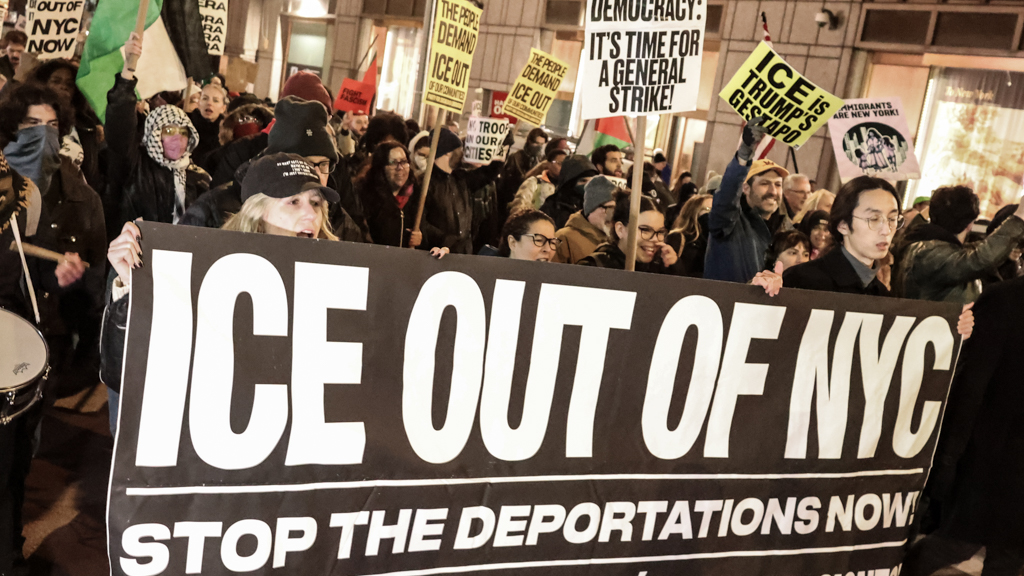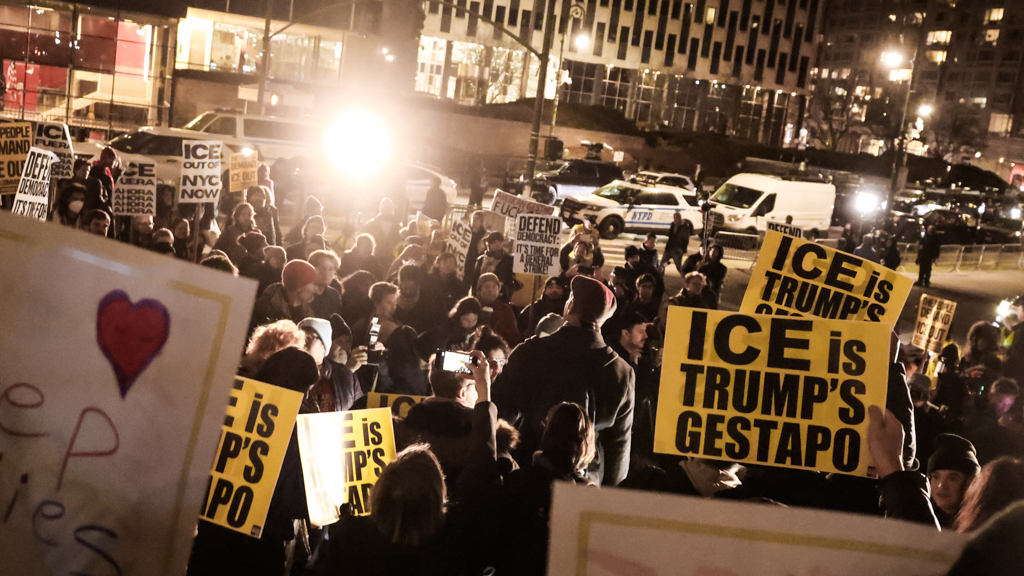


We are living through one of the most intense periods of immigration enforcement in American history.
The practical realities of deportation are no longer isolated to the U.S.-Mexico border, nor to the country’s immigrant communities for whom the threat of forced removal has long been a part of everyday life. The combination of political will and record levels of funding has turned an already broken and outdated immigration system into a vast, nationwide machinery of high- and low-tech ways of arresting, detaining, and deporting noncitizens.
Today, nearly everyone I talk to, from U.S. citizens in mixed-status families to immigrants who are in the country lawfully, feels the threat of immigration enforcement close to home.

In fiscal year 2018, the busiest year of the first Trump administration, ICE made nearly 160,000 arrests. If the summer surge in ICE arrests continued through the end of fiscal year 2026, which ended on September 30, ICE likely made about 460,000 arrests — nearly three times as many as 2018, and the most in any year since at least 2009.
Hiding behind this national story are hundreds of local stories of communities forced to grapple with a new wave of enforcement — and New York City is no exception.
ICE arrests on the streets of New York City went from about 19 a month in 2024 to 476 in July 2026, and Delaney Hall in Newark, where many New Yorkers arrested by ICE are held, went from 10 people on its first night in May 2025 to an average of 826 a night in July 2026.
The public urgently needs and deserves an honest starting point for making sense of our labyrinthine immigration system.
People are overwhelmed, confused, and divided. Our information ecosystem is fractured and polarized. With local news gutted and confidence in higher education sliding for years, there are fewer trusted sources left to sort fact from spin. And the system itself is genuinely complicated, a web of agencies, courts, jails and detention centers whose rules change every week.
Ironically, we’ve never had access to more immigration data than we do today — not because government agencies are more transparent (quite the opposite), but because methods pioneered by researchers at the Transactional Records Access Clearinghouse (TRAC) and by investigative journalists have spread to newsrooms, universities, and advocacy organizations. But data alone does not bring clarity to the whirlwind around us.
For me, the path from more data to more understanding started years ago on the back roads of North Carolina, with a stack of records that meant almost nothing until I took them back to the places and people they described.
In my first column, I want to tell that story and one about a Swiss immigrant on a beach on Fire Island in 1834, because together they explain how I plan to approach the work of making sense of immigration enforcement in New York City each month.
Many summers ago, I got hold of public records showing where law enforcement agencies in North Carolina were running driver’s license checkpoints. The state had recently restricted many immigrants from getting licenses, so every checkpoint, where sheriff’s deputies stopped every car on a two-lane road and asked for ID, worked as a covert immigration checkpoint.
My job was to see whether the records supported immigrant residents’ concerns about racially motivated policing. The records were thin. Each page listed a date, a time, a cryptic road code and, now and then, a note in the margin about how many tickets were issued.
Working through more than 500 pages by trial and error, I built a spreadsheet: I deciphered the road names, geolocated every checkpoint by hand and recorded when each one took place. Then I flew to Raleigh and spent days driving to every checkpoint location, looking for clues in the landscape as to why a checkpoint had been set up there.
The dataset wasn’t perfect, but it was enough to find that checkpoints were disproportionately located in Latino areas, often at a time of day when people were commuting to and from work. Worse, many were set up at the only entrance to rural trailer parks where mostly working-class Latino families lived, effectively trapping residents at home and outraging at least one property manager I spoke with.
I didn’t know then how to turn my research findings into a bigger story. So, they went no further than landing inside a thesis that moved me along an academic track. But what I learned, and what continues to motivate my work, was the power of combining creative data analysis and grounded conversations with people most impacted by immigration enforcement. I also resolved never again to let research languish inside an academic bubble.
I didn’t set out to be a data person. (I hadn’t — and still haven’t — taken a data science course in my life.) But that’s because data wasn’t, and still isn’t, the goal; my goal was to understand how the deportation process worked and data helped me answer that question. In the intervening years, immigration enforcement has only continued to intensify, polarize, and confuse, and the lessons of that first project apply even more today.
To make sense of our convoluted and rapidly evolving immigration system, we need a firm base upon which to construct our understanding. Which brings me to my second story, about where this column — The Baseline — gets its name.
In the early 1800s, long before GPS, the work of mapping our young nation fell to surveyors, who used precise instruments, trigonometry and a lot of legwork to measure the angles between distant points. The first survey of the United States began near New York City and eventually stretched from Maine to Alabama, a chain of triangles that laid the groundwork for the coordinate systems we still use. The calculations were so precise that over hundreds of miles, measurements were off by only a few inches.
For these calculations to work, however, the surveyors needed a starting point, or rather a starting line. They measured the exact length of one line on the ground and used it to calculate every other length in the survey. This line was known as the baseline.
In the spring of 1834, as New Yorkers went to the polls to choose their first popularly elected mayor, Ferdinand Hassler, a Swiss-born immigrant, was preparing to lay the baseline that would anchor the survey, along a long stretch of beach east of the city on Fire Island.
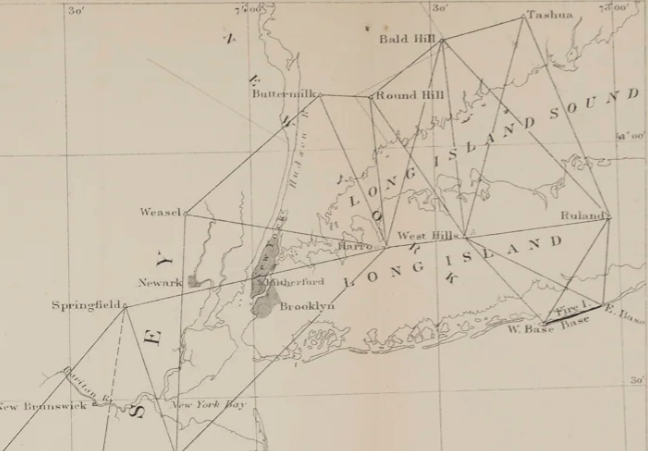
Maps of the new nation in Hassler’s day lacked standardization and precision. New York City’s economic dominance depended on maritime trade, and ships approaching the harbor had no trusted reference for navigating the coast.
What I love about the concept of a surveyor’s baseline is that, in principle, it can be placed anywhere. A baseline was nothing more than a convenient starting point, but everything that followed depended on measuring it with care. And one was never enough: the survey checked the Fire Island line against new baselines measured in Maryland and Maine. Like Hassler’s baseline, this column aims to provide a careful foundation for exploring the immigration system, built from a dialogue between complex datasets and human experience. We need to construct not just one baseline but multiple baselines.
The Baseline will be a conversation about finding and maintaining our bearings through the hurricane of immigration news. Each month, I’ll offer a new baseline for discussion, centered on the best data we have about how immigration enforcement is affecting New York City and New Yorkers. My hope for this column is not that it will serve as a source of objective truth, but that it will serve as a reliable starting point for readers to plot their own waypoints along whichever path is most relevant to them.
We need more than mere data: we need to place data into a broader context and put it into conversation with the lived experiences of impacted communities. This space can be a starting point for informed conversations that are grounded in fact, rooted in the immigrant experience, and flexible enough to enrich, and be enriched by, the diverse range of perspectives that readers bring.
Next month, I’ll focus on the New York City immigration courts where about 300,000 people currently have pending deportation cases.
You can be part of that conversation and help shape that post by reaching out to me directly at austin.kocher@documentedny.com with questions, comments, insider information about the courts, as well as first-hand experience about what you’ve experienced at one of the courts.