

If you’ve heard of Chili’s, the famous Tex-Mex restaurant chain, you’ve probably heard their iconic jingle, “I want my baby back, baby back, baby back… Chili’s baby back ribs.”
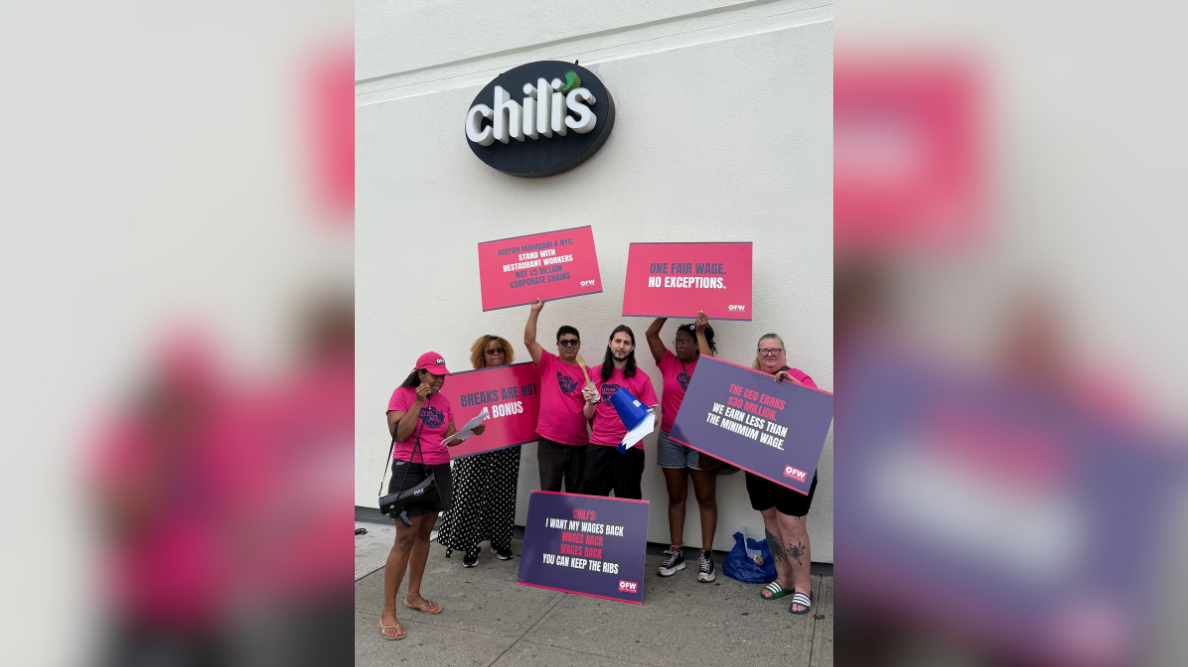
Now, their workers are singing a different tune: “I want my wages back, wages back, wages back…”
On Friday, a group of Chili’s restaurant workers in Glendale, Queens, who have been organizing with One Fair Wage, filed a federal class action lawsuit in the U.S. District Court for the Eastern District of New York against the restaurant’s parent company, Brinker International. The initial lawsuit covers workers in New York, but One Fair Wage plans to expand the case into a nationwide class action under federal civil rights law.

According to the lawsuit, a draft of which was shared exclusively with Documented, the company, which owns, operates, or franchises over 1,600 restaurants across 29 countries, is being accused of subjecting employees to racial discrimination and sexual harassment by only paying workers the federal tipped minimum wage.
Workers, many of whom at the Queens location are immigrants, according to One Fair Wage, are then forced to rely on customers’ tips for a “substantial portion of their compensation.” In turn, the suit alleges, to stay in customers’ good graces and make a living wage, female workers are sometimes subjected to “routine sexual harassment by customers” and tipped employees of color to “race discrimination with respect to their pay.”
“This is the start of a national campaign,” said Anjana Malhotra, one of the lead attorneys on the case to Documented. “It’s incredible how many workers have endured this really deep sexual harassment, and it affects their wages.”
The federal minimum wage for tipped workers is just a mere $2.13 an hour, which hasn’t changed since 1991. In New York City, Long Island, and Westchester County, the minimum wage for food service workers is $11.35 per hour, compared to a $17.00 per hour minimum wage for non-food service workers.
The lawsuit also alleges that Chili’s’ employee scoring system is racially biased: After a meal, customers are asked to evaluate their servers on a scale of one to five. Every two weeks, managers calculate and then assign the highest-scoring servers the best shifts with the highest tip potential. Servers of color, who are more likely to receive the lowest scores, are then assigned fewer hours and sleepier, lower-earning shifts.
By tying a significant portion of servers’ pay to customer discretion, the lawsuit argues that Chili’s is subjecting its female employees to sexual harassment and workers of color to racial discrimination. Thus, the lawsuit claims Chili’s business practices are inherently discriminatory and in violation of Title VII of the Civil Rights Act of 1964. One Fair Wage is hoping to use the lawsuit as a springboard to launch its campaign to abolish the subminimum wage for tipped workers.
“This case begins in New York, but the fight is national. We are demanding an end to the racist legacy of the tipped subminimum wage and a living wage of at least $25 for every worker in America, with tips on top,” said Saru Jayaraman, president and co-founder of One Fair Wage, in a statement shared with Documented. “Chili’s workers are standing up and saying: enough is enough — we want our money back, money back, money back!”
A 2021 national study by One Fair Wage and the Food Labor Research Center at UC Berkeley found that of the 510 current and former women restaurant workers surveyed, 76% of female tipped workers reported that they experienced some form of sexual harassment during their shifts compared to 52% of non-tipped female workers.
The lawsuit comes after workers in Queens rallied outside a local Chili’s location last month, alleging that the company had failed to give them breaks or sick time. Brinker, which has revenue of over $5 billion, has previously faced sexual harassment accusations.
In 2004, the company was forced by the U.S. Equal Employment Opportunity Commission (EEOC) to pay out $283,000 for alleged sexual harassment at its location in Maryland. The company was again required to pay $150,000 to five of its restaurant employees in Colorado to settle a lawsuit brought by the EEOC charging sexual harassment and retaliation. In 2023, the company was again forced by the EEOC to pay $75,000 to two female teenage employees for subjecting them to a sexually hostile work environment.
In another lawsuit from 2014, Brinker paid a $44,300,000 settlement in a California class action lawsuit for failing to provide its employees meal and rest breaks.
Brinker did not respond to Documented’s requests for comment.