

Once upon a time, inside the Chinatown Fair arcade on Mott Street, lived a legendary tic-tac-toe game player. With just 50 cents, visitors could challenge her to a game of tic-tac-toe. If they were lucky enough to win — a rare feat — they’d walk away with a big bag of fortune cookies. But the player was nearly unbeatable; no one can recall her ever losing. The player, Lillie, was a chicken.
For Kimberly Tso, who grew up in New York and spent weekends visiting her father in Chinatown, the arcade and especially the tic-tac-toe chicken, remains a treasured childhood memory filled with fun, laughter, and a sense of wonder. That nostalgia resonates not only within her but with many New Yorkers and out-of-towners alike who visited the Chinatown arcade in the 1970s and ’80s and witnessed a chicken behind a glass enclosure pecking her way to tic-tac-toe victories.
Now a writer based in San Gabriel Valley, Los Angeles, Tso has transformed this slice of her childhood and a quirky piece of New York’s urban history into her first children’s book, Tic-Tac-Toe Chicken, published this August and shared as part of this year’s Mid-Autumn Festival family celebration through the Museum of Chinese in America (MOCA). Told from a child’s perspective, the book offers a playful, lighthearted way of connecting kids to Chinatown history and community heritage.

About three years ago, while she was celebrating her wedding anniversary, Tso was struck by the idea of writing a book about the tic-tac-toe chicken at Chinatown Fair. “The memory of the chicken came back to me, and I thought, ‘Oh, that would make a good children’s book’. And that’s when I started writing it,” Tso recalled.
Also Read: Ghosts of Chinatown
Tso was born in New York and grew up in Queens with her mother and grandparents after her parents’ divorce. On weekends, she would visit her father in Chinatown, a place she remembers as both exciting and overwhelming. The crowded, noisy streets overflowed with toys, fans, slippers, and colorful embroidered trinkets that caught her young eyes as she walked by storefronts. “There’s a real sort of life and pulse to it. It is a full sensory experience to be in Chinatown. There’s lots of things to hear, lots of things to see, lots of things to smell,” Tso laughed.

For many Chinese parents like her mother, the Chinatown Fair Arcade served almost like childcare, a safe spot to leave older kids before the venue gained fame for hosting Street Fighter competitions in the 1990s.
The arcade, often called “the last great arcade” in New York City, first opened in 1944 as a penny arcade and small museum. By the 1970s, it had become a video game arcade, purchased by Pakistani immigrant Sam Palmer. Before the famous Tic-Tac-Toe Chicken arrived, the arcade featured a Dancing Chicken attraction. But the tic-tac-toe game quickly stole the spotlight, often mentioned in New York City tourist guides as a reason to visit Chinatown. Lillie was one of several tic-tac-toe chickens that worked at the arcade, since chickens typically live only five to ten years.
The coin-operated animal act, known as Bird Brain, featured a chicken, who, with the help of a primitive computer, could play tic-tac-toe endlessly without losing. It was developed by Marian Bailey, one of the famous behavioral psychologist B. F. Skinner’s first graduate students and research assistants, along with her husband Bob Bailey, a fellow animal trainer and the U.S. Navy’s first director of marine mammal training. Tic-Tac-Toe Chicken made its debut at Chinatown Fair around 1974 and was one of hundreds of games installed in mom-and-pop amusement parks, Six Flags, and Circus Circus across the country, and even as far as Tokyo.
Even into adulthood, Tso would occasionally return to the arcade to play tic-tac-toe with the chicken. Her last visit was around 1996. At the back of the arcade, inside a glass booth, she spotted Lillie, the final chicken to play the game. On one side stood Lillie; on the other, the electronic tic-tac-toe board where hopeful challengers placed their “O.”
Tso dropped in two quarters. As always, Lillie went first. The bird walked over to the “thinking booth,” a small metal device that concealed the mechanism of the game, then pecked a punch pad to make her move. A pellet treat fell out as a reward. Next it was Tso’s turn, pressing the electronic board to place her “O.” Two rounds later, she lost, just as she expected.
“She always won,” Tso explained, noting that Lillie was actually trained and made moves directed by a computer. In tic-tac-toe, the player who goes first, in this case always Lillie, has a higher chance of winning, unless the computer slips up. But Tso never minded losing to a chicken. “You did it because you played knowing that you would lose, knowing that you were throwing away your money. But you did it just to see and to have some fun with it […] sometimes maybe it’s kind of curiosity, like how does this really work? […] And just to say, I got beaten by a chicken playing tic-tac-toe,” Tso laughed.
In 1998, two years after Tso played her last game of tic-tac-toe with Lillie, animal rights activists persuaded the owner to free her. Lillie was sent to a farm in Massachusetts, where she lived out her days freely. Palmer permanently closed the booth but kept a framed photograph of Lillie nearby as a hallowed reminder.
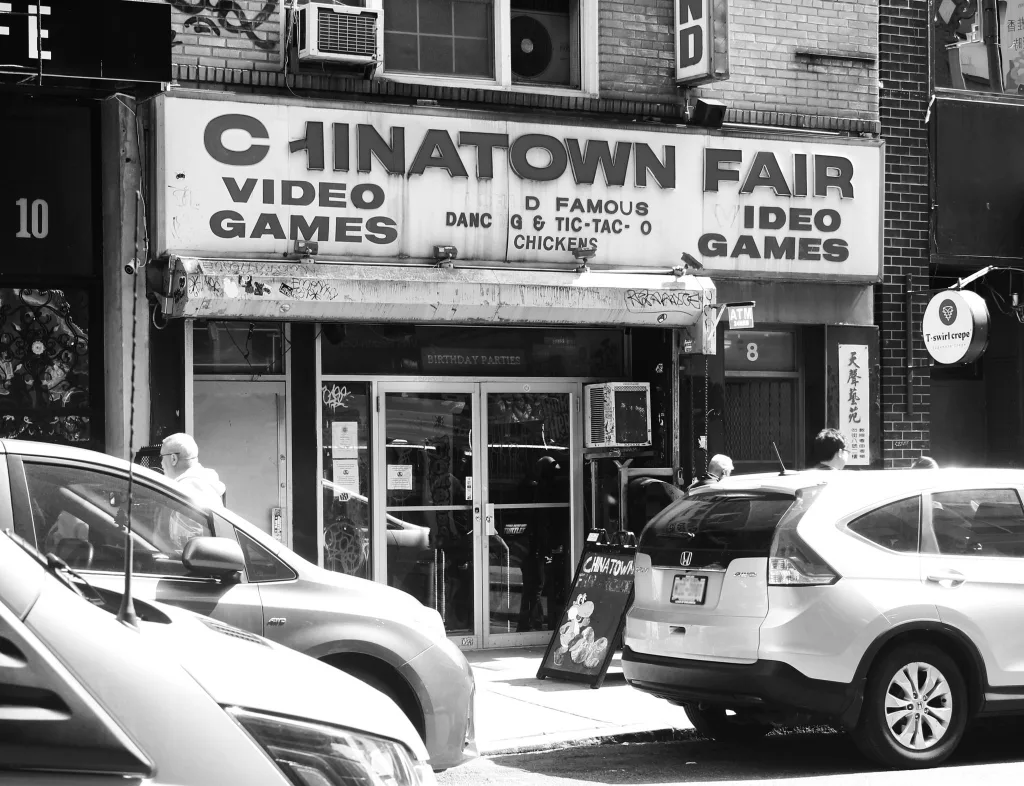
Yet even after her departure, people continued showing up at Chinatown Fair asking, “Where’s Lillie?” Calvin Trillin, the longtime New Yorker columnist who often wrote about the tic-tac-toe chicken and brought visiting friends to challenge her, even penned a long piece mourning the loss of the game and delving into the mystery behind this “smart” bird.
Tso went on a similar journey while writing her children’s book about Lillie. Despite being only 500 words, the project took her a year and a half to finish. “Children’s books, I think, are more akin to poetry,” said Tso. “Not because it has to rhyme or anything like that, but it’s just because you’re trying to tell a really complex story in as few words and as simple words as possible, as straightforwardly as you can.”
For Tso, the process was both incredibly challenging and deeply rewarding. At one point, she even considered writing the book as an autobiography told from the chicken’s point of view. “It’s kind of a silly, made-up story. I’m glad that never went through,” Tso admitted. Over time, the story shifted and reshaped as her research deepened and surprised her, as it reconnected her with the history of the arcade and its unforgettable game.
Also Read: The Last Wedding Shop in Chinatown
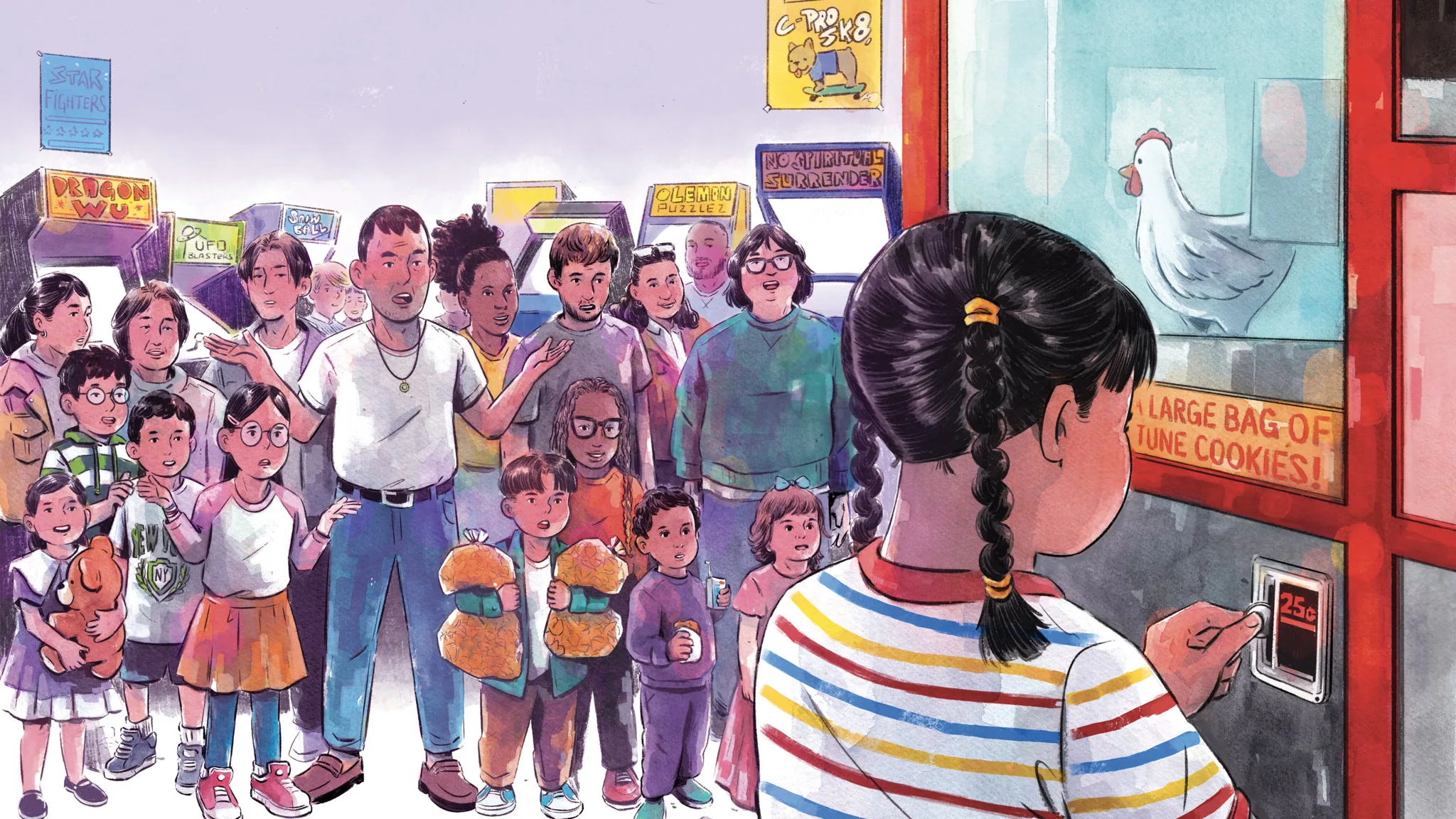
In Tso’s children’s book, the story is told through the eyes of a little girl named Beatrice. Beatrice cares deeply for Lillie and finds her own creative way, different from the activists’ approach, to set the chicken free.
“Almost everything I write has some element of truth to it. And I take inspiration from real events or real things that are happening and then explore it more through fiction,” Tso explained. While researching, she discovered different accounts from the arcade owner’s family and from activists about what happened and how they felt about it.
“I didn’t want to get too mired in that because I didn’t really necessarily want to take sides. But at the same time, the reality of the booth that the chicken lived in really does kind of force you to confront the conditions,” said Tso.
She added that one of the hardest parts was figuring out how to tell the story truthfully while acknowledging both nostalgia and discomfort. That’s when she realized the story needed to be told from a child’s perspective.
“When I thought about my own children, I knew that they would not have the same nostalgia. They would not have the same fond memories. They would probably look at this chicken in a booth and be like, well, that’s kind of weird, and it’s kind of mean,” she said. That realization inspired her to imagine how a child today might respond and what actions they might take.
At the same time, Tso wanted to expand the kinds of stories told about Chinatown. “Not all about trauma and bad things […] I mean, I think there are enough stories about Asian Americans in children’s literature that you might think that we are all about the Chinese New Year and food, which, sure, is pretty important, but that’s not the only thing about us. And so to be able to give a more, a wider perspective on what it’s like in Chinatown, and what it’s like growing up Asian American, I just wanted to expand that notion of it,” she said.
Illustrator Louie Chin, a New York City native, brought Tso’s vision to life with bright, colorful depictions of Chinatown. Young readers flipping through the pages will spot iconic landmarks like Confucius Plaza and Columbus Park, all captured with a playful, vibrant spirit.
This Saturday, Tso will bring her book to the Museum of Chinese in America in Chinatown, where she’ll share the story of Lillie and the arcade as part of the Mid-Autumn Festival family celebration. More details are available at MOCA’s website here.