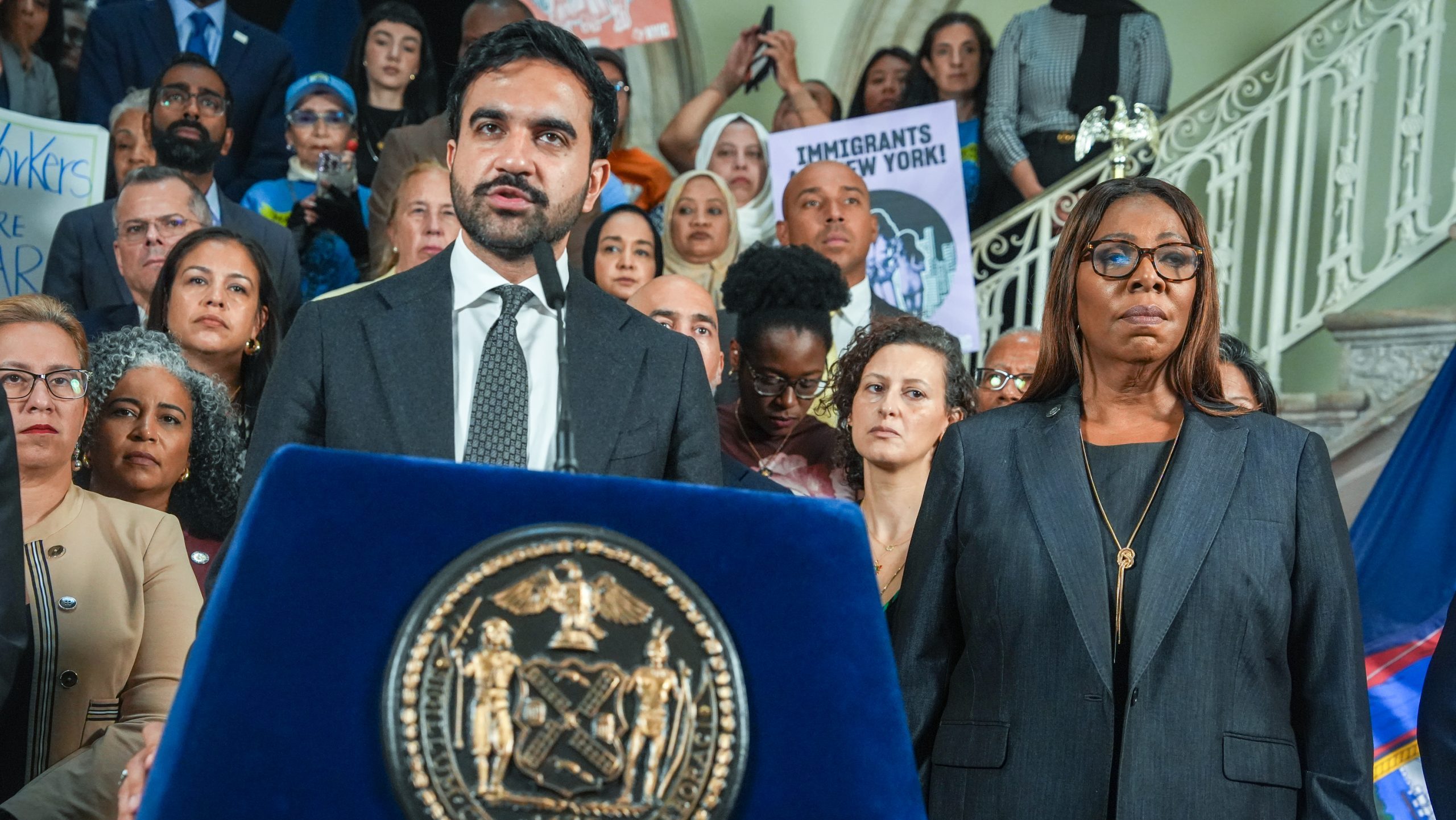


The City Council this week overrode former Mayor Eric Adams’ vetoes of several historic pieces of legislation that aim to place the city at the forefront of worker protection laws.
The new laws, which aim to tackle issues facing for-hire drivers, private security guards, and street vendors, are the latest in a series of victories for New York’s immigrant labor movement.
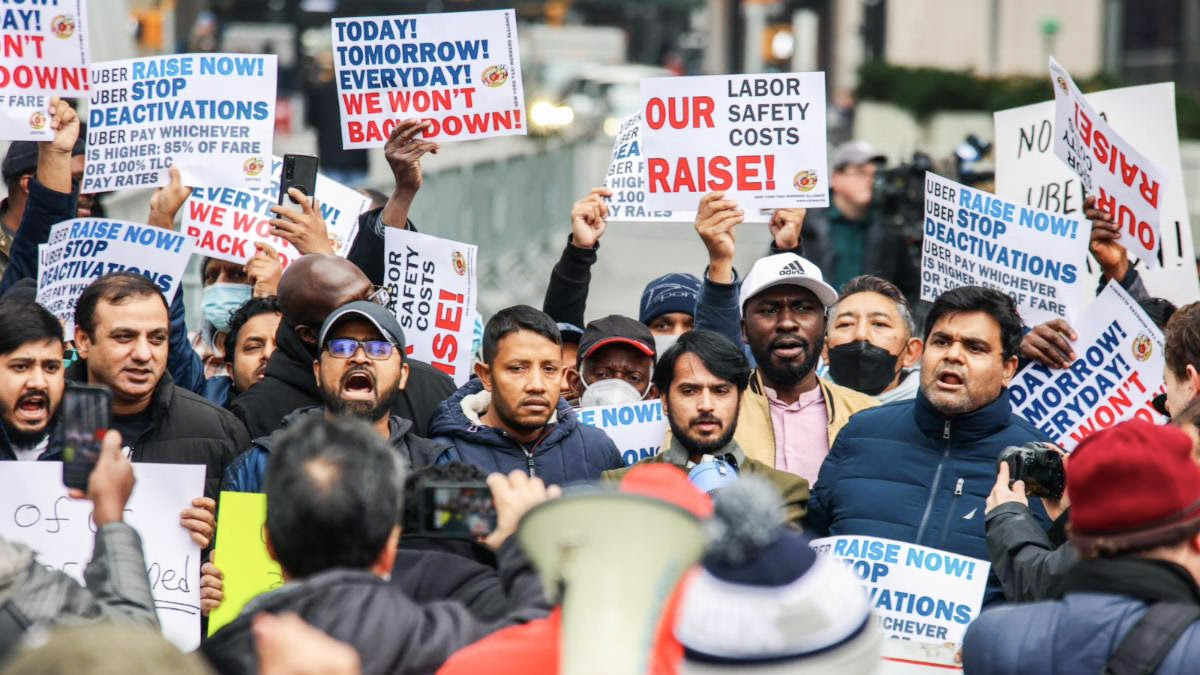
Taxi Workers Win Deactivation Protections

In a 46-to-5 vote, the New York City Council passed Intro 276, which creates the strongest and most comprehensive just cause protections for Uber and Lyft drivers in the nation.
Documented was among the first to report on the mounting deactivation crisis that for-hire vehicle app drivers have been grappling with. Drivers, many of whom are immigrants of color, were arbitrarily losing access to their Uber and Lyft accounts with very little due process. In 2024, in response to the crisis, City Council member Shekar Krishnan introduced Intro 276 that would prohibit for-hire vehicle apps like Uber and Lyft from deactivating drivers without just cause.
“No longer can Uber and Lyft hold the fear of unfair firings over the heads of almost 100,000 drivers in New York City,” Krishnan said in a statement.
The law, which goes into effect on July 28, now makes it unlawful for Uber and Lyft to deactivate drivers without just cause and, in non-egregious cases that don’t involve assault, without advance notice or progressive discipline.
Both Lyft and Uber have pushed back on accusations that they arbitrarily deactivate drivers.
“Unnecessary deactivations negatively impact our business model, so we engage in thorough review processes and aim to only deactivate drivers to protect the safety of our community,” said C.J. Macklin, Lyft’s director of communications, in a comment shared with Documented in October.
Uber’s spokesperson, Freddi Goldstein, told Documented in October that the company does its best to avoid deactivations whenever possible.
“Restricting a driver’s access to the platform is always a last resort, done not because we want to, but because we need to ensure everyone who uses Uber can have a safe and reliable experience. Access restriction is not a common occurrence,” he said, adding fewer than 2% of Uber drivers were permanently deactivated in the first six months of 2025, due in most cases to fraud or safety issues.
App companies must now bear the burden of proof in deactivation cases, not the drivers. The companies are required to give drivers 14 days’ notice before deactivation is in effect, except in cases of egregious misconduct like sexual assault. Drivers will also have the right to an independent appeal process — through arbitration, going to court, working with the city agency to file a complaint, or even using the company-run appeal process.
“New York City Uber and Lyft drivers made history today, winning the strongest just cause protections in the nation,” said NYTWA Executive Director Bhairavi Desa in a statement shared with Documented. “Members of the New York Taxi Workers Alliance refused to give up or give in, continued to fight and show up through every storm and every setback, knowing that when workers lead, change is possible.”
For drivers like Saif Aizah, a Lyft driver and NYTWA member who said his account was suspended by Uber without a reason being given, the law gives him hope that he could get himself out from under the debt he has accumulated since being deactivated.
“Today’s victory means that other drivers and their families won’t have to go through what I did,” he said in a statement to Documented. “Finally, we are at the end of the tunnel of suffering from unfair deactivations. Because Uber deactivated me unfairly without giving me a chance to defend myself, I’m drowning in so much debt that I filed for bankruptcy.”
New York City Enacts First Private Sector Wage Law Since 1964
In another 46-5 vote, New York City Council enacted the Aland Etienne Safety and Security Act (Intro. 1391), the city’s first law since 1964 to set a minimum wage standard for private sector employees who are not employed through a city contract.
Named after Aland Etienne, a Haitian security guard who was murdered in last year’s Midtown mass shooting, the law will guarantee a minimum wage, paid vacation and holidays, as well as supplemental benefits for all 60,000 New York City private sector security officers. The Act’s compensation package will be at least as much as the compensation package of security officers employed on New York City public building service contracts and will help address a 77% annual industry turnover rate that has jeopardized public safety.
Under current minimum wage laws, the city’s security officers can earn at least $17 an hour without receiving benefits, paid vacation and paid holidays. The new law sets the minimum take-home package for a new hire at $26.49 an hour, plus paid vacation and eight paid holidays. The minimum take-home package for an officer with two years of experience and required training would be $29.67 an hour, with two weeks of paid vacation and eight paid holidays.
“This law will change the lives of tens of thousands of low-wage security officers who for too long have been overlooked and underappreciated,” said Manny Pastreich, President of 32BJ SEIU, which represents thousands of security workers.
Etienne’s brother, Smith Etienne, is proud that his brother’s legacy will live on to help others.
“As a father, partner, brother, son, and mentor, he did whatever he could to uplift not just his family and friends, but strangers and colleagues alike,” he said in a statement. “If he were with us today, he’d be fighting for this legislation. This Act honors his legacy by uplifting and protecting his colleagues across the city. Aland is a New York hero.”
Street Vendor Reform Wins Big
On Thursday, the City Council, in a 41-10 vote, passed a package of bills aimed at reforming its archaic street vendor regulations. Known as the “Street Vendor Reform Package,” the city established Intros 431-B, 408, and 1251 as law after a decades-long fight by street vendor advocates representing approximately 23,000 street vendors, many of whom are immigrants.
The first law, Int. 431-B expands the number of new licenses available to vendors, which will help bring existing unlicensed street vendors into the city’s regulatory system. Researchers with the Independent Budget Office estimate that the passage of Intro 431-B could have a net revenue impact of $59 million on the city economy annually.
Int. 1251-A aims to cut the red tape involved in the licensing process for vendors, and Int. 408-A will create a Division of Street Vendor Assistance within the Department of Small Business Services (SBS). The new division will provide training, outreach and education to all food vendors and general vendors on compliance with all applicable local laws, rules and regulations.
These new pieces of legislation come at a time when street vendors have come under increased scrutiny by the city. A 2024 report by the Immigration Research Initiative found that only one-quarter of mobile food vendors have been able to secure a permit for their business. Unlicensed vendors are subjected to fines, harassment, police raids, violence, and property confiscation, with little opportunity for recourse.
“The passage of the Street Vendor Reform Package is a win for all New Yorkers,” said Carina Kaufman-Gutierrez, Deputy Director, Street Vendor Project at the Urban Justice Center, in a statement shared with Documented. “This victory honors the tens of thousands of street vendors who suffered decades of injustice and took to the streets time and time again to stand up for their rights.”