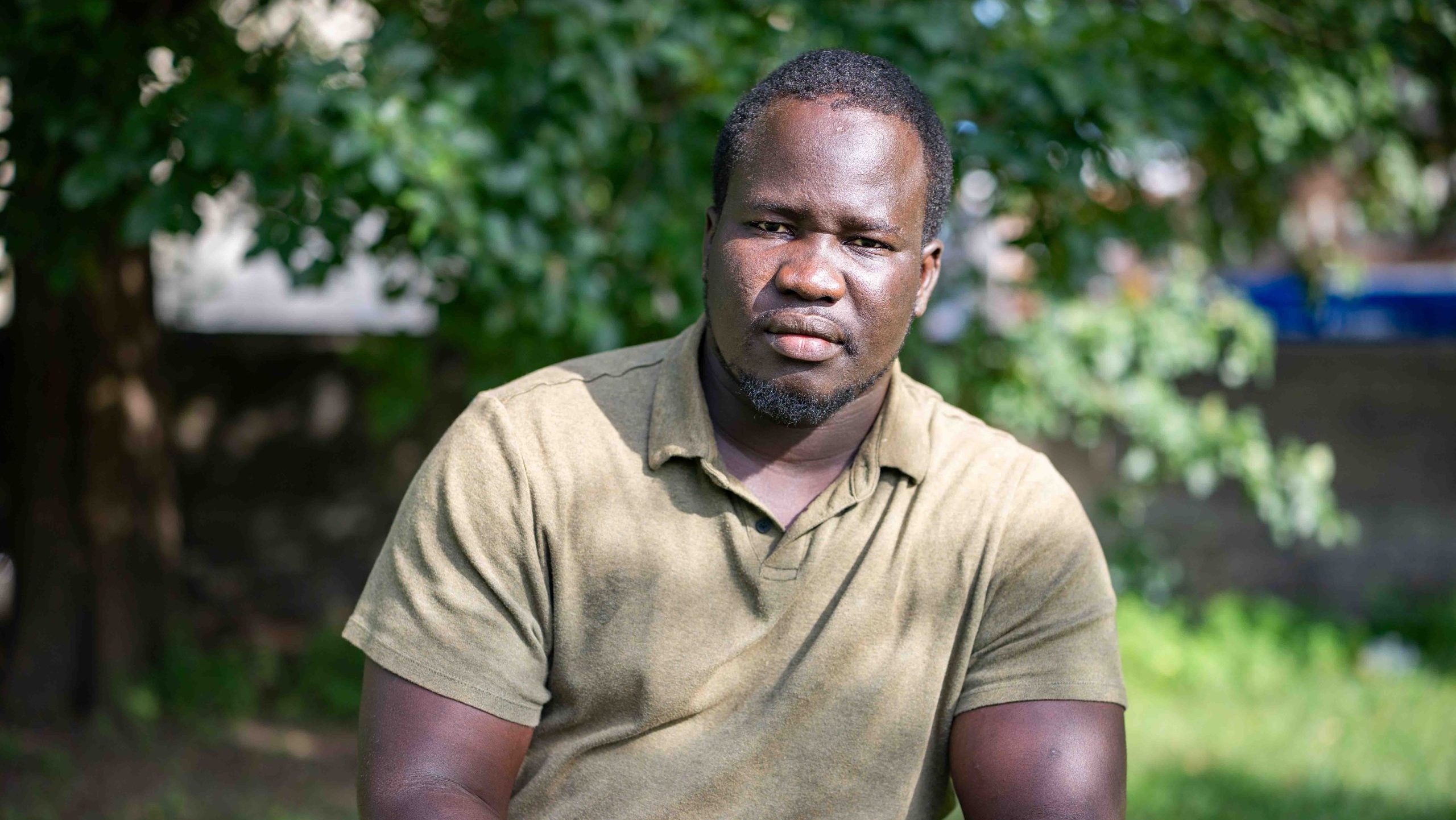


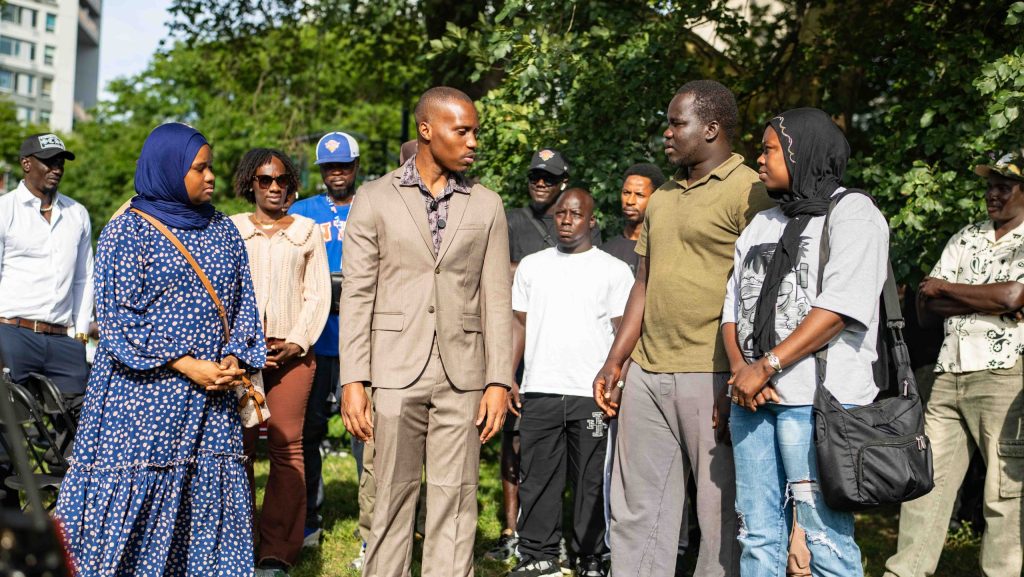
On Wednesday afternoon, August 19, dozens of Senegalese immigrants gathered on the grasses of Central Park in the Bronx to support their friend Gagne Diagne. Their fellow delivery worker had just been released from Immigration and Customs Enforcement custody after six days.
Diagne was almost deported to Senegal, but at the last second a judge granted his habeas petition, blocking the transfer. The judge granted his motion to reopen his asylum case, which effectively eliminated the removal order and allowed him to be released.
Some of the men parked their delivery e-bikes nearby, stepping away from their routes to share brief moments of conversation with Diagne who arrived in New York from Senegal in August 2023. He worked as a DoorDash delivery driver while living in a Bronx apartment with his wife and their baby.
That Wednesday in Central Park, Diagne sat smiling under the watchful eye of his wife, who tended to their 4-month-old baby in a stroller.

His release was made possible by the Amadou Ly Foundation, a nonprofit organization that assists West African immigrants and asylum seekers in New York. The foundation has advocated for and secured the release of detained immigrants such as street vendors from Canal Street and other detainees through legal strategies like habeas corpus petitions and advocacy efforts.
In one notable case, the foundation helped secure the release of Abdou Tall, a Senegalese asylum seeker detained by ICE during an enforcement operation on Canal Street. The foundation filed a habeas petition, helped mobilize Tall’s community, and advocated publicly for his release.
In the case of Diagne, as soon as the foundation confirmed Diagne had an active deportation order, his lawyer filed a motion to reopen his immigration case to cancel the removal order. They also filed a pro se habeas petition to stop ICE from transferring him out of New York and the Second Circuit.
“I’m pretty sure that if that habeas was not [filed] that very same day or the next, they would have transferred him to circuits that were most likely to deny his case and send him back to the country where he came from. So I think time is of the essence whenever someone gets caught by ICE,” said Amadou Ly, the founder and president of the Amadou Ly Foundation.
A deportation order with few help outside
Diagne was arrested by federal agents the morning of Aug. 14 before his work as a DoorDash courier. After spending a moment with his baby, he made himself a coffee and went downstairs to grab a box from his car parked across the street, he told Documented.
Masked individuals approached him, asked his name, showed him a document with his photo, and shoved him against his car. He was supposed to log into his DoorDash app by 8:30 a.m., but was detained before he was able to start.
“They asked who I’m living with. I told them, my wife and my kid. And they asked to call her so she comes to pick up the keys,” Diagne, 32, told Documented, speaking in Wolof. “I had thought they were thieves since they all wore masks.”
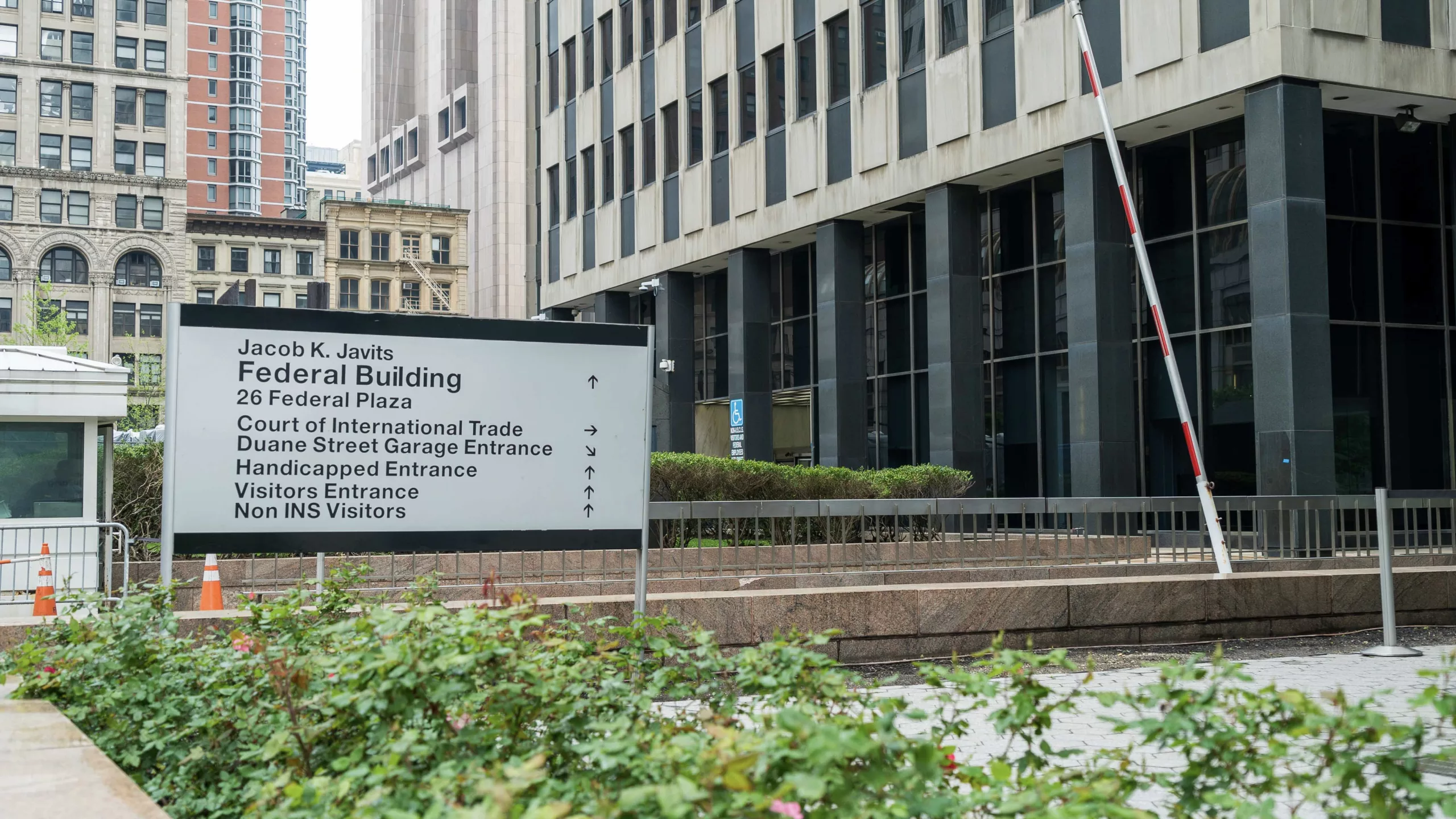
As neighbors gathered outside, the masked agents handcuffed Diagne and pushed him into a car before taking him to the detention facility at 26 Federal Plaza in Manhattan. At a gas station, the agents stopped to chain his feet. Once at Federal Plaza, they locked him in a small room with other detainees. “At first, it was very tough; the food was terrible,” he said.
Diagne, who does not speak English, said he could not understand the agents. He repeatedly asked for an interpreter, but said ICE agents made him sign documents he did not understand. Only after he insisted several times, was he finally provided an interpreter. “It was then I cried when I realized that I was about to leave my wife and my kid behind,” he said.
His arrest on Aug. 14 happened one day after he had filed a motion to reopen his asylum case.
Caught in a broader immigration crackdown
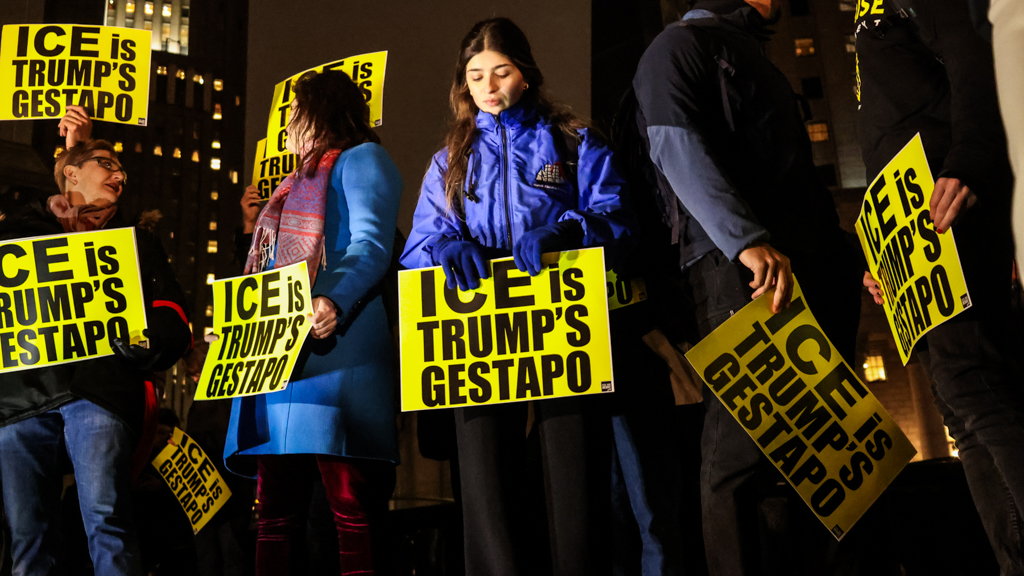
Since President Trump’s return to office, the administration has ramped up immigration arrests and detention across the United States, fulfilling Trump’s campaign promise to execute the largest deportation effort in American history.
Diagne’s arrest comes on the heels of the administration’s latest push to ramp up arrests and deportations, as immigration agents have intensified enforcement nationwide through workplace raids, home arrests and quieter, targeted operations. In New York City, federal immigration arrests have also risen sharply, while immigration courts have become a major site of enforcement, with ICE agents arresting people as they leave their hearings.
In the administration’s first year, ICE conducted about 379,000 arrests. Yet like Diagne, more than 70% of the individuals held in ICE detention had no prior criminal convictions, according to data from the Transaction Records Access Clearinghouse.
Diagne came to the U.S. in April 2023 via the U.S-Mexico border. From his village of Touba in Senegal, he crossed five different countries before arriving in the U.S.
Upon his arrival, Diagne was arrested by U.S. Customs and Border Protection and held in detention for about three months before being released. According to Ly, Diagne applied for asylum within the one-year deadline and regularly attended his court dates.
Ly is a Senegalese-American immigrant advocate and actor who came to New York from Senegal in 2001 at age 13 on a visitor visa. After his mother returned to Senegal, he remained in the U.S. after his visa expired and eventually faced deportation proceedings as a teenager. His case gained national attention in 2006 while he was a high school student and member of an award-winning robotics team. With legal assistance and support from elected officials, Ly was able to remain in the country, first obtaining a student visa and later a green card through Special Immigrant Juvenile Status.
In the case of Diagne, after his arrest, his friends contacted the Amadou Ly Foundation. The foundation managed to help him file a habeas corpus petition without a lawyer, preventing ICE from transferring Diagne to another state. His motion was accepted, the deportation order was canceled and the judge ordered his release.
Early on the morning of Aug. 19, Diagne’s wife and Amadou Ly told him he would be released. “Realizing this made me truly happy. The neighbors came, and I’m grateful that I’m once again with my family,” Diagne said.
At Central Park, Diagne regained his smile. His friends embraced him and spoke with him for long stretches in Wolof.
“Those people are my friends. They are usually there all the time. They are just happy to see me outside,” he said.
Still, he is fearful. Diagne said he worries that ICE can arrest him again, anytime, in the streets.
For Ly, Diagne’s case is proof that city officials need to invest more in small, community-based organizations like his, pointing out that organizations like his are the ones that marginalized neighborhoods trust. Ly said the organization receives little to no funding as larger, well-known organizations get most of the resources.
“Seeing him back with his baby, who depends on him, and who hopefully gets to grow up next to his father and his mom bringing that family together, definitely brought joy to my heart,” Ly said. “I’m truly grateful that God made me part of their journey to assist in any way that we can.”