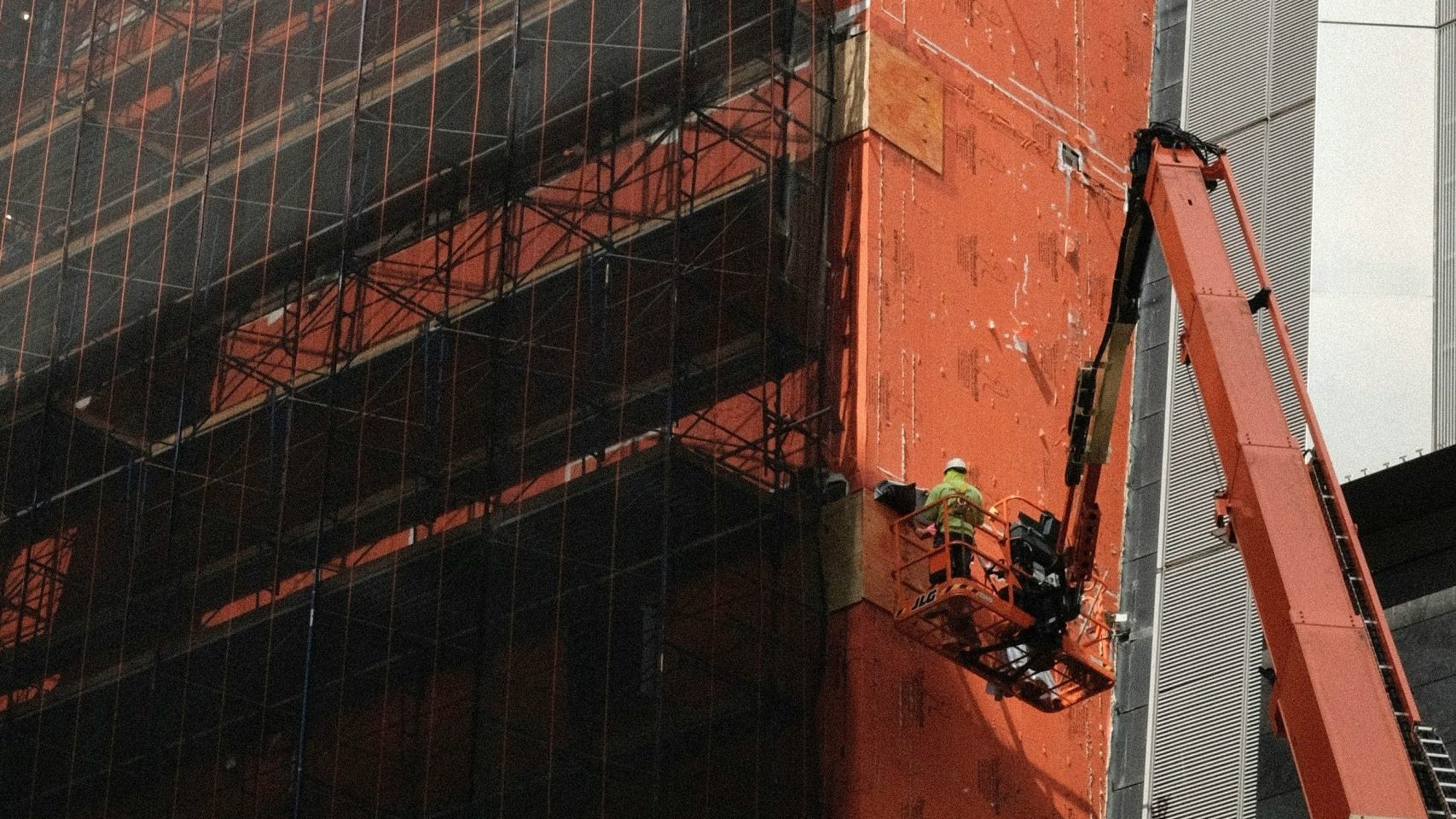


While Jose Briones was at home recovering from his construction accident injuries, two men would come regularly to bring him groceries, courtesy of his employers, Skyline Restoration and OneTeam Restoration.
Months earlier, on March 16, 2020, Briones, who worked for OneTeam, a subcontractor for Skyline, lost his balance while climbing the base of a Bronx public housing water tank. He says he wasn’t wearing a harness when he fell several feet to the roof.
“I don’t really remember much because they told me that I was unconscious for some time,” he said. “I injured my head, neck, back, shoulders, knees, and hip.”

After the accident, he spent two weeks in the hospital before returning home. The men visited him several times at his home. One day in June, Briones said, Skyline’s field supervisor, Jhony Ramos, and OneTeam’s site supervisor, Breiner Sarmiento, showed up at his Queens apartment building again. This time, he felt something was off and started recording their conversation.
In a nearly 25-minute video, the men asked how he was doing, whether he needed any groceries, and whether he could make all his doctor appointments. Then they got to the point. They presented him with a $100,000 check in exchange for not filing a lawsuit against OneTeam, according to a video of the encounter he recorded and shared with Documented. During a previous visit, Briones said they had offered him a $10,000 check from OneTeam Restoration Inc., and Documented obtained a photo of it.
“Let me tell you something, the money, there’s nothing behind it, besides two things,” one of the men said in Spanish in the video Briones recorded and shared with Documented. “One is to help you for what happened, and the other thing is, if you decide to sue us, then it’ll affect us in the sense that renewing insurance will be more problematic. Not being able to renew the insurance, we won’t be able to do lots of jobs.”
What the two men did not tell Briones is that because he was injured in a fall, a unique 19th-century law enabled him to hold property owners and contractors directly liable if he was working 20 feet off the ground and was not provided proper safety equipment. His case could result in an eight-figure settlement for his pain and suffering as well as his inability to work for the rest of his life. It’s a law that New Yorkers use to win life-changing financial settlements that Skyline and other companies and industry groups are fighting to end.
“If I knew that the intentions were for them to offer me money and have me sign those documents so that I don’t file a lawsuit, I would have never opened the door for them,” he told Documented.
Briones is only one part of Skyline’s defense strategy. The company is mounting a sophisticated attack that goes well beyond persuading workers not to file workplace injury cases. The company and several affiliates are using aggressive legal tactics against lawyers and doctors who work with injured workers, alleging fraud, in addition to funding academic research studies against the law and courting the highest rungs of political power, including Gov. Kathy Hochul.
Although Documented could not prove that fraud is not occurring, a Documented investigation has found that the group, led by Skyline, has constructed a narrative — with little proof — that workers are conducting industrial-scale fraud across the state by faking injuries at the direction of gang leaders, lawyers, or doctors and successfully planting stories in the media that support this claim. They claim that a “Fraudemic” is underway where injury attorneys are recruiting immigrant workers to stage construction accidents, in turn driving up the cost of construction in the city. Beyond the group’s own claims, Documented has found little evidence that this widespread fraud or “fraudemic” is occurring, with two of the group’s Racketeer Influenced and Corrupt Organizations Act (RICO) cases filed against lawyers and doctors dismissed in court on procedural grounds.
If successful, they would end one of the remaining avenues for workers to recoup lost wages when they are permanently and severely injured in construction accidents.
Documented could not reach Jhony Ramos for comment. Breiner Sarmiento told Documented that he no longer works for OneTeam or Skyline before hanging up the phone.
RICO Suits
In 2021, a year after he was injured, Briones hired Nick Liakas, an injury attorney who routinely sues contractors responsible for worksite accidents. Like many workers experiencing workplace accidents, Briones filed a lawsuit against his employers, OneTeam Restoration and the general contractor, Skyline Restoration, under New York’s so-called Scaffold Law, which would allow him to receive potentially over $1,000,000 in compensation for the life-altering accident.
Workers injured on the job are entitled to workers’ compensation insurance that covers lost wages and medical care regardless of immigration status. But in addition to standard workers’ compensation protections, construction workers who are injured in falls also have another legal remedy: the state’s more than 140-year-old Scaffold Law.
Established two years after the completion of the Brooklyn Bridge in 1883, which saw the deaths of 27 workers, the law enables workers to hold property owners and contractors directly responsible for injuries on a job that required working above 20 feet from the ground.
In 2025, Briones’ lawyer Liakas and several doctors were named in a RICO lawsuit filed by three insurance companies: Roosevelt Road Re, Ltd., Poughkeepsie-based Tradesman Program Managers, LLC, and New York-based Ionian Re LLC.
The suit alleges that Liakas’ law firm is engaging in an organized scheme with doctors to exploit New York’s Scaffold Law by exaggerating the severity of workplace injury claims and earning multi-million-dollar settlements as a result. Liakas denies these allegations, and the RICO case is still ongoing.
“Defendants, together with others known and unknown, for their financial benefit, orchestrated a widespread fraud scheme to defraud Plaintiffs and others by unlawfully grooming and recruiting construction workers into staging and perpetuating fake construction accidents that occurred in New York and/or transforming legitimate minor or localized injuries into lucrative full-body claims,” the lawsuit alleges.
Ionian Re LLC’s president, John Kalafatis, the founder and former CEO of Skyline, is involved in much more than construction and industry advocacy. He is also the CEO of York Studios, one of the largest movie production facilities in the city where parts of John Wick and The Amazing Spider-Man 2 were shot. York Studios is not involved in any of the RICO litigation.
Dan Hickey Jr., is the CEO of Roosevelt, which wholly owns Tradesman. In addition to jointly filing their lawsuit with Ionian Re LLC — one of the many companies associated with Kalafatis — against Liakas, Roosevelt was also a sponsor of Skyline’s 2025 Annual Golf Classic charity fundraiser at Long Island’s Old Westbury Golf and Country Club. Hickey Jr. was previously the chairman and chief executive officer of CRM, a major third-party administrator for self-insured workers’ compensation trusts in New York.
In 2008, CRM agreed to surrender its state license after allegations that it had committed fraud. The following year, in 2009, the New York State Workers’ Compensation Board and the state’s attorney general’s office accused CRM of committing fraud and owed $405 million in unfunded insurance liabilities. The state settled with CRM and was able to recover over $13 million. Per the terms of the settlement, CRM admitted no wrongdoing.
Several state lawmakers issued a joint letter in 2025 calling on the Attorney General’s office to investigate Tradesman, alleging that the company is operating as an unauthorized insurer in the state. Documented could not confirm if an investigation was ever initiated, and the company has not been found guilty of any wrongdoing.
In a statement to Documented, Roosevelt Road’s General Counsel Thomas F. Kelly III, Esq., could not point to any criminal cases involving organized scaffolding law fraud when asked; instead, he pointed to two cases that were unrelated to scaffolding law, and reasserted their own claims in their lawsuit against Liakas, which is still ongoing. Kelly did confirm that they were a sponsor of Skyline’s charitable golf tournament in 2025.
Regarding questions about Dan Hickey Jr. and CRM, Kelly denied knowledge of past or current wrongdoing.
“We are unaware of any finding of fraud against CRM Holdings, much less one made while Roosevelt Road Re, Ltd. v. Liakas Law, P.C. has been pending, and a finding of fraud is not supported by the materials in your email,” he said in a statement to Documented.
Last February, a judge dismissed a similar RICO suit brought by Roosevelt Road and Tradesman against another injury law firm in 2025 on procedural grounds. It was the second RICO case of theirs to be dismissed, with a judge in 2025 stating that the “plaintiffs’ RICO claims fail because they fail to adequately plead cognizable, direct injuries.” In both cases, the courts dismissed the suits before they could determine if the allegations were true.
To Liakas, the lawsuits are a frivolous attempt by the insurance companies to cheat injured immigrant workers out of their right to sue.
“They are trying to cut access for immigrants to the workers’ compensation system by eliminating anybody who could help them,” he said.
Charlene Obernauer, executive director of the New York Committee for Occupational Safety and Health (NYCOSH), which advocates for worker safety, believes that the attacks on the scaffolding law are a way to deprive workers of their rights.
“Look at who’s being targeted,” she said. “We’ve got immigrant workers being accused of fraud. We’ve got lawyers being accused of fraud. We’ve got doctors who are being accused of fraud, but none of these cases are really going anywhere.”
Information Wars
For years, industry groups and labor associations have fought over whether the Scaffolding Law is a major contributing cause of New York’s skyrocketing construction costs.
According to proponents of scaffolding law reform like Skyline, fraudulent lawsuits under the legislation drive up the cost of construction in New York City, which already has the highest building costs in the country. A 2025 study funded by the industry group the Building Trades Employers’ Association claims that the scaffolding law drives up insurance costs in New York by 200% to 500%.
An earlier study from 2013 by the Nelson A. Rockefeller Institute of Government found that the scaffolding law added $1.5 billion in private sector construction insurance costs. That report was supported by the New York Civil Justice Institute, which is associated with the business-friendly Lawsuit Reform Alliance of New York (LRANY). Skyline’s former CEO Kalafatis sat on the board of the New York City Special Riggers Association, which has partnered with LRANY to lobby for Scaffolding Law reform.
However, Obernauer doubts that the scaffolding law is driving up construction costs. A 2014 report by NYCOSH and the Center for Public Democracy found that the New York Civil Justice Institute paid $82,800 to the Rockefeller Institute to conduct the study.
“When we look at who’s providing the data from the studies, when you actually kind of peek behind the curtain, what we really see is studies that are commissioned by the Building Trades Employers Association,” she told Documented. “The construction and insurance industry are really paying for a study that concludes the things they want them to conclude. That’s not really independent research.”
Richard W. Hurd, professor and associate dean at the Cornell University School of Industrial and Labor Relations argued that the Rockefeller report produced “inaccurate results.”
Still, Skyline operates a news publication that promotes the “Fraudemic” theory. Former WABC local New York affiliate reporter Kristin Thorne, who aired a segment in 2023 about workers staging accidents on construction sites while working at that network, has since become the senior vice president of corporate communications for Roosevelt Road, one of Skyline’s co-plaintiffs in its suit against Liakas.
Thorne also hosted a podcast called “insights.intouch” all about the “Fraudemic” theory in 2025. The show was presented by the iFraud Foundation, a construction and insurance industry group combating insurance fraud. Andriana Vamvakas, president of Andromeda Advantage, a Skyline-affiliated construction management company, serves on the iFraud Foundation board of directors.
Thorne did not respond to Documented’s request for comment via her website; however, Roosevelt Road confirmed that she does work for them.
“We were fortunate to have Kristin Thorne join Tradesman Program Managers, LLC in March 2025,” Kelly said in a statement to Documented.
Workers’ Compensation Fraud
None of the multiple state regulators Documented contacted could confirm that a widespread network of organized construction worker injury fraud is occurring.
In 2024, the New York State Workers’ Compensation Board received over 8 million worker injury claims and found only 22 instances of fraud that year, with 14 of them conducted by claimants faking injuries and eight conducted by employers, resulting in $1.7 million in restitution.
“The workers’ compensation system is essential to protecting all of New York’s workers,” said Michael Cook, press secretary for the Office of the New York State Inspector General, in a statement to Documented. “While most use workers’ compensation as intended, fraud by claimants, employers, physicians, and insurance professionals continues to threaten the system for those who truly rely on it.”
According to Obernauer, one of the common ways employers commit workers’ compensation fraud is by paying off injured workers to prevent them from filing a workers’ compensation claim. In Briones’ case, the employer was not offering him payment in exchange for not filing a workers’ comp claim; they were offering him a lump-sum settlement in exchange for not filing a personal injury lawsuit, which is not illegal
NYCOSH trains roughly 8,000 workers a year in worker safety, and occasionally, Obernauer says, a worker will tell them that when they got injured on the job they “were taken to urgent care, and they were told to say they didn’t get injured on the job.”
A Legislative Push
In addition to filing RICO cases, in 2024 Skyline hired the lobbying firm Gotham Government Relations to help introduce the Staged Accident Bill in Albany. Sponsored by Assemblyman David Weprin and Senator Neil Breslin, the bill would make staging a construction-site accident a Class E felony, which can carry a maximum prison sentence of four years, a change that Skyline’s lobbyists have directly pushed for.
On May 20, Andromeda, the Skyline-affiliated company, hosted Gov. Hochul at their offices with 50 construction industry stakeholders present. They served wine, beer, and hors d’oeuvres among large signs that read “Scaffold Law Enables Fraud.” Court records reviewed by Documented show that Ionian does business as Andromeda Advantage, Inc., an affiliated organization of Skyline.
Top of the agenda was the discussion about Scaffold Law reform. Hochul stood for a photo with Kalafatis and Andriana Vamvakas.
According to public campaign finance records reviewed by Documented, in addition to hosting the governor, in June, Kalafatis donated $2,000 to Hochul’s reelection campaign. Vamvakas has also been a generous patron to the governor’s campaign, donating $5,000 in 2024.
A source told Documented that early next year, the governor plans to announce potential scaffolding law reform, or even repealing the law, to build more affordable housing.
Kristin Devoe, spokesperson for the governor, denied that Hochul has been influenced by the donations made to her campaign or is planning any scaffolding law reform.
“Political donations have no bearing on policy decisions,” she told Documented in a statement. “Additionally, the Governor is always looking for ways to improve how New York builds, but there is no proposal to announce on scaffolding law requirements. As always, she’ll lay out her policy agenda in January.”
New York State Assemblymember Diana Moreno told Documented that she opposes any efforts to weaken the state’s scaffolding law.
“I’m really concerned that the governor, real estate development and insurance lobbies are going to be using these arguments of affordability and the inability to build to weaken our worker safety laws,” she said. “I think that advocates and legislators who have workers’ interests in mind should be ready to organize and fight back against these efforts.”
As the former deputy director of New Immigrant Community Empowerment (NICE), a workers center based in Queens, Moreno says she saw firsthand how injured workers were persuaded by their employers not to report their workplace injuries.
“They came into our worker center with stories after stories of their employers telling them to shut up and not tell the truth about where they got hurt, and they drove them to clinics further away from their work site and dropped them off and essentially threatened them,” she said. “For these workers, the protection offered under the scaffold safety law is some of the only recourse for workers to be made whole after catastrophic, life-changing, disabling injuries. So I personally am prepared to protect worker safety, especially for our immigrant workers who are already suffering greatly under the current economic conditions and also under the current political conditions.”
Reviewing Labor Violations
While Skyline asserts that staged workplace accidents are rampant, Documented has found that the company itself has been cited for numerous instances of unsafe working conditions. In 2019, Skyline was implicated in the workplace death of Eric Mendoza, an immigrant worker who was killed after falling 13 stories at a Brooklyn construction site. The Occupational Safety and Health Administration (OSHA) issued Skyline a $25,194 fine for five serious unsafe working condition violations discovered after Mendoza’s death.
In 2023, OSHA found that Skyline was responsible for seven serious workplace safety violations, even though a subcontractor was the direct employer for the workers. OSHA’s investigation found that Skyline’s business model was to outsource all construction labor to third-party contractors in an effort to avoid liability, and that the company was the “controlling employer” on its worksites.
“Skyline’s employees do not perform any trade labor construction work in the performance of its general contracts, and none of its employees are employed as skilled labor,” said OSHA in its report. “Skyline’s corporate model is to subcontract the entire scope of work specified in its general contracts.”
Later that year, Manhattan District Attorney Alvin Bragg indicted Skyline’s subcontractor, OneTeam Restoration Inc., for allegedly engaging in a $7 million insurance scheme to defraud the state workers’ compensation fund. OneTeam’s owner, Mario Rojas Jr., pleaded guilty to one count of Falsifying Business Records in the First Degree and was sentenced to a three-year conditional discharge.
Neither Rojas nor a OneTeam representative could be reached for comment via email.
Skyline was again cited by OSHA, which issued Skyline a $29,036 penalty for two serious workplace safety violations that resulted in a worker being injured due to a fall at a Brooklyn construction site in 2024.
Skyline was given several opportunities to comment regarding the facts stated in this story, but the company did not respond to Documented’s multiple requests for comment.
Life In Pain
Since his accident, Briones has had five surgeries on his neck, back, right shoulder, and both knees. He also requires weekly dialysis due to kidney failure, a result of the accident, he said. Once an avid soccer player, the former Colombian Army soldier now spends his days at home watching television. With his lawsuit still working its way through the courts, he subsists mostly on the little he gets from workers’ compensation payments.
“My day-to-day is very complicated because I’m always in pain,” he said. “My neck and my back hurt. If I’m lying down for too long, I’m in severe pain. If I stand for too long, I’m in severe pain. If I walk for too long, I’m in severe pain. And what makes it worse is that I can’t take pain medication because of the kidney problems.”
While working for Skyline before the accident, Briones says he was treated poorly.
“It was like a dictatorship,” he said.“We had to work and work.”
Skyline did not respond to Documented’s request for a comment to these claims.
Before his injuries, Briones had a lot of dreams when he first came to the United States eight years ago. He wanted to be financially stable and provide a good life for his two daughters.
“After the accident, for the first few months I couldn’t sleep,” he said. “It was constant thinking about everything that happened to me and how my life has changed.”
Briones is now unable to walk much, let alone play soccer, a lifelong passion of his. His case is still not settled, as he spends his days at home, subsisting on the little he receives from workers’ compensation. Pain is the only thing he has left to show for the years he worked.
“There is not a day when I’m not in pain.”