

Editor’s note: This story contains references to suicide and suicidal ideation. Reader discretion is advised.
Before Chaofeng Ge was found dead from hanging in a shower stall at an immigration detention facility in western Pennsylvania on August 5, 2025, he had made two desperate pleas to be placed with inmates who spoke Chinese. His requests were not fulfilled despite the presence of other Chinese detainees in the facility. If the jail had placed Ge, an immigrant who only spoke Chinese, with inmates he could communicate with, he may still be alive today, according to newly released government documents.
Documented reviewed some of the thousands of pages of documents related to Ge’s death, which were obtained recently by David Rankin and Jeremy Ravinsky, lawyers representing Ge’s family, via the Freedom of Information Act. They present a heartbreaking picture of how a preventable tragedy was allowed to happen while in ICE custody.

Ge, who came to the United States from China in 2023 by crossing the U.S.-Mexico border without papers, was initially arrested by Border Patrol but was released with a notice to appear in immigration court. He later moved to New York City where he worked odd jobs to make ends meet. He was arrested in January 2025, incarcerated and ultimately was convicted of fraud for purchasing $154.62 in gift cards with stolen credit card information. On the night of July 31 2025, at the request of U.S. Immigration and Customs Enforcement (ICE) he was moved from Dauphin County Prison (DCP) in Harrisburg, PA to Moshannon Valley Processing Center in Philipsburg, PA — the largest immigration detention facility in the northeast United States. Ge arrived with transfer paperwork from DCP showing previous suicide attempts and a diagnosis of mental illness, including an unspecified mood disorder in the prison, according to documents shared with Documented.
The information was not immediately reviewed at Moshannon, and the facility deemed that Ge did not require immediate evaluation even after the paperwork was processed, according to a psychological autopsy report conducted by the Health Service Corps of ICE, a division that oversees medical care for immigrant detainees, dated October 1, 2025.
Right after he was taken in by Moshannon, Ge asked to be put in the same dorm with detainees who spoke Chinese. On the night of August 4, 2025, hours before he died, he asked again for Chinese-speaking cellmates, making clear this time that the isolation had affected his mental health, according to the report.
A screenshot of a note submitted with the documents that was written by Ge and translated into English reflected his frustration. “Another day has passed. I applied to share a room with a Chinese person,” the note said. “But the CO (corrections officer) said: ‘Not my duty.’”
Separately, the psychological autopsy report stated that the jail’s policy requires three work days to respond to inmates’ requests, and Ge’s two requests for Chinese cellmates — the first on August 1 and the second on August 4 — remained unprocessed due to a weekend (August 2 and 3) in the middle.
The psychological autopsy report acknowledged that Ge “was socially isolated” at Moshannon, and was “likely experiencing many of the elevated suicide risks associated with somebody housed in isolation.” It concluded this might be one of the factors that had led to his death. The isolation, the report states, “is known to significantly exacerbate mental health symptoms and suicidality, both of which were already documented in his transfer paperwork.”
An email sent by an internal investigator from the GEO Group, a private company that runs the Moshannon detention center, apparently to DHS, confirmed that while there were no Chinese detainees in Ge’s unit, there were four in another unit in the facility at the time Ge died.
An investigation conducted by the ICE Office of Professional Responsibility (OPR) showed that Ge had spent a great deal of time preparing for his death in the early hours of August 5. He methodically walked back and forth from his bunk to the shower area several times to place chairs in the shower stall. He also tore up bedsheets and towels to make a ligature, according to the OPR investigation.
Moshannon requires detention officers to frequently (roughly every 30 minutes) patrol the campus for security checks. But the OPR investigation found that the staff did not perform timely or thorough rounds, neglecting to check the bunks, bathroom or shower areas after midnight that night.
Ge was found hanging in the shower area at 5:19 a.m. when staff conducted the morning head count. He had been dead for at least an hour, according to the estimate of a jail nurse. The psychological autopsy stated that staff didn’t cut Ge down immediately for fear of disturbing what they considered a crime scene. Even after a nurse requested that Ge be pulled down, it was further delayed. Even though the tool needed to cut him down was stored just a few steps away in its secure lock box, the OPR investigation noted, the lockbox had been “jammed shut.” Altogether it took approximately six minutes for the staff to get him down and on the ground.
The psychological autopsy report also contained a piece of perplexing information, regarding the way Ge was found hanging, hog-tied with his hands and feet bound behind his back using bed linens. According to the report, multiple staffers at Moshannon said they’d been told that this kind of binding was a traditional method of suicide in the Chinese culture. It is a claim Chinese community leaders have publicly panned as both wrong and absurd.
“Hanging is a suicide method that appears more often in classic Chinese novels than in reality,” said Jicheng Wang, former president of the New York-based Henan Association of Eastern America, a hometown organization serving immigrants from Henan, Ge’s home province. “Hanging with bound hands and feet? I have never heard about something like that.”
GEO referred Documented’s request for comments to ICE. ICE and the U.S. Department of Homeland Security didn’t respond to Documented’s inquiries by the time of publication.
The lawyers for Ge’s family are in the midst of preparing a lawsuit and are still waiting to receive video documentation surrounding his death — and in turn, they have not yet decided on the final list of defendants. “What the documents show is that several mistakes were made that resulted in Chaofeng’s death,” said Ravinsky. “Mistakes that should never have been made and that are not excusable.”
At least 55 immigrants have died in ICE custody since President Trump took office in 2025, including two at Moshannon. Inmates went on a hunger strike at the facility in May 2026 to protest against conditions at the jail including inadequate medical care and rotten food. Local residents and activists have been demanding that the facility be shut down for years.
GEO has made some immediate changes at Moshannon in response to Ge’s death, including removing shower hooks and equipping each facility supervisor with a tool that can be immediately used to cut down someone hanging. But inmates said it is still hard to get proper medical care.
Qing Li, an asylum seeker from China who was living in New York was arrested on Oct. 13 during her regular immigration check in with ICE at 26 Federal Plaza in Lower Manhattan. She is currently incarcerated at Moshannon, and said she suffers from serious health problems caused by years of working in a toxic factory environment in China.
When she complained to staff about the sharp pain in her muscles and joints, a symptom often made worse when she isn’t able to eat enough food rich in calcium and potassium, she was sent to see a mental health doctor. “I told them my problem is the pain. But nobody listened,” Li said.
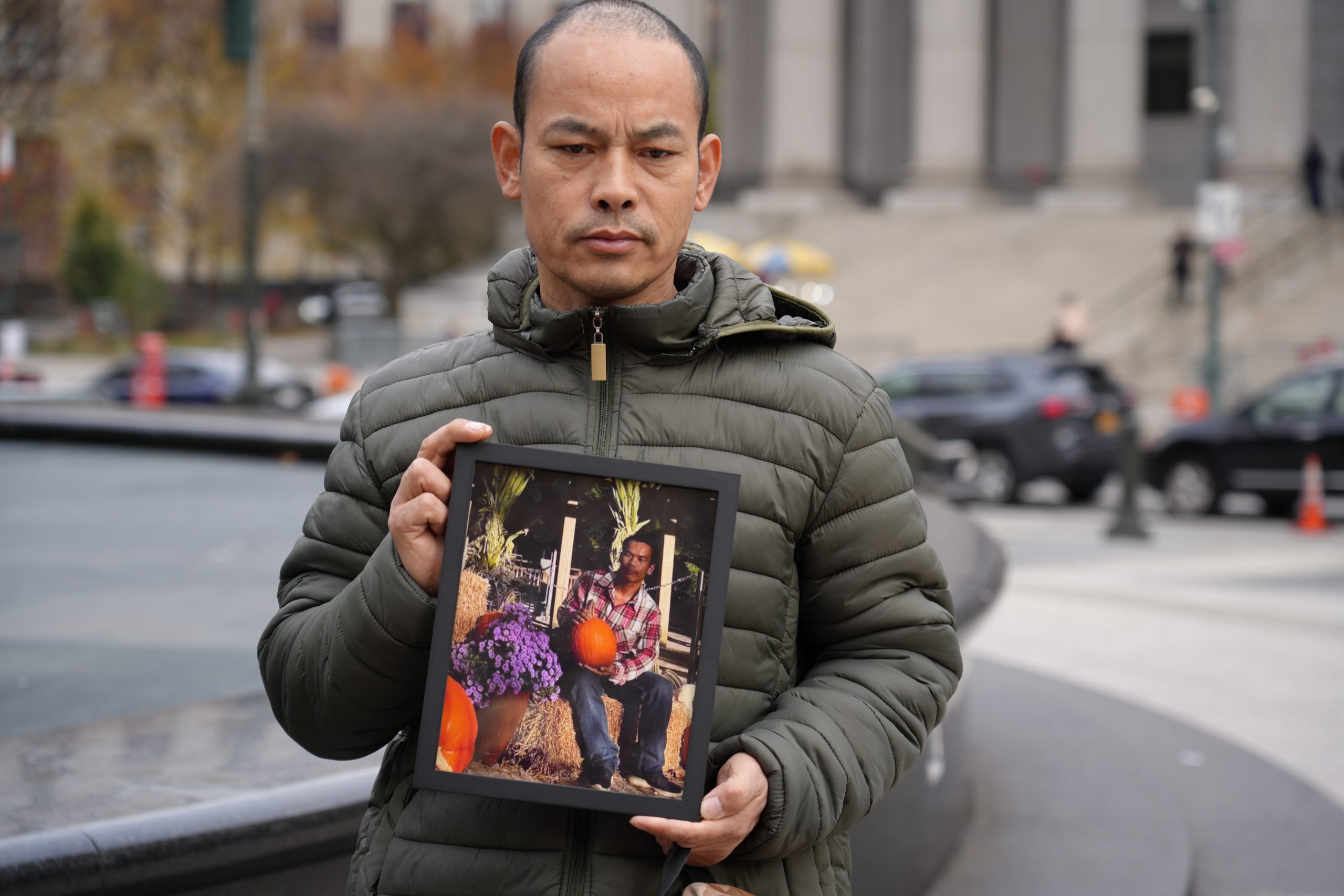
To Ge’s family, any change made at the facility is too late. Ge is already gone and Yanfeng Ge, Ge’s brother, said he believes the neglect of Ge’s mental health problems — both at the Dauphin County prison and in ICE detention — was a major factor that led to his brother’s death.
He also said that while Dauphin had sent Ge to see a mental health doctor following a suicide attempt, the prison did not make a suicide-prevention plan for him, and it actually placed Ge in solitary confinement several times. Dauphin County prison didn’t reply to Documented’s request for comment.
“My brother was not someone who could be easily put down by a harsh environment,” said Yanfeng, noting that Ge was sleeping in his car and living on instant noodles to save money in the Pennsylvania winter when he was arrested. “If someone could talk to him and pull him out of despair, he wouldn’t have died.”