

Braving the heat on Monday afternoon, more than 60 delivery workers, community organizations and City Council members gathered on the steps of City Hall to celebrate the passage of five bills strengthening worker protections and pay transparency for delivery workers in NYC —with one bill giving them a huge raise.
Intro 1135 will increase the wages of nearly 20,000 grocery delivery workers who work for apps like Instacart and Shipt, to match the $21.44 per hour minimum wage earned by delivery workers on DoorDash, Grubhub and UberEats. Specifically, the bill addresses complaints from workers for third party grocery delivery companies, like Instacart, who have said they sometimes make less than $7.00 per hour.
For delivery workers like David Dimas, 41, who has worked for various delivery apps since 2022, the passage of the bills are long overdue. “It gives you peace knowing that you are going to make the guaranteed $20.00,” Dimas, who migrated from Mexico nine years ago, told Documented in Spanish.

Dimas used to work during the weekends delivering for Instacart, one of the third party grocery delivery companies that will now be required to pay the same minimum wage to delivery workers as UberEats, DoorDash and Grubhub.
Also read: Run a Red Light on an E-Bike? You Might Get a Criminal Summons
Dimas said completing an order for Instacart, which involves deliveristas picking up the items at convenience and grocery stores, can take anywhere from 20 minutes to one hour depending on the distance, inventory, and customer’s approval of items to replace.
“For a trip of six products, if things go well, it takes you twenty minutes if it’s two or three miles away,” he said. “But most trips do not go well, and the same amount [of items] can take up to an hour.”
But even with all the added work, Dimas said he earned less per hour than the similar type of work done delivering for other app companies like Grubhub, the app he currently delivers for.
Dimas explained that during the weekend deliveries took longer because several stores did not update their inventory. As a result he couldn’t find items or had to quickly look for alternatives. But choosing an alternative item introduced another set of problems. Dimas needed to get authorization from the customer via text or phone call, which would additionally delay the time to complete the order.
“They usually never respond to the messages,” he said, adding that although the app gives delivery workers an option to replace the items without the authorization of the customer, doing so could lead to a negative rating if the customer did not like the alternative.
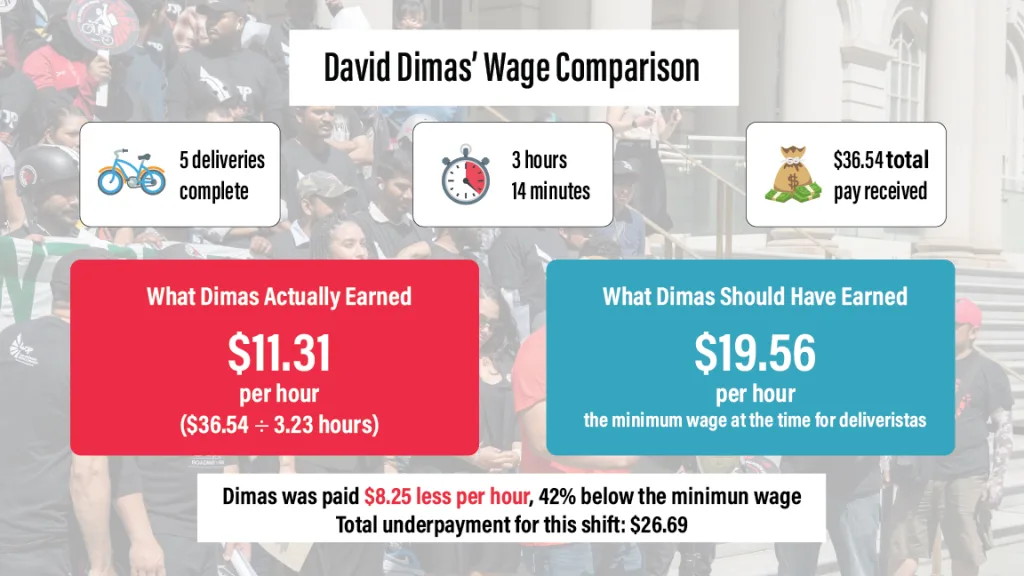
On a paystub shared with Documented, during the weekend of November 23, 2024, Dimas was paid $36.54 cents, before taxes, for five deliveries which took him 3 hours and 14 minutes to complete. His pay that day equaled less than $12.00 per hour, below the wage of $19.56 per hour that delivery workers were paid during the same time period last year.
Documented asked Instacart to clarify if the app company would pass the incurred cost of higher wages to their customers. In a statement shared with Documented, Instacart said: “It’s simply unconscionable that the City Council would pass a bill that would have such devastating consequences for New Yorkers. Grocery delivery is a lifeline for thousands of people across the city, especially those facing health, mobility, or transportation challenges. The City’s own data shows that this bill could drive grocery delivery prices up by a staggering 46%, cut off access to work for thousands of NYC delivery workers, and increase fees on local grocers.” They added: “At a time when millions across the city are already struggling with rising costs for food and daily essentials, we stand with the more than 6,000 New Yorkers – including over 1,300 delivery workers on our platform – who have called on the City Council and Mayor Adams to oppose this bill.”
Council member Sandy Nurse, D-37, who was a former delivery worker herself, said that the bill passed in 2021 — which implemented a minimum wage for deliveries — has led to about a billion dollars in increased wages for delivery workers. “But, unfortunately, grocery delivery workers were left out of that. After it was studied, it was found that they do similar tasks and they face similar exploitations by the apps,” said Nurse, who is one of the sponsors for Intro 1135.
Antonio “Toño” Solís, an organizer for Los Deliversitas Unidos, condemned Instacart’s comment that the minimum wage would raise the cost for families who use the app. “Instacart has accused the Department of Customer and Worker Protection [DCWP] of harming small businesses, but that is a lie. The DCWP is the only agency that has defended our rights,” he told Monday’s crowd of attendees in Spanish.
‘Fighting with people that have a lot of political influence’
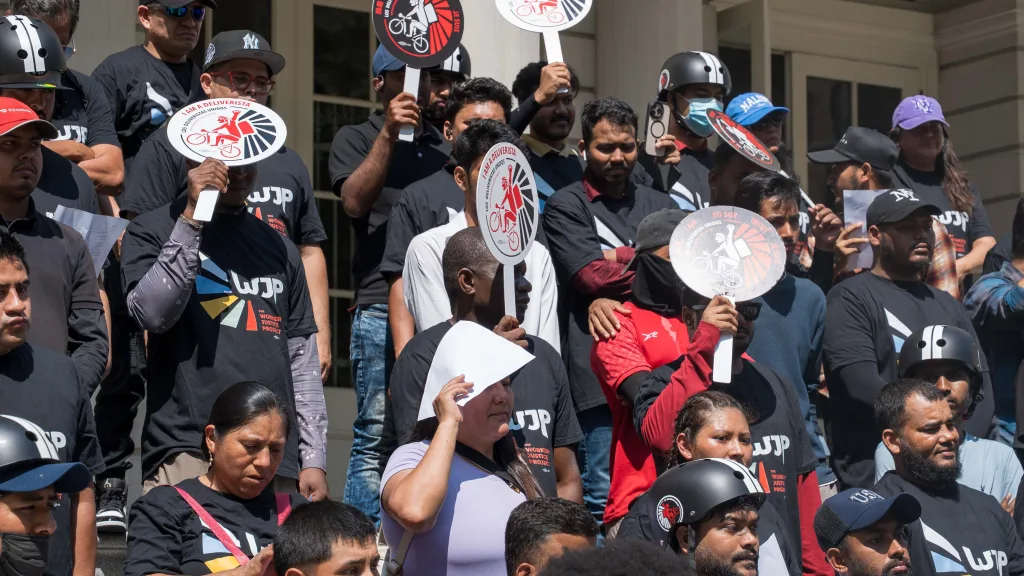
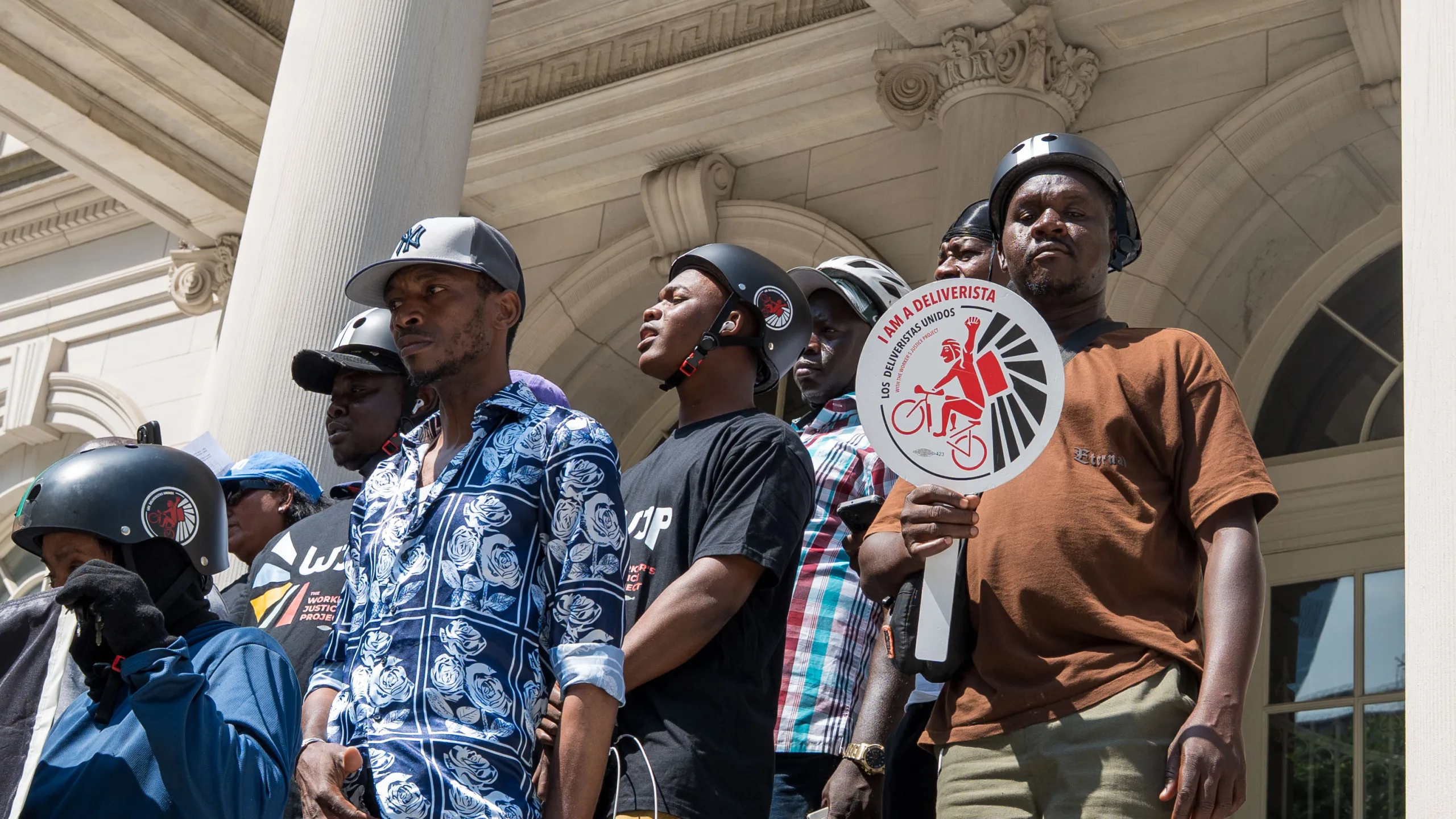
During the hot afternoon celebration, delivery workers, who are known as “deliversitas,” stood at the steps of City Hall wearing black shirts, and waving paper fans with logos of a delivery worker and the initials of the Worker Justice Project. Throughout the hour-long demonstration, they chanted “Deliversitas unidos, jamás serán vencidos,” in Spanish, a popular phrase that translates to “Deliveristas united will never be defeated.”
Among the bills requiring the minimum wage for grocery delivery workers to match that of deliveries for Uber Eats, Grubhub, and DoorDash, four other bills expanding pay transparency also passed. One of them, which received a lot of support from the crowd in attendance, was Intro 0728 — which will give the app user the option to tip as they place the order.
For Gustavo Ajche, a leader with Los Deliveristas Unidos and a deliversita himself, the passing of the bill is a testament to the work that they have been doing to promote better working conditions and dignified living for deliversitas.
Ajche said the delivery apps retaliated in the past by moving the tipping option to after the other placed, a feature which deliveries told Documented has made tipping harder.
“They [the app companies] don’t give up, but we are aware that we are fighting with people that have a lot of political influence, and who have money. So they are able to do whatever they want, but that hasn’t intimidated us: we continue fighting,” Ajche said.
He added that in the past the applications had hidden the tipping option in the past, which had impacted the deliveristas to lose wages. “But, I repeat, through the help of council members we have managed to reverse this. We hope that everything goes the way the law dictates.”
UberEats and DoorDash did not respond to Documented requests for comment.
GrubHub’s Senior Manager of Policies and Issues Communications shared a statement with Documented, stating: “We have been working closely with driver advocates and the City Council to make sure New York’s delivery workforce is protected without sacrificing the flexibility customers expect. We will continue working alongside them to make sure the rules are clear, workable, and squarely focused on the people powering New York’s delivery economy.”
While the passage of the bills brought a celebratory atmosphere that afternoon, Ajche said that the advocacy of fair and dignified working conditions will continue. “We are not asking [the companies] to share their entire profits. It’s a tiny fraction: we are fighting for what’s fair.”