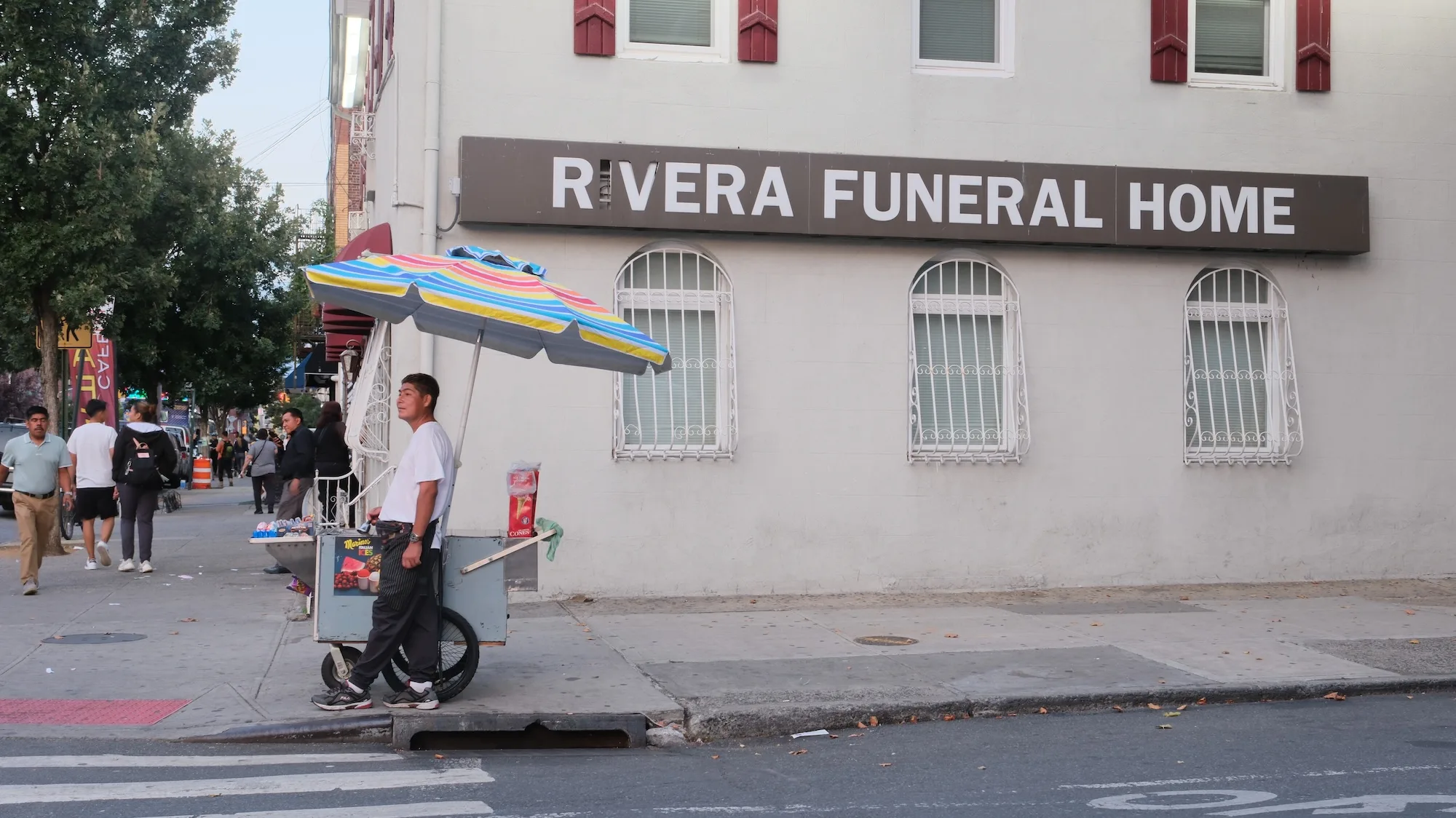


Leonor Valente steadily watched the computer screen from her apartment in Corona, Queens, while her two young children played in the background. She thought she was watching a live stream of her husband’s casket returning to his native Guatemala, courtesy of Rivera Funeral Home. Elder Garcia, a long-time waiter at El Coyote Restaurant in Corona, died from a sudden heart attack on May 2, 2024.
Initially resistant to the idea of shipping her husband’s body abroad, Valente was persuaded by her mother-in-law.
“His mother wanted to see her son for a final time,” Valente said in Spanish. “I put myself in her shoes as a mother and decided to send him back.”
Except his body wasn’t there.

When Garcia’s family in Guatemala peered inside the casket, they saw an elderly woman they didn’t recognize. They later learned she was Carmen Maldonado, who died in her home in Queens at age 96, and was meant to be shipped to her native Ecuador. Maldonado’s children later learned from a TikTok video that the funeral home had sent her body to Guatemala instead.
Rivera Funeral Home swiftly cut off the live stream of the casket’s arrival, sending Valente into a panic. Her family, bewildered by the mix-up, frantically called her from Guatemala.
“At this moment, I could not find any sense of comfort because I had to know where [Elder] was,” said Valente. “What happened with him? I didn’t know how to feel at first, but it was then instant despair.”
The decision to repatriate a loved one to another country, often for religious or personal reasons, can be wrenching for immigrant families. The process is complex and costly, involving extensive documentation, specialized freight, and embassy involvement. It also requires a family to entrust a funeral home with carrying out the complicated arrangements.
The price of a funeral repatriation can also vary widely depending on the destination country and the funeral home. The entire process can cost anywhere from $5,000 to $12,000, according to International Funeral Service of New York II, which arranges both domestic and international funerals.
R.G. Ortiz Funeral Homes, which owns 17 mortuaries in New York City including Rivera, has been under fire in recent years for not only misplacing bodies, but also misrepresenting funeral costs, failing to provide information about the deceased, and presenting bodies in unacceptable conditions, according to an August 2024 press release issued by the NYC Department of Consumer and Worker Protection.
R.G. Ortiz has also faced more than 100 reported lawsuits. The funeral home chain caters mostly to Spanish-speaking immigrants, according to attorney Phil Rizzuto, who represents about a dozen plaintiffs.
Rizzuto said Carmen’s youngest son flew to Guatemala on the family’s expense to repatriate her to Ecuador. The process involved navigating the country’s health department, customs, and police. Garcia’s body hadn’t left Queens, and remained at the Rivera Funeral Home for 24 days before his body was finally sent to Guatemala.
“When we pass the funeral home, my children still say, ‘Dad is there?’” Valente said.
Rizzuto, who represents Valente and the Maldonado family, said the R.G. Ortiz company puts profits over people.
“They just don’t care,” he said. “They try to cover it up. They lie to their clients.”
R.G. Ortiz declined to comment for this story when approached in person at Rivera Funeral Home in Corona and hung up during a subsequent phone call.
Immigrants are especially vulnerable to exploitation when making funeral arrangements, said Virginia Beard, a professor of criminal justice at Longwood University, who studies the funeral home industry.
“This is something that is a time-restricted decision people are making,” Beard said. “For anyone, that is a vulnerability part of it, but if you then start layering in language barriers, cultural differences in terms of respect of professions, if they’re working with low-income individuals, they are in a position of financial vulnerability.”
Repatriating a body is a complicated process that can easily go awry. A funeral home has to be equipped to handle extensive paperwork and logistics. Typically, the process begins with preparing, or embalming, the body and placing it in an airtight container. At the same time, the funeral home is collecting death certificates, letters from doctors, and notarized forms, which sometimes need to be translated and filed with foreign officials.
Embassies have different requirements for repatriation. For example, the French embassy requires the casket to be brought to their consulate in New York City. Others just require the paperwork. After gaining approval, the flight to transport the casket will be booked with a freight forwarder that specializes in working with funeral homes.
Also Read: Family Reunions for Mexican Immigrants Persist in the Shadow of Immigration Enforcement
In many ways, repatriating a body is just another part of the immigrant experience. Despite the cost and complexity, it may seem like the only option, according to Candi Cann, a professor who researches death and grief at Baylor University.
“We have to be really careful of how we judge these kinds of disposition rituals because sometimes people don’t feel like they have a choice, and they might feel obligated to cremate because they don’t have any money,” Cann said.
Additionally, the deceased’s loved ones may be thousands of miles away, unable to afford travel to a funeral in the U.S. or obtain the necessary visas in time. Returning a body to a homeland also holds immense religious and cultural significance in many immigrant communities.
“You may not imagine where you are as your home, but rather a temporary displacement. And if that’s the case, then you obviously would want to repatriate your body,” Cann said.
New York City’s Human Resources Administration Office of Burial Services offers low-income New Yorkers financial assistance with a $3,400 cap for funeral expenses, but the benefit is not available to undocumented immigrants.
While some employers offer benefits such as life insurance and other support that can go toward funeral costs, these protections are not always available to immigrant workers.
Mario Meletz, 31, died last year following a Sunset Park, Brooklyn apartment fire sparked by the lithium-ion battery bike he used for food deliveries for a local restaurant. His brothers, Luis and Oscar, managed to escape the fire. Luis said the family wanted to send Mario’s body back to their native Guatemala, but could not get help from his employer for the arrangements.
“It was not hard to find the funeral home, but the more difficult part was the cost,” Luis Meletz said in Spanish.
Luis held a wake for Mario at Las Rosas Funeral Home, located in their neighborhood, but he said the cost to repatriate Mario’s body would be close to $9,000. In their hometown of Sololá, the local community came together to sell food and donate clothes in the town square, raising the funds to bring Mario’s body back to his birthplace.
“I had a motorbike, but I sold it because I couldn’t use it,” Luis said in Spanish. “Every time I see someone with a bike, I think about the accident.”
Leonor Valente said she was able to help cover the cost of her husband, Elder Garcia’s, funeral and repatriation with the help of his boss, who organized a GoFundMe campaign that raised $1,880. But Valente’s lawsuit against R.G. Ortiz Funeral Homes over the body mixup is still pending.
“The funeral home does not know the extent of the pain it caused us,” Valente said in Spanish. “I don’t want more families to suffer from this trauma.”