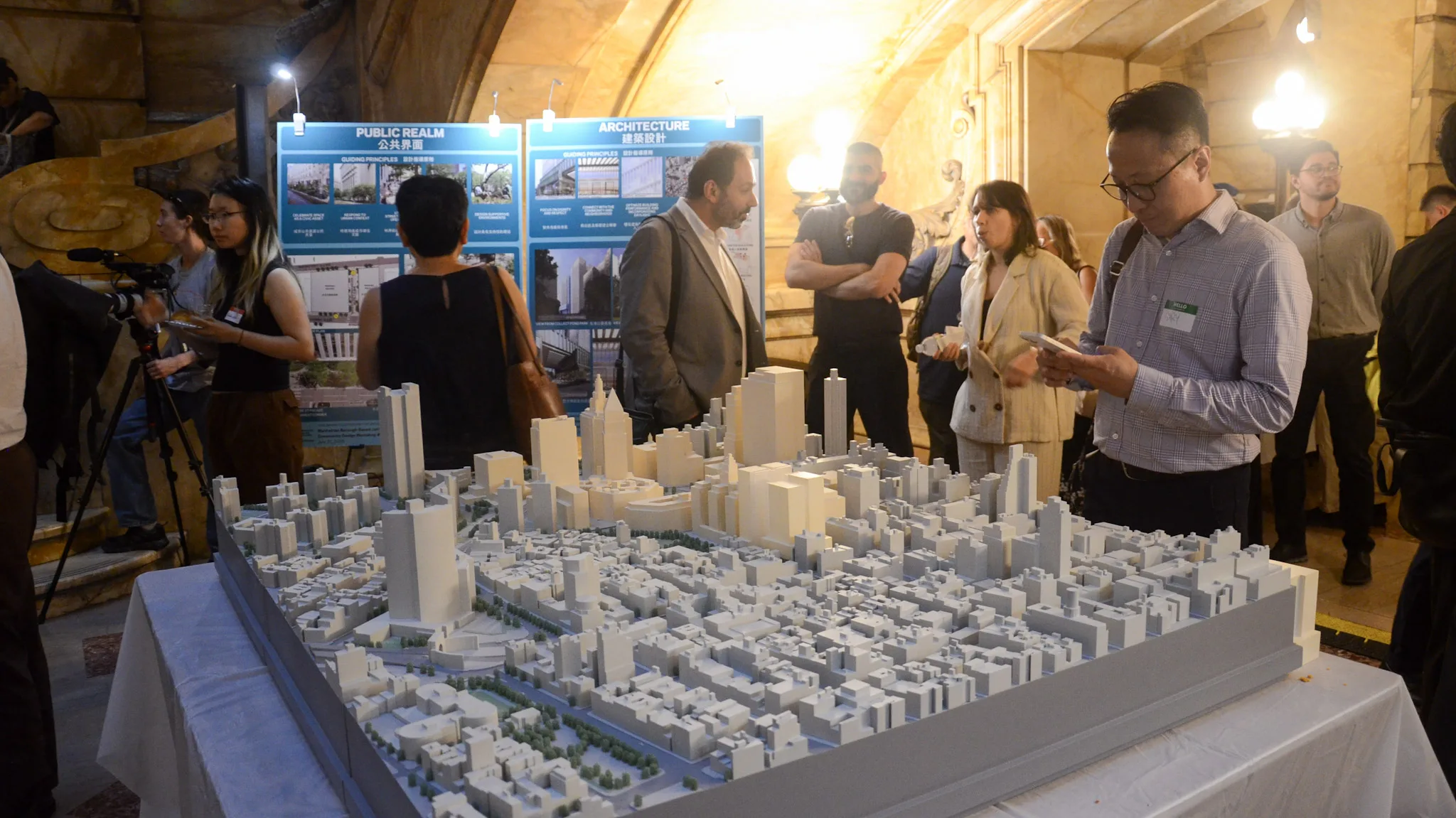


They never wanted it. They never asked for it. But last Thursday, many Chinatown residents found themselves in NYC’s Surrogate’s Courthouse, offering feedback on the design of the Manhattan borough-based jail project which is going to be built in their neighborhood after years of rallies against the proposed facility.
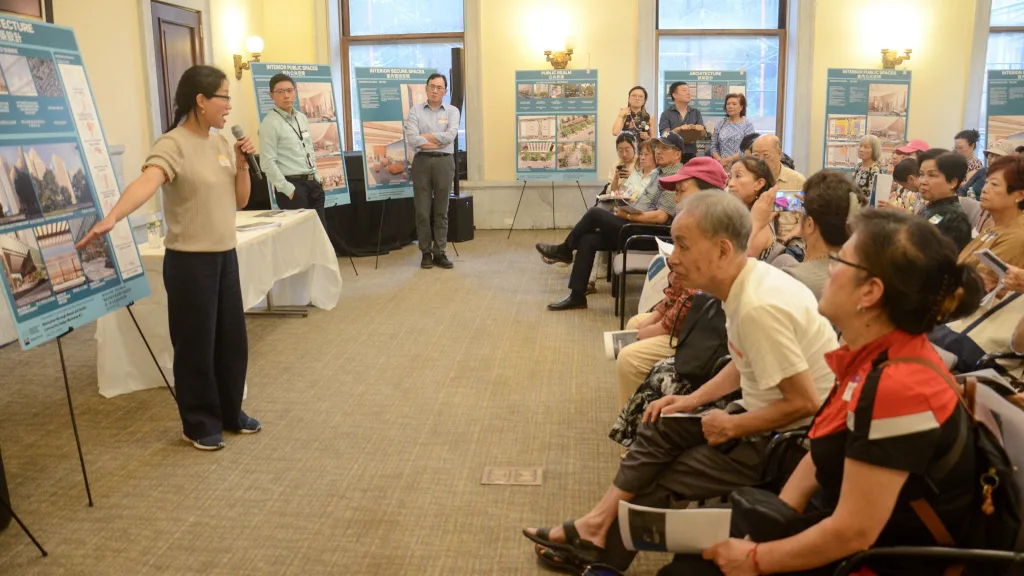
The meeting was the first community design workshop organized for the 125 White Street facility, hosted by the NYC Department of Design and Construction (DDC), contractor Tutor Perini-O&G Joint Venture, and design partner HOK.
Organizers said the workshop would be a chance for the community to share their thoughts on key elements of the jail, including the public space around the facility, its architecture, interior public spaces and interior secure spaces, before the Public Design Commission’s conceptual review this fall.
But while more than 200 residents attended the workshop inside Surrogate’s Courthouse, outside over a dozen protesters held signs against the jail project and chanted, “You’re standing on stolen land!” During the Chinese-language session following the presentation at the workshop, presenters were met with chants of “We don’t want jails!”

The borough-based jail plan was first announced in 2017 under then-Mayor Bill de Blasio as part of the effort to close Rikers Island. The proposal for Chinatown has faced consistent resistance over concerns about its impact on local businesses, residents’ quality of life, and disproportionate siting of carceral facilities.
Also Read: Chinatown’s Proposal to Create Affordable Housing — Not Jail — Gains Momentum
Two months before the workshop, community groups, including NUBC, a nonprofit community organization leading the opposition to the Manhattan borough-based jail, and elected officials made a final push for an alternative: affordable housing at the 125 White Street site and instead moving the jail to the shuttered Metropolitan Correctional Center. That effort was fruitless.
At Thursday’s workshop, Jan Lee, co-founder of NUBC, brought a 3-page list of questions covering the project’s costs, exterior design, construction logistics, and site risks. Other attendees raised public safety concerns, questioning whether there would be adequate security measures such as video cameras, sufficient lighting, and efforts to keep homeless individuals from sheltering under the pedestrian arcade at night. Still others expressed their worry about environmental impacts.
Although he remains firmly opposed to the city’s Manhattan borough-based jail plan, Lee acknowledged that the project is moving forward and is a reality that Chinatown residents like him must accept. But Lee said NUBC will continue pressing for transparency and accountability in the project.
“We will keep advancing our alternative plan […],” said Lee in a statement shared with Documented. “At the same time, NUBC will hold the City to complete transparency, an independent cost review, and clear answers on safety, scale, fiscal risk, and community impact throughout planning, construction, and operation of the megajail project, which sadly remains underway.”
HOK’s presentation featured plans for what they called a “state-of-the-art” facility with 1,040 beds, 125 below-grade parking spaces, 20,000 square feet of community and commercial space, including 5,960 square feet of retail space for Chung Pak complex, a development that provides 88 affordable senior housing units. The design also includes elements intended to integrate with Chinatown’s low-rise landscape. In designing the jail, HOK said they would prioritize natural light, outdoor access, and varied materials.
In the updated design for the new Manhattan borough-based jail, the space would operate separately from the jail facility, and the city has pledged to conduct community engagement later in the process to determine programming for the portion accessible to the community.
Following the main presentation, community leaders and members shared their views during a separate Chinese-language workshop session.
Also Read: Non-Major Crime at 20-Year High in Chinatown as City Sees Spike
“No matter how beautiful the jail is, I’m against it,” said Justin Yu, Chinatown Democratic district leader. He argued that the proposed 300-foot-tall design, set to be one of the tallest jails in the world, would be out of scale for the neighborhood and should incorporate Chinese architectural elements to better reflect Chinatown’s civic context. “Right now, I can only see it having a negative influence on the neighborhood,” said Yu in Mandarin.
HOK architect Xiaohan Wen explained to Yu that the renderings were preliminary and intended for discussion only. He said the company would incorporate community feedback when making adjustments.
“Please make sure you write this down, I’m against the jail.” said Rong Li, a Chinatown resident of more than three decades. “They should not build this here!”
Later this month, on August 26, the NYC DDC will host a Minority- and Women-owned Business Enterprises (M/WBE) informational workshop on the Manhattan borough-based jail as part of the design engagement plan. According to the plan, there will be several workshops collecting community input from now until the winter of 2027, at which point the Public Design Commission’s final review of the design of the project will take place.
Jacky Wong, a newly elected Chinatown Democratic district leader, suggested using more glass for the facility’s façade to redirect sunlight toward Columbus Park, one of Chinatown’s most popular gathering spaces. Without that, the park would likely be cast in shadow during parts of the day once the jail is built.
In response, architect Wen noted that New York City has some of the strictest construction and architectural regulations in the country. He added that many concerns raised by Wong and other attendees would already be addressed in existing laws.
“For example, we will make sure there are no blind corners around the detention center because such facilities require very high security standards,” Wen told Documented in Chinese. With regard to the façade design, he said the company would consider residents’ suggestions but must also comply with city rules: “Too much glass can create light pollution.”
Other comments reflected Chinatown’s ongoing struggles with limited space and land use, especially issues like a lack of affordable housing and a shortage of parking for residents and visitors, which were raised by several attendees.
Longtime Chinatown resident Qiaoling Chen noted that although the design includes 125 below-grade parking spaces for staff and service providers, there should be no parking under the White Street pedestrian arcade.
“For years, we’ve seen too many government staff park their cars in Chinatown,” Chen said, speaking in Cantonese. ”We don’t have much public space. This should be for residents, maybe even as a playground for teenagers.”
Chen also voiced frustration at the contrast between the jail’s amenities and local living conditions.
“Many Chinatown residents live in worse conditions than the jail you’re designing,” she said. “It’s such a nicely designed jail, even more luxurious than my home. How can you deter crime with such comfortable living conditions?”
Wen emphasized that the Manhattan facility will house pre-trial detainees, not convicted criminals. “No matter from the outside or inside, we don’t want this facility to be depressing,” he said. “We hope to create as good an experience as possible within our ability.”
As to why the community’s opposition to the jail or alternative plans were not being considered any longer, Denisse Moreno, a DDC spokesperson, said in a statement that City Council law and the city map require the closure of Rikers Island and the creation of four modern, more humane jail sites in Manhattan, Brooklyn, Queens, and the Bronx.
“The smaller borough-based jail locations were selected because they are next to/close to Criminal Courts and accessible by subway lines and public transportation, strengthening connections to families, attorneys, courts, and other social services,” Moreno said. “The new Manhattan facility is being constructed where an existing jail (Manhattan Detention Complex) was, next to the Criminal Court.”
Moreno said the Manhattan borough-based jail team will continue engaging the community through public workshops to review and give feedback on the jail’s design. She noted that the second community design workshop will be held in September. In the upcoming workshop, the city and the design-build team will summarize how previous community feedback was incorporated into the design and will collect additional feedback.
Updated August 14, 2025, 3:00 p.m.: This article was updated to include a response from DDC.