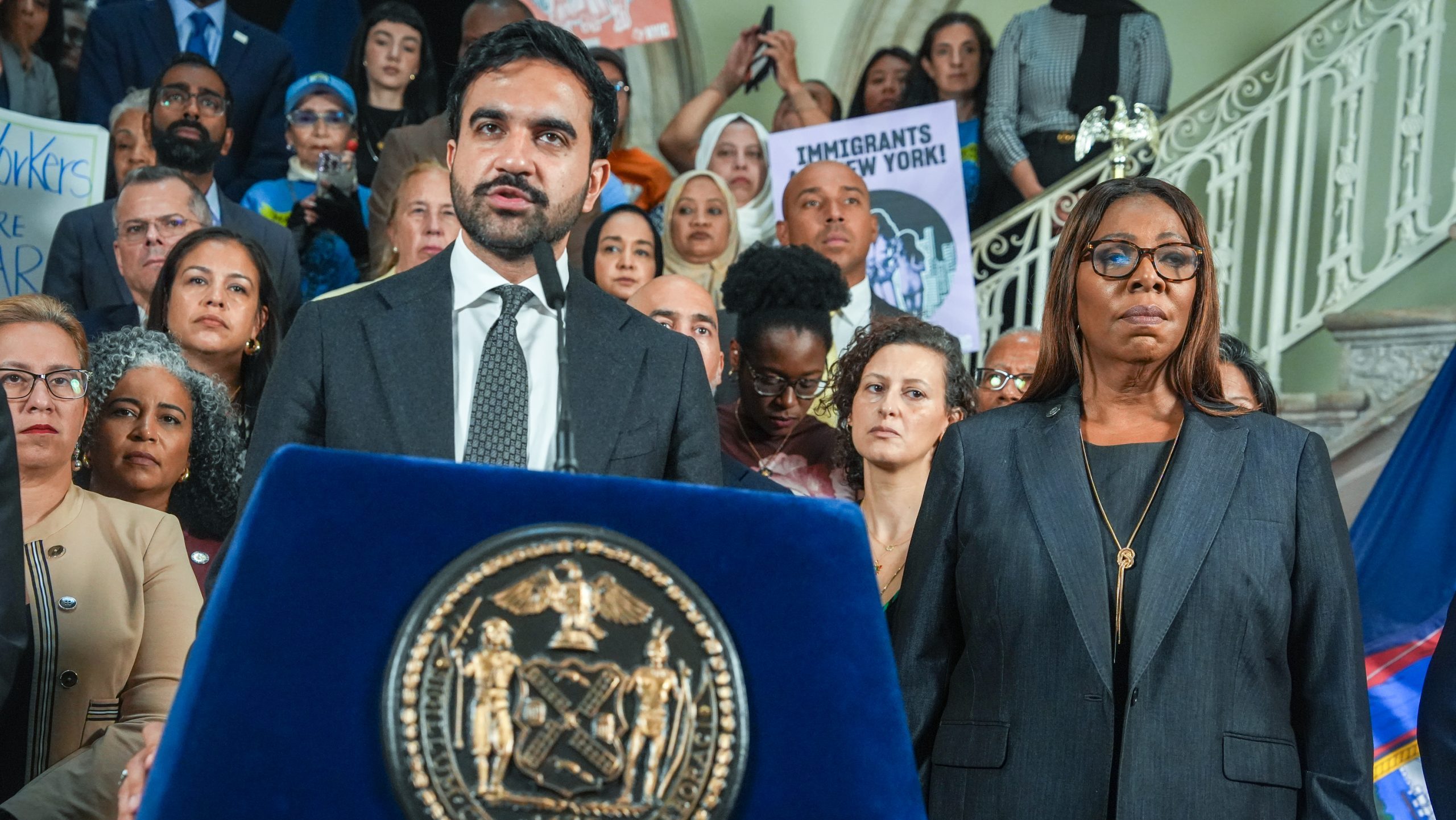


Dozens of employees of the International Rescue Committee gathered in New York City on Aug. 25 to demand a contract that guarantees living wages and strong layoff protections. Workers from offices including Elizabeth, Dallas, Atlanta, Oakland, and more were coming together the last week of August to meet with IRC management in hopes of resolving a contract dispute which has been ongoing for over 18 months.
Documented spoke with half a dozen IRC workers, who said that they want a contract which can address workplace issues that they see as placing a strain on their work of providing services for refugee communities. The strain has gotten worse under the Trump administration, with many of the president’s immigration policies impacting their clients and even their coworkers.
Taisiya N. is a caseworker at the New York City office of the IRC, a global humanitarian non-governmental organization which provides a wide range of services to refugee communities.
She works closely with immigrants who arrived in the United States after 2022 and still have not been granted asylum or temporary protected status. As a frontline worker providing services for immigrant communities, she says the impact of the Trump administration’s policies are causing shockwaves across families.

Also Read: Leading Immigrant Rights Nonprofit Make the Road Lays Off Dozens, Sparking Staff Outcry
“We see so much fear, so much worry day to day,” she said. “We the workers try to support our clients the best that we can […] but I think that it’s really challenging these days.”
The majority of her clients are families with children and who typically live in shelters, have low income, and do not qualify for public benefits such as the Supplemental Nutritional Assistance Program. She said this adds an extra level of insecurity along with living under the nation’s constantly changing immigration policies that aim to deter immigrants from coming to or staying in the United States.
The IRC works with immigrant communities in 29 cities throughout the United States, providing resettlement, asylum, and integration services.
The organization’s work spans more than 40 crisis-affected countries, has reached millions impacted by the crisis, and helped over one million youth receive educational support. (Disclosure: Documented and the IRC have a partnership to provide multilingual information and resources to New York’s immigrant communities.)
International Rescue Committee Workers Unite (IRCWU) members from across the country who spoke with Documented expressed complaints including less-than-living wages, high case loads, and little say in workplace decision-making. Despite working in a range of cities including Elizabeth, New Jersey as well as New York, Dallas, and Atlanta, they shared many of the same criticisms. As they see it, management has not responded to employees repeatedly raising these concerns, even when the workers have expressed how it impacts their frontline work with immigrant communities.
An IRCWU press release shared with Documented says, “IRC workers organized in response to unsafe working conditions, unmanageable caseloads, sub-living wages and a lack of any meaningful voice in the decision-making process in their workplace. These conditions ultimately led to IRC staff being unable to provide the quality of service their refugee and immigrant clients desperately need, especially while facing unprecedented attacks from the Trump administration.”
When asked about the contract negotiations, a spokesperson for the IRC wrote in a statement to Documented that the organization is “optimistic that we can reach an agreement and a good contract, one that is good for our staff, maintains great services for our vulnerable clients and strengthens working conditions while also ensuring the organization is sustainable, even in this challenging climate.”
In September 2023, workers at the IRC’s office in Dallas became the first at the organization to unionize with the Office and Professional Employees International Union (OPEIU), a union with more than 100,000 members across the United States and Canada. Since then, 13 IRC offices across the United States have joined the union, IRCWU.
“We love our jobs, but we still see this issue of massive turnover,” said Jodi Camino, a union member at the IRC’s Atlanta office who helps students from immigrant families receive education and succeed in school. “I’ve had clients not know who their caseworker is because they’ve had like three different caseworkers in the past three months.”
According to workers who spoke with Documented, caseload amounts and intensity vary widely depending on one’s department. Some had up to 80 to 90 clients they were expected to make weekly contact with. Others had closer to 30 to 40 monthly, but each case consisted of many steps.
Camino, who has worked at IRC since 2023, said that her office’s team which helps youth with school enrollment sees 30 to 40 cases a month. Each enrollment involves an application, an interview, and in-person screening with the county, and an in-person enrollment at each individual school.
“I have 34 active cases and all of my cases are fairly intensive and can take multiple years to close,” Camino told Documented. “A lower caseload would mean I could have a closer partnership and more frequent check-ins with families.”
As the IRC’s website explains, “the Trump administration suspended refugee resettlement, implemented a new travel ban, and eliminated crucial support systems.”
The administration has also threatened funding for progressive non-profits. In February, the administration froze funds to many non-profits that provide refugee resettlement services. An IRC spokesperson wrote to Documented that management is concerned about potential funding cuts.
“The cuts to humanitarian aid and funding have impacted the entire sector, including us. And stop work orders, and funding cancellations have impacted — and could further impact — the work of our OPEIU [The Office and Professional Employees International Union] staff, whose primary role is direct support for refugees and asylum seekers in cities in the United States.”
In response to questions, IRC management and IRC workers did not mention any specific cuts already impacting the organization, but were clear that the prospect of cuts weighs heavily on the organization and its decisions.
Camino said that this uncertainty over funding is especially hard for IRC workers.
“We are being asked to shoulder the uncertainty and the burden of if we are going to lose our jobs, or if we’ll be able to continue to pay rent,” Camino said. “Folks are being asked to take the uncertainty of if they’ll be able to provide for their families instead of IRC doing what they can to protect their staff.”
IRCWU members added that many of the IRC’s employees are immigrants themselves, and even former IRC clients. This has fueled concerns among staff such as what to do if their own immigration status is threatened or if they are caught in an ICE raid when visiting clients.
When asked about this, an IRC spokesperson replied: “IRC has measures in place to support immigrant employees who may themselves be subject to changes in immigration law and status put forth by the Trump administration.”
IRCWU members who spoke with Documented, however, expressed dissatisfaction with the level of communication.
“I’m only seeing the tip of the iceberg of the information that is provided to us, but I would like to say that I think that it is not enough,” Taisiya said.
At the August bargaining sessions in New York, the union brought up their concerns over funding and wages, protections for immigrant employees, and high case loads. They said that they left believing the union and management were on the same page and would schedule another round of meetings in September to resolve the union’s main demands. Afterward, they engaged in eight different meetings with individual locals of the union around specific issues.
Responding to a question about their approach to bargaining, an IRC spokesperson wrote, “Like most discussions for a first collective bargaining agreement covering multiple locations, these negotiations are complex discussions that take time and include a range of factors and considerations.”
IRCWU members said they had hoped to reach a contract by the end of September which marks the end of the IRC’s fiscal year. This timeline for IRC’s funding is indicated in the organization’s financial statement for the fiscal year of 2024.
While September passed without the two sides reaching an agreement, an OPEIU staff member told Documented that they had a meeting on Sept. 30 and had three additional meetings in October, and bargaining will continue in November.
All the IRC workers who spoke with Documented emphasized that despite their dispute with management, they are proud to be part of the organization. Their hope is that as a union they can improve the work environment and quality of services for the immigrant communities they serve.