

“I couldn’t buy anything. They said there was no money left in your account.” S. Lai, a 91-year-old who lives near Chinatown, was stunned when his home aide told him she was unable to purchase groceries as usual, returning empty-handed from the DC Meat Market on East Broadway on August 20.
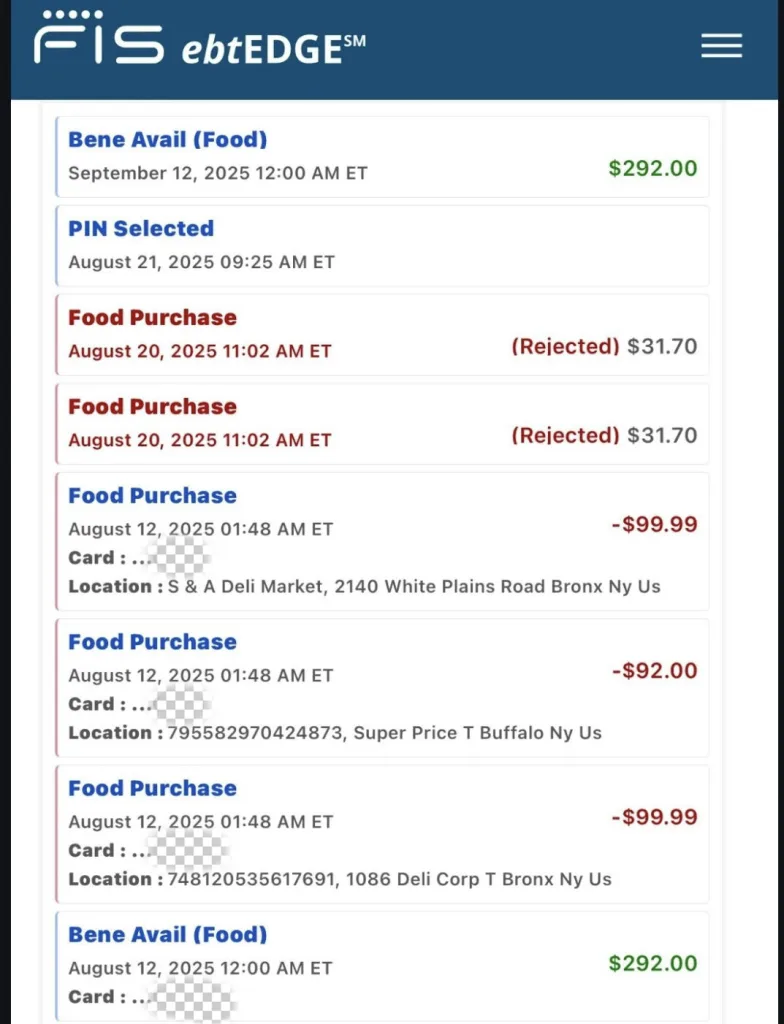
When Lai and his home aid checked Lai’s balance through ebtEDGE, a mobile and web-based app launched in May 2024 to help New Yorkers manage their Electronic Benefit Transfer (EBT) accounts, including Supplemental Nutrition Assistance Program (SNAP) benefits, they discovered his benefits had been drained eight days earlier, on August 12 — the same day his monthly food stamps were deposited.
According to transaction records, $292 in SNAP benefits was loaded onto Lai’s account at midnight that day. Less than two hours later, at 1:48 a.m., three separate transactions were made simultaneously in the South Bronx, East Bronx, and Buffalo, leaving him with only two cents remaining in his account.

Lai is just one of the latest victims of EBT card skimming, an unfortunately common and widespread form of card fraud, where thieves steal and sometimes deplete SNAP recipients’ public benefits from their accounts. In New York City, about 1.8 million residents receive SNAP benefits to help purchase food. Roughly 30% of them are seniors aged 60 or older.
Amidst the ongoing shutdown that threatens SNAP benefits, community organizations serving immigrant neighborhoods say many of these older adults like Lai, especially those with limited English proficiency, are grappling with protecting the safety net that keeps them food-secure.
According to a recent report by New York’s Department of Investigation (DOI), the volume of this fraud in New York City alone is significant: between August 2023 and March 2025, the Department of Social Services processed 142,178 SNAP reimbursement applications from victims of EBT theft, approved 96,048 of those applications, and issued $43.7 million worth of reimbursements of stolen benefits.
DOI pointed out that fraudsters steal EBT benefits by capturing a recipient’s card information via devices placed surreptitiously on card-reading machines, such as ATMs or point-of-sale (POS) terminals, then they replicate the stolen information to make counterfeit cards, use the data to make unauthorized purchases, or withdraw money from the cardholder’s account.
In just the first six months of this year, from Jan. 1 to June 30, the Office of Temporary and Disability Assistance (OTDA), which administers SNAP in New York, received reports of a total of $14.5 million in stolen SNAP benefits statewide, according to City Limits.
Seniors Hit Hard by SNAP Thefts
“We received about five to ten reports of SNAP theft every week, most of the victims are seniors,” said Mathew Mui, English secretary of the Chinese Consolidated Benevolent Association (CCBA), one of the oldest community organizations in Chinatown. Mui said CCBA works with other groups, such as the Chinese-American Planning Council, to help eligible seniors apply for food stamps each week, but recently, more seniors have been seeking help after discovering their SNAP accounts had been drained by fraudsters.
Homecrest Community Services (HCS), a Brooklyn-based nonprofit providing social services to southern Brooklyn residents, including Chinese immigrants, has seen many of its elderly members fall victim to SNAP benefit theft.
A. Huang, an 82-year-old Chinese member of HCS, said his benefits were stolen twice since last September before he learned to use the ebtEDGE app’s “Freeze Card” feature, which allows cardholders to temporarily disable their cards to prevent unauthorized purchases or PIN changes.
“The thefts happened so quickly, usually around midnight, not long after the benefits were loaded onto my account,” Huang recalled, adding that several of his friends have also experienced SNAP benefit thefts. “When it happened, we had to cut our food budget that month, buy less, eat less,” he said in Mandarin.
Lisa Zhen, director of social services at HCS, said the app’s new feature, which blocks out-of-state transactions, has helped reduce unauthorized EBT card use outside New York. However, she says she continues to hear from elderly community members whose benefits were stolen within the state or city.
“It has a big impact on seniors. Many feel frustrated, especially when they have to turn to food banks as an alternative food source after the program that allowed a limited replacement of skimmed benefits ended last December,” Zhen said.
She added that while the app’s security updates are helpful, many seniors still struggle to navigate them. Homecrest has hosted workshops teaching older users how to use the ebtEDGE app, including setting up facial recognition to make logging in easier. But Zhen said many still return repeatedly with questions or technical issues.
“Some seniors rely on their children to help them shop for food,” she said. “But when their children are out of town, they lose an important source of support.”
Also Read: SNAP Cuts From ‘Big Beautiful Bill’ Threaten Chinatown Businesses
Seniors from other communities have also felt the devastating impact of SNAP benefit theft. In June, Legal Services NYC filed a lawsuit on behalf of seven individuals and one advocacy group in the U.S. District Court for the Southern District of New York, accusing OTDA of failing to protect recipients from widespread electronic theft known as “skimming.”
Among the plaintiffs is Anna Gelman, a 90-year-old Brooklyn resident who lives alone and her $292 monthly SNAP benefit is an important income source for her to buy food. Because of a pacemaker, heart arrhythmias, and severe arthritis, Gelman has limited mobility. She lost her food assistance last December due to SNAP theft and had to cut back on food purchases, unable to celebrate Hanukkah as she usually does, according to court filings.
“What I’ve seen frequently at this point now are people who are really on top of the actual hunger. They’re afraid. There doesn’t seem to be any hope. And people get their benefits stolen month over month, and there’s no remedy,”said Jack Newton, an attorney in the Public Benefits Unit at Legal Services NYC’s Bronx office. He noted that recently, the organization has been receiving more than 100 reports of SNAP thefts each month.
Newton said many seniors now spend all their benefits on the first day they’re loaded, out of fear the money will be stolen later. “That’s no way to live,” he said. “It really sharply reduces people’s choices and their access to quality and nutrition for themselves and families.”
The lawsuit argues that OTDA’s current protections, including the ebtEDGE app’s Freeze Card feature, are insufficient. The feature, the filing says, “does not completely stop skimming or EBT theft” and is “difficult or impossible to use” for recipients who lack internet access, have limited literacy, or do not read English or the few other languages supported by the app.
A Slow Fix
Advocates, lawmakers, and community groups have long called for stronger EBT card security measures, particularly the adoption of chip-enabled cards, similar to modern debit and credit cards.
Currently, California and Oklahoma lead the way in EBT modernization. Last November, the U.S. Secretary of Agriculture urged all states to transition to chip cards “as soon as feasible.” In New York, two State Senate and two Assembly bills introduced earlier this year would require OTDA to adopt chip technology. But State Senator Roxanne J. Persaud, chair of the Senate Social Services Committee, said the legislation has stalled.
“We couldn’t get it moved,” Persaud said. “We’re working on it again for the upcoming session. That’s our priority.”
Persaud cited high implementation costs as the biggest obstacle. “You’re asking that every existing card be reissued, manufactured, and coded,” she said.
OTDA has not only estimated that implementation would cost at least $40 million in the first year, but the FY 2026 state budget did not include funding for the transition either. The USDA announced this February that it would reimburse states for 50% of the administrative costs of switching to chip-enabled EBT cards. However, under the SNAP provisions of the One Big Beautiful Bill Act, the share has been reduced to 25%, beginning in fiscal year 2027.
Law enforcement agencies have also stepped up efforts to combat EBT skimming. In early October, the U.S. Secret Service, working with local and federal partners, inspected 943 businesses across New York, removing 65 skimming devices from ATMs, gas pumps, and point-of-sale terminals. The agency said the operation prevented an estimated $67.8 million in losses. A similar sweep in May uncovered 55 skimming devices.
Still, the New York City Department of Investigation (DOI) said in a recent report that authorities still face “significant obstacles” in protecting SNAP beneficiaries. Because skimming can occur remotely and often immediately after funds are loaded, it is difficult to identify compromised cards and locate the skimming devices in time. By the time thefts are detected, crucial surveillance footage is often no longer available, and perpetrators can retrieve skimming devices before law enforcement intervenes.
DOI recommended that OTDA transition to chip-enabled EBT cards and introduce new safeguards, including real-time transaction verification, automatic text alerts for PIN changes, and alerts for late-night repetitive transactions. The report also called for continued public education and collaboration with law enforcement to remove skimming devices.
“OTDA takes any report of benefit theft seriously and remains committed to protecting New Yorkers’ benefits from scammers,” Darren O’Sullivan, an OTDA spokesperson, said in a statement shared with Documented. He encouraged users to monitor their accounts, use the Freeze Card feature on the ebtEDGE app, and change their PINs regularly.
The agency also reminded the public that it will never send text messages asking for personal information. Anyone uncertain about the legitimacy of a request related to SNAP or EBT should contact their local department of social services.
OTDA has issued a request for proposals for a vendor that can supply both magnetic strip and chip-enabled EBT cards, which will help the agency assess costs and logistics. However, it’s unclear when chip cards might be introduced.
For many families, the delay feels costly. Michael Lau, a retired NYPD officer who spoke on behalf of his elderly father-in-law, Lai, said replacing lost benefits would mean far less than preventing the thefts altogether.
“I don’t know how much that [replacing cards] costs, but versus my father-in-law losing $292 that’s never coming back, even if you were to deduct the amount that the card costs on these accounts, I think most people will be happy to do that to feel safe,” said Lau.
Lau said the government should take immediate action to address the ongoing EBT card thefts and to provide more in-language education for seniors in immigrant communities on how to protect their benefits.
“I think the greater cause is the damage and harm that’s been done to all these seniors. My father-in-law has a safety net, he has his children to rely on, but there are plenty of people out there that don’t, what do they do? […] The bottom line is to make sure that these people have enough to survive.”
Additional resources on how to recognize and avoid EBT scams are available at otda.ny.gov/ebtscam.