

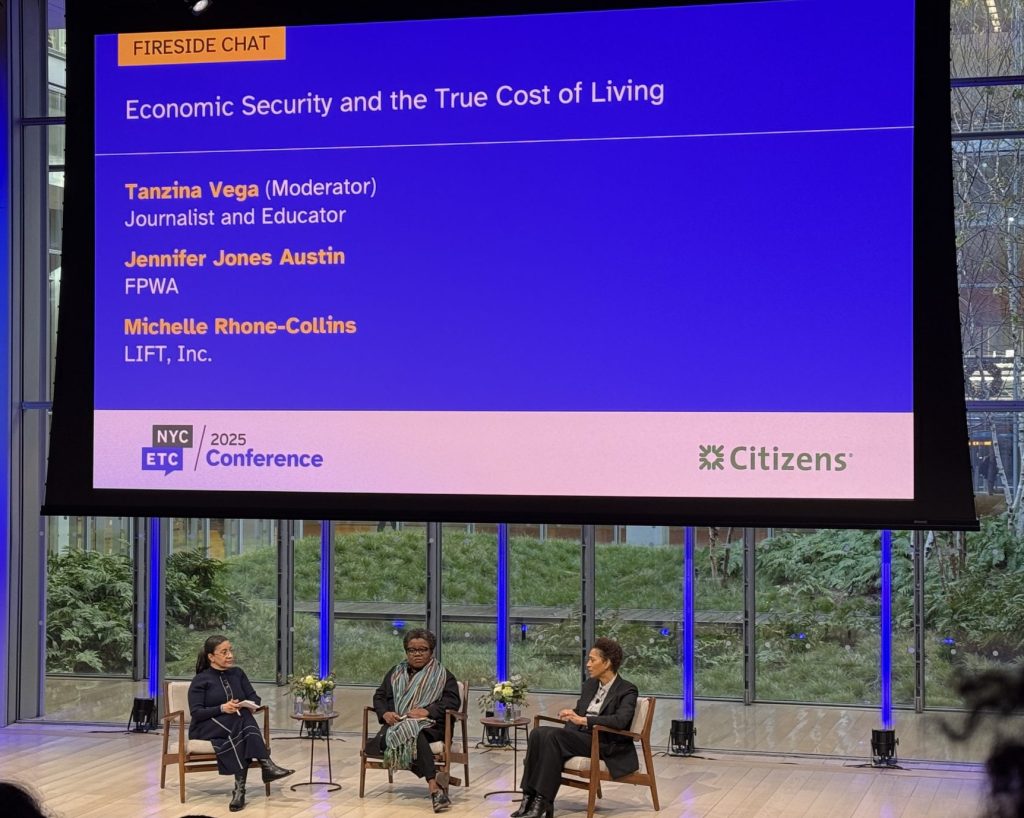
Most New Yorkers work day in and day out to meet basic costs — from rent and groceries to healthcare. As the city prepares for a new administration, the New York City Employment and Training Coalition (NYCETC) convened leaders from across sectors to urge the Mayor-elect Mamdani to address cost-of-living and affordability issues by finally aligning economic and workforce development — two systems they say have long operated in isolation while working families continue to fall behind.
Speakers argued that economic growth depends on accessible job training, continuous support and clear pathways into good-paying jobs, especially for Black, brown, and immigrant workers. They want incoming Mayor Mamdani to treat these fundamental workforce investments as core infrastructure, just like housing and transportation — and ensure that when the city builds new industries and opportunities, the people who live beside them can actually share in that prosperity.
“Affordability doesn’t exist without a strong workforce system.” Gregory J Morris, NYCETC’s CEO
“Affordability doesn’t exist without a strong workforce system,” said Gregory J Morris, NYCETC’s CEO and a member of one of the Mayor-elect’s new transition committees, at the conference’s opening on Tuesday. “A strong workforce system cannot exist without affordability. The two rise and fall together.”

Research presented at the conference showed that 62% of New Yorkers are economically insecure, a statistic that includes many families earning well above the federal poverty line. FPWA CEO Jennifer Jones Austin described that threshold as disconnected from reality, noting that it “willfully undercounts” what people need to survive, including the actual cost of housing, childcare, and daily necessities.
Voters echoed that frustration when, in 2022, they approved a ballot measure requiring the city to publish a True Cost of Economic Security — a metric meant to reflect not just basic necessities but what families need to achieve real economic stability.
But even strong unique workforce programs aren’t a silver bullet solution given the city’s fractured system. “We don’t have one workforce system in New York City. We have several,” Morris said, describing how a structural maze of agencies and programs often duplicate services in some areas and leave glaring gaps in others. “If we’re going to make sure that the city is an affordable one, we need to both figure out how we raise wages while we compress the costs of things.”

Immigrants comprise almost half of New York’s labor force
Maria Torres-Springer, co-chair of the mayoral transition team, said the city must design programs with consistent input from workers they are meant to serve, many of whom are immigrants. To do so, the city must communicate in the right languages and partner with trusted messengers. “It’s … about making sure that they are not an afterthought,” she said.
Immigrant communities, which make up 44% of New York’s labor force, feel these barriers most acutely. They’re the “the backbone of our city,” said Morris, adding that “too few of our immigrant community members are getting access to the resources, services, [and] wages that they have earned.” New York needs to “fight back”, he said, or it “won’t be able to find its footing.”
“If we don’t invest in housing and in workforce development, then what we’re paying for downstream are the cost of someone being in a homeless shelter, the cost of someone being in the criminal justice system,” Torres-Springer said. “That is far more expensive than what it costs to make the upstream investments.”
Speakers say the city must design programs with worker input
Speakers noted that the upcoming administration has a unique opportunity to finally link economic and workforce development as the dual keys to affordability, and that civic society needs to organize to build understanding and demand. Several argued that progress also depends on repairing the city’s internal machinery, the “plumbing” of the system — updating technology and reducing bureaucracy around procurement, contracting, and payment systems — so that good ideas don’t rely on heroic workarounds.
[Reflecting the scope of some of these challenges, Documented created and regularly updates a comprehensive wage theft monitor in English, Spanish, and Chinese. And just this week, three New York-based nonprofits launched reclamo.ai — a new effort to advise workers dealing with wage theft and support them in recovering stolen wages.]
Despite the scale of the challenges, speakers expressed cautious optimism. The clarity of the affordability agenda, Torres-Springer said, is a “game changer,” offering the city a chance to “stabilize costs by stabilizing lives and increasing earning power.”