


The weeklong hunger strike by 15 elderly immigrant home care workers to end 24-hour shifts in the home care industry is coming to an end.
The workers said they reached a deal with City Council Speaker Julie Menin on Wednesday night, during which they claim her office promised to introduce the No More 24 Act to a vote by May 14. Although workers, who are part of the Ain’t I a Woman?! campaign, hoped that the speaker would introduce the bill sooner, they are willing to pause their hunger strike.
“She has promised to submit the bill to a vote by May 14,” Xue Zhen Chen, a 62-year-old home care worker who had been on the hunger strike, said Thursday. “This is an excellent outcome, one truly worthy of celebration. Yet, as the saying goes, the revolution is not yet complete.”

The bill, which promises to end 24-hour work by pushing agencies to split shifts, would still face an uphill battle in the City Council. Opponents including the Legal Aid Society and disability advocates argue it targets home care agencies without adjusting the Medicaid rules around live-in care, which could adversely affect patients whose insurance would not cover the costs if care were split into two distinct 12-hour shifts.
The home care workers may also run into challenges from the speaker herself.
In a statement to Documented, Menin’s office denied it had struck such a deal with home care workers, saying that no promises were made about specific dates, and that conversations remain ongoing as the bill goes through the legislative process. “The Council has sent an updated version of this bill to the mayoral administration for review, and we remain in constant communication with stakeholders throughout this process,” Benjamin Fang-Estrada, a spokesperson for Menin, said.
Zishun Ning, a member of the Chinese Staff and Workers’ Association that helped organize the hunger strike, refuted these claims, saying the speakers’ staff did indeed promise hunger strikers on Wednesday that the bill would be submitted for a vote by May 14. Three others who were in the room corroborated that claim.
If Menin fails to introduce the bill or doesn’t honor what they view as an agreement, the home care workers say they are prepared to resume their hunger strike on May 15.
“We will hold her accountable,” Ning said.
City Councilmember Christopher Marte, the bill’s chief sponsor, said he was optimistic about the latest developments.
“After a productive meeting with the Speaker’s office and the Ain’t I a Woman?! coalition, I’m confident we are on the right track to pass this bill as soon as possible,” he told Documented in a statement.Menin did not immediately respond to a request for comment on whether she would introduce the bill in May.
Since April 16, the workers, who are predominantly women, have camped outside the iron gates of City Hall, wearing red bandanas, and braving the cold, wind, and rain. At great risk to their health, the workers refused to eat until Menin introduced the No More 24 Act to a vote. The bill promises to end the practice by pushing agencies to split 24-hour care into two distinct 12-hour shifts.
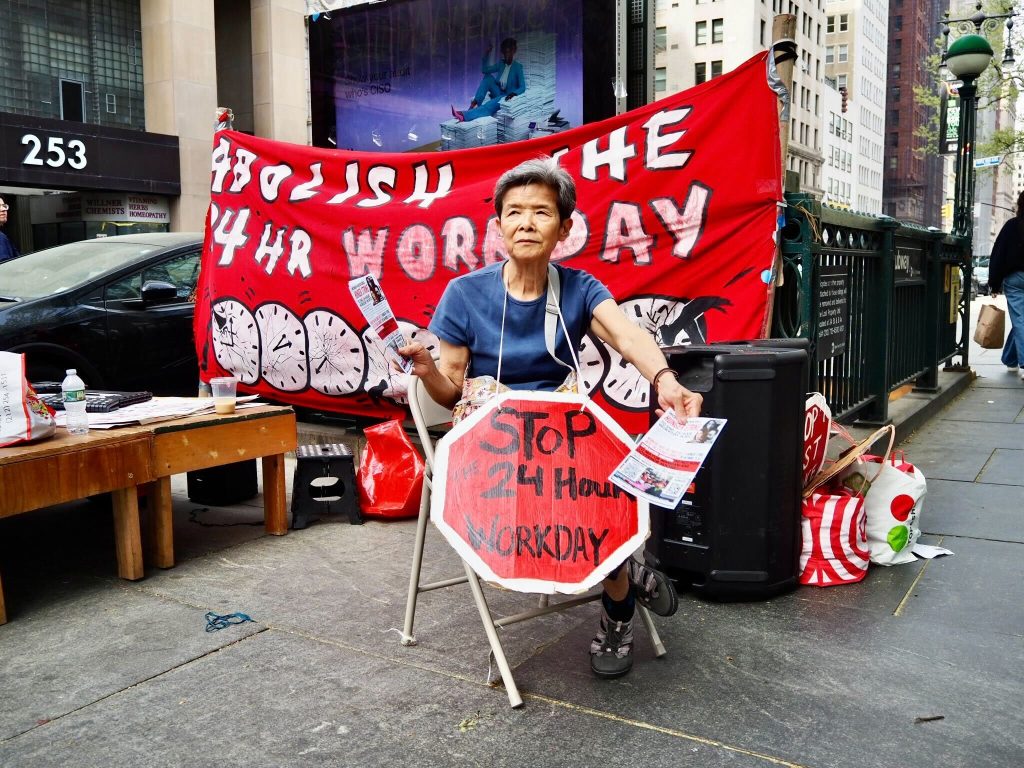
Inside City Hall, lawmakers faced pressure from multiple fronts. According to a source with direct knowledge of the situation, Speaker Menin planned to introduce the bill, which has 16 co-sponsors, only after the New York state budget is passed in Albany, which is more than three weeks late. The logic behind the move, according to the source, is that once the state budget is passed, there won’t be a risk of Gov. Kathy Hochul withholding the expected increase in Medicaid costs that could accompany the bill. Menin’s office declined to comment on its timeline to reintroduce the bill.
The home care workers had hoped that their hunger strike would gain the same momentum as the successful 15-day hunger strike launched by yellow cab drivers for medallion debt relief in 2021, which helped launch Mayor Zohran Mamdani’s political career.
Before the hunger strike, the bill to ban 24-hour shifts seemed all but assured in March, with both Menin and Mamdani voicing their support. But disability advocates and groups like the Legal Aid Society expressed their opposition before the bill could come to a vote. If passed, the bill would split home care work into two distinct shifts and cap worker hours at 56 hours per week. Opponents argue that the change would negatively impact disabled people who require live-in care, as the change to distinct shifts would no longer qualify them for coverage under the state’s existing Medicaid law.
Menin had initially promised home care workers that she would introduce the bill for a vote by April, but missed the April deadline after sources told Documented she received pressure from the mayor’s office, prompting the hunger strike. Behind-the-scenes, Gov. Hochul had also pressured Menin to withdraw the legislation, threatening to withhold Medicaid funding to the city, sources previously told Documented. The speaker’s office has declined to comment when asked by Documented if Menin was delaying introducing the bill because of pressure from the governor.
Other lawmakers are also getting cold feet. According to the source familiar, Councilmember Sandy Nurse, who co-sponsored the bill, has withdrawn her support. When asked about Nurse withdrawing her support by Documented, the councilmember’s office declined to comment for this story.

Jonah Allon, Deputy Communications Director for Health for the Governor’s office, declined to comment about any pressure the governor was exerting to stall the bill, and stressed Hochul’s commitment to home care workers.
“Our home care workers play an invaluable role in the lives of New Yorkers, and that is why Governor Hochul has made unprecedented investments in home care wages, increasing the minimum wage for home care aides, and securing $13 billion for home care wage increases since 2023,” he said in a statement to Documented. “Governor Hochul is committed to ensuring our workers receive any wages they are owed.”
At the center of the bill’s controversy is whether the city has the authority to abolish 24-hour home care shifts or if it should be done at the state level.
The city bill, introduced by Councilmember Marte last December, would abolish 24-hour work in the home care industry by splitting overnight home care hours into two distinct shifts and capping the total number of hours home health care aides can work at no more than 56 hours a week. Agencies found to be retaliating against workers for refusing to work 24-hour shifts would be fined $500 for each violation not involving termination. If a worker is terminated as a result of refusing 24-hour shifts, the agency would be fined $2,500 for each violation.
Abolishing 24-hour shifts within New York City comes after a similar bill failed to pass in Albany in 2022.
Medicaid governs authorization of 24-hour home care at the state level. Opponents of the city legislation argue that the bill would negatively affect disabled patients, as it targets home care agencies but doesn’t include the ability to automatically convert 24-hour live-in care into two district split-shifts. If an insurance plan has only authorized live-in 24-hour shifts, a home care agency would not be legally able to bill Medicaid for split shifts, the opponents claim.

“Unfortunately, this bill doesn’t resolve the issue, and it also doesn’t take into account the needs of the people with disabilities who rely on this care,” said Rebecca Antar, director of the health law unit at the Legal Aid Society. “By just telling home care agencies that they can’t schedule these shifts, it doesn’t change the authorization for care from Medicaid. So they can’t just change the authorization by banning the shifts.”
If the law is passed, according to Antar, it would force home care agencies to either comply with the state Medicaid mandates and face potential fines from the city for noncompliance, or follow the city’s law and face losing their Medicaid contracts. For the system to change, it would have to be done by the state.
“The bill isn’t paid for,” Antar said. “This change needs to happen in Albany. It requires a policy change in Albany that requires funding for the additional hours of care.”
Councilmember Marte pushed back against that argument, saying that the bill would only codify trends that are already occurring in the home care industry.
“Today, most agencies no longer assign 24-hour shifts, and we have not seen the industry collapse or a Medicaid funding crisis,” he said in a statement to Documented. “What we have seen is home attendants able to stay working as home attendants, instead of being forced into early retirement because of brutal working conditions. We have seen improved patient care, as patients receive true 24-hour care by workers who are not deprived of sleep and time at their own homes.”

As lawmakers debated the merits of the bill, home care workers like Raulina Duran, 68, were determined to continue the hunger strike until the bill was passed. Duran, who is originally from the Dominican Republic, has worked 24-hour shifts for 14 years. A breast cancer survivor, she said she is putting her life on the line to prevent additional harm to the next generation of home care workers.
“Having to work those hours destroyed my health,” she said. “I don’t want my daughter to go through what I went through.”
Because many of the workers have other health issues, volunteer healthcare workers provided them with daily health monitoring to ensure they were physically able to continue the strike. Many of the 15 striking home care workers said they suffered from diabetes, cancer, and high blood pressure.
Collectively, the workers wore red bandanas around their foreheads, a historic symbol of labor solidarity that dates back to the West Virginia Coal Wars of the 1920s.
For Chinese home care worker Cai Qiong Liu, 69, who suffers from high blood pressure after 18 years of working 24-hour shifts, she said she is in the fight for the long run. For her, the hunger strike sent a message to those in power that the workers are willing to put their lives on the line.
“I want to make a point that we are risking our health, our lives,” she said.
Update, April 23, 2026: This post has been updated to include comment from the office of City Council Speaker Julie Menin.
Correction, April 23, 2026: An earlier version of this article and two photo captions misspelled the names of two of the home-care workers on hunger strike. They are Cai Qiong Liu and Raulina Duran.