

When he first arrived at John F. Kennedy International Airport in 2015 as a 28-year-old, G already knew that he wanted to be a nurse, a dream that first formed back in his homeland of Nepal.
“I always wanted to serve my community,” he told Documented.
In 2024, that dream became a reality. After years spent making a living as a restaurant worker, G graduated with a nursing degree from LaGuardia Community College and began taking care of patients at a nursing care center. The temporary protected status (TPS) offered to people from Nepal following a devastating earthquake had allowed G to legally work in the country, pursue his education, and get access to medical insurance.

Yet, barely a year into serving his community as a healthcare worker, the federal government terminated the TPS status of G and more than 7,100 other people from Nepal who were residing in the United States. G and many others not only lost their jobs, but also access to healthcare and the ability to move freely or seek new employment elsewhere.
As part of President Donald Trump’s sweeping immigration crackdown, the Department of Homeland Security last June terminated the protected humanitarian status offered to people from Nepal, Honduras, and Nicaragua, removing their ability to work, access to healthcare, social security benefits and the right to lawfully reside in the country. The decision affected the more than 60,000 immigrants from those three countries that lived in the United States under the TPS designation.
The Trump administration also terminated the TPS designation of a host of other countries, such as Haiti, Venezuela, Ethiopia, Afghanistan, and Syria, jeopardizing access to employment and healthcare, and the immigration statuses of more than 1.2 million people.
Nepal was first offered the TPS designation in 2015, when the Himalayan country suffered its worst climate calamity in recent history in the form of a 7.8 magnitude earthquake, which killed nearly 9,000 people.
G, who did not give his full name for fear of retribution, was in Kathmandu at the time. He remembers the economy collapsing after the natural disaster, which made him leave the country and migrate to the U.S. to pursue his dream. But since last June, his American dream has been nothing like he had imagined.
“It has been difficult for the last year. I stopped working for a few months after the TPS decision came. I am working now, but I am not able to go to work every day. It is scary to step out of the house,” he said.
The DHS’s decision to terminate the temporary protected status of the three countries was challenged in court by the National TPS Alliance (NTPSA), an advocacy group that seeks to protect the rights of TPS holders. In December, a Northern California district court ruled that the Trump administration’s decision to terminate TPS designations for immigrants from Honduras, Nepal, and Nicaragua was illegal, and it restored protections for those TPS holders. The government appealed the decision, and in March, the Ninth Circuit Court of Appeals allowed the government to implement the TPS termination, while placing a hold on a final decision until the U.S. Supreme Court delivers its rulings on TPS statuses of people from Syria and Haiti.
Last week, the Supreme Court heard arguments on behalf of Haitians and Syrians, with judges reportedly appearing to be divided about which way they are leaning. Reports suggest a judgment on the consequential case is expected from the conservative majority court by the end of June.
In its order last year, the DHS had said that Nepal no longer met the conditions for its designation for TPS. But in September, less than three months after its TPS designation was stripped, the country underwent its biggest political upheaval in decades. The country’s youth were on the streets protesting against corruption, its entire government resigned, and its parliament was set ablaze by protestors. The country elected a new government last month.
37-year-old Prakriti and her husband began making plans to return to Nepal, after their TPS statuses were terminated. At the time, the two were living in Florida with their two children.
“We started looking for jobs in Nepal. And for our son, we were searching for services in Kathmandu,” said Prakriti, who didn’t give her full name due to concerns about her safety. Her 5-year-old son has autism and has environmental allergies that require specialized medical attention.
But the current political circumstances in Nepal made Prakriti think twice about moving back.
“We were scrolling every day on LinkedIn and talking to our relatives, looking for jobs. But there were no jobs due to the political situation,” she said. “We also did not find any health service that could match the level of help my son is used to in the U.S.”
Prakriti and her husband are both software engineers. They came to the United States in 2008 on student visas from Nepal. Since the birth of their first child, Prakriti has focused her time on taking care of her children while her husband continued working. After the termination of their TPS status, however, her husband lost his job, meaning the entire family lost their health insurance.
“It was becoming extremely expensive to continue living in Florida. And news about ICE arresting TPS holders whose status has been terminated was also causing a lot of anxiety,” Prakriti said. Florida is among the states with the highest numbers of ICE arrests in the country in 2025.
In November, they moved to Rhode Island with their children. “The rent is more affordable here, and healthcare is more accessible,” she said.
But the fear of ICE arrests and not being able to work and earn still induces a lot of anxiety. “We are basically surviving on our savings currently,” she said.
On the West Coast, 40-year-old Aarti, who asked to be identified with a pseudonym for safety reasons, is six months pregnant. “I hadn’t seen a doctor until last month. But since it’s been six months, I had to see a doctor to make sure my health is safe for delivery,” she said. Aarti took help from community groups and friends who helped her arrange a private visit to a doctor.
Before her TPS status was terminated, Aarti worked at a hospital in San Francisco as a nurse, after coming to the U.S. in 2007 as a student. She is also the sole source of income for the rest of her family, who live in Kathmandu.
“Even before my TPS was terminated, I had stopped going out after seeing all the news about ICE arrests,” said Aarti, who used to go on hikes every month. It has been over a year since she last went on a hike, due to fear of ICE arrests.
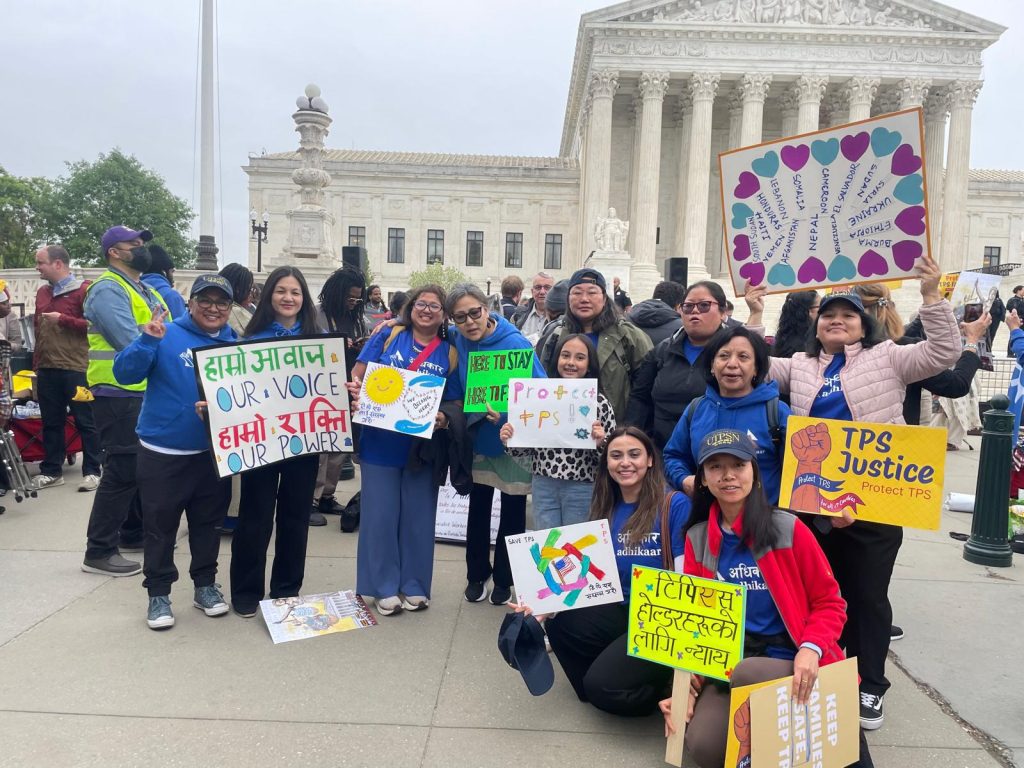
Aarti’s concerns are felt across the Nepali community, some of whom had to face the harsh consequences of the federal administration’s crackdown. “From what Adhikaar has heard,hundreds of people from Nepal have been deported already And at least a handful used to be TPS holders,” said Tsering Lama, an organizer with the New York-based Nepali advocacy group Adhikaar, which was among the groups Aarti sought help from to be able to access healthcare. Aarti, G, and Prakriti are all members of Adhikaar.
Among those deported were many who were trying to adjust their immigration status after the government terminated TPS, Lama said. “But a majority of the Nepali people who were deported were newer undocumented folks who came to the country recently.”
In Woodside, Queens, in New York, 63-year-old Shiva, also a member of Adhikaar who asked to be identified with a pseudonym, used to work as a security guard. Before migrating to the U.S. in 2008, he was a farmer in Lamjung, in central Nepal. But in 2008, when the country went into turmoil as it transitioned from a monarchy to a democracy, his family was threatened by political violence in his village.
“Our lives were in danger and it was too risky to continue living there. There was no work,” he told Documented in Nepali. He decided to move to the U.S. and seek asylum while being hired by a security firm. His asylum petition was denied by a district court in 2012, which he appealed. In 2015, he was able to apply for and receive the TPS status offered to Nepalis. But last year things changed.
“Since 2024, my health has been worsening and doctors told me my kidneys are functioning only at 60 percent,” said Shiva, who underwent a kidney transplant in 2016.
He had already left his security job due to his health in early 2025, and started to look for new jobs. But the abrupt termination of his TPS status meant that the prospects of finding any employment became dire.
“My savings are about to end, and social security and food stamps have become extremely unreliable. It has become really difficult for me here,” he said. Although he has been able to see doctors through NYC Cares, New York City’s low-to-no-cost service healthcare program, having to cut corners has worsened his health. And the uncertainty has only added additional harm.
“The legal pathways available are frankly quite limited,” said Raheen Zaman, a New York-based attorney who has represented TPS holders including Nepalis. “No one here is safe, not even U.S. citizens and nothing can guarantee anyone’s safety. Because what the government is doing is increasingly creating criminalized categories.”
At the heart of the termination of TPS status for hundreds of thousands of people, Zaman believes, is stripping away the means of livelihood of people. “Right to work is at the center of your life. These terminations have rendered hundreds of thousands of immigrants undocumented, stripping away their livelihoods,” she said.
Meanwhile, G still has hopes that the court will act to protect the legal statuses of Nepalis. But he is worried about what might be lost until that happens.
“We are free but we don’t have any freedoms. It’s really weird because the U.S. is a free country and we technically have freedoms in this country,” he said.
“But what freedoms will we have if we are treated like criminals?”