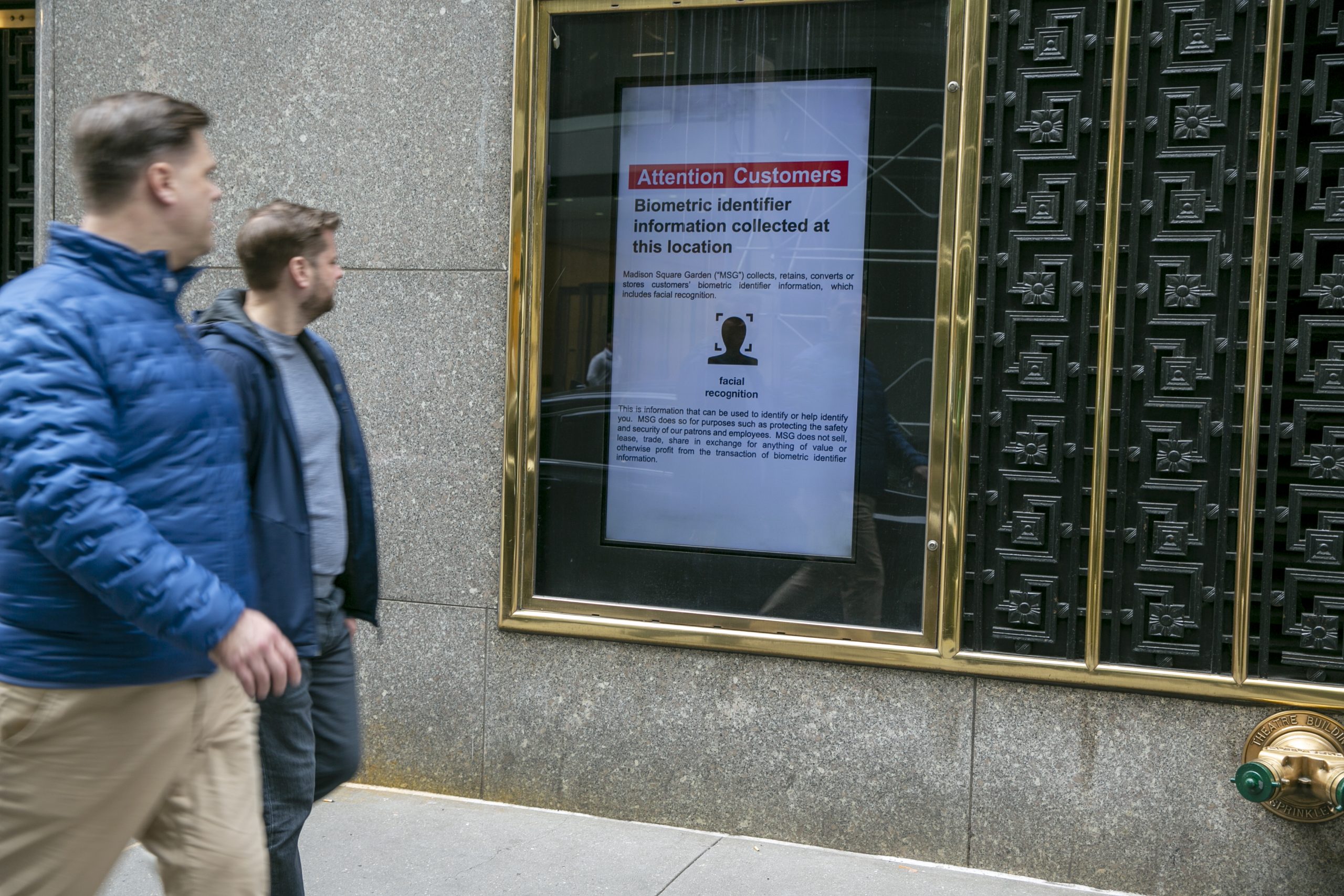


In January, signs appeared at a Wegmans in Manhattan, notifying customers the company would collect, store and share “customers’ biometric identifier information” including their faces, voices and eye scans.
Not far from Wegmans, a newly redesigned 42-story tower in the Financial District offered its prospective tenants the opportunity to enter their home “effortlessly with facial recognition technology.”
As biometric identification becomes more commonplace in New York, private companies are more easily able to collect data on New Yorkers’ lives – and advocates and some elected officials believe this should stop. They fear the information, which includes individuals’ faces, names and voices, could land in the hands of law enforcement agencies, including U.S. Immigration and Customs Enforcement, or hackers, either intentionally or through data breaches. (Neither Wegmans nor the nearby residential building responded to a request for comment.)

“We don’t know where any of this information is going,” said City Council member Shahana Hanif, who represents the 39th district in Brooklyn. “That, paired with the ways in which ICE is operating and the ways in which AI is being introduced into our lives, means we need to be having a conversation about how we regulate these technologies.”
Facial recognition is marketed as a contactless convenience that keeps prices low for consumers. “Retail theft and shoplifting have a high rate of repeat offense and drive up grocery costs for all customers,” the supermarket chain Fairway claimed in a statement to Fox News. And residential buildings pitch the technology as a way to keep tenants safe.
But for immigrants, the underregulated expansion of facial recognition technology across New York City poses a unique threat, advocates say.
“These businesses may think it’s only about shoplifting,” said Marina W, who co-leads the Democratic Socialists of America’s Immigration Justice Working Group, “without considering the broader cost to society of living in a space where we’re increasingly surveilled, where people are often misidentified and punished in harmful ways, including by ICE.”
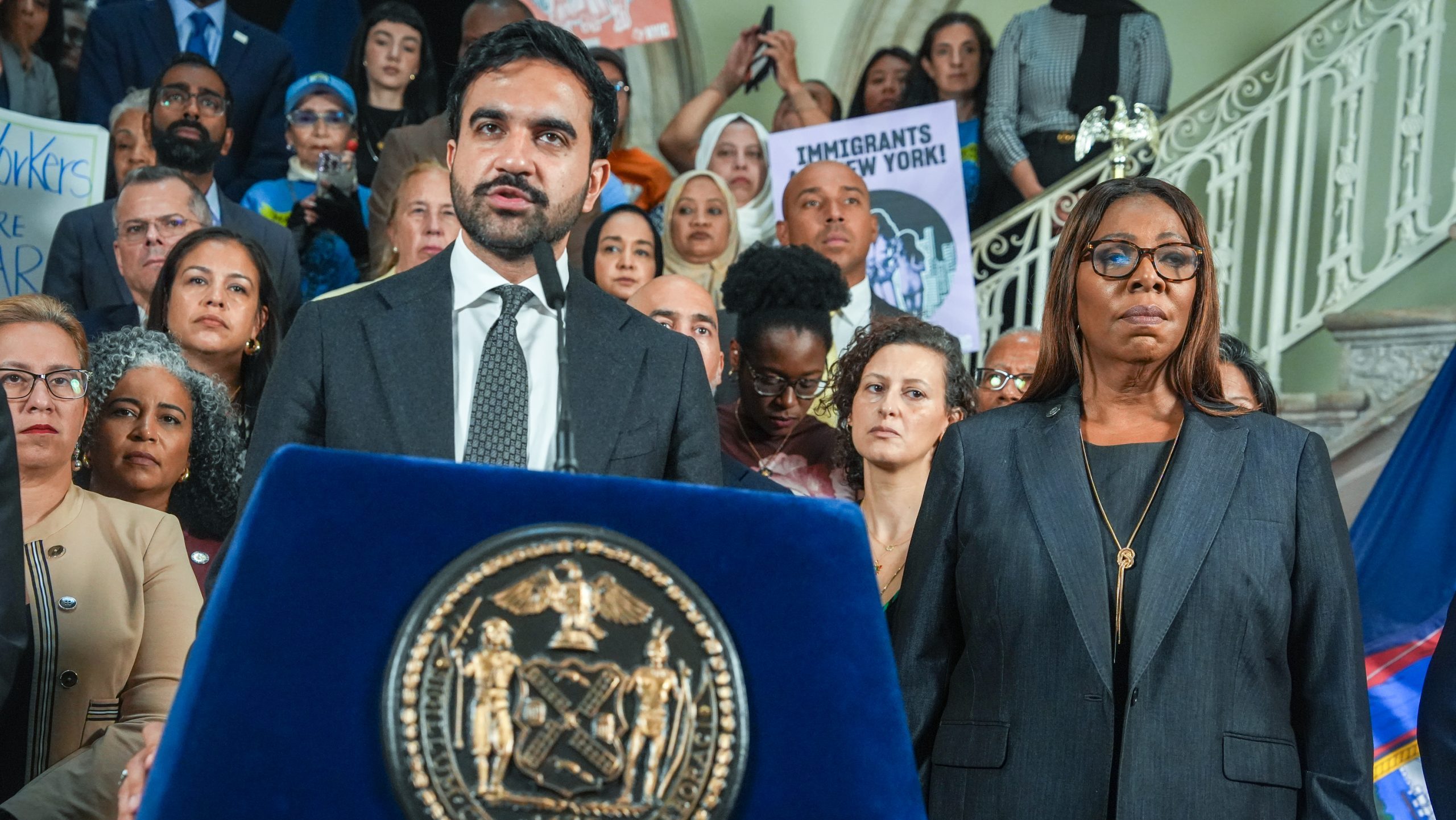
Earlier this year, Hanif introduced a bill to ban the use of facial recognition in public access businesses. “This bill protects everybody,” she said, “but we know who experiences disproportionate surveillance, and our immigrant community is among them.”
Another bill seeks to ban facial recognition in private residences. These two bills are endorsed by the Ban the Scan campaign, a coalition of civil rights groups and the New York City chapter of the Democratic Socialists of America. The bills were introduced to the Council’s technology committee in March and may be put to a vote during this legislative session.
The bill introduced by Hanif has been endorsed by 26 of the 51 councilmembers, the highest number since it was first introduced in 2023, according to Hanif. If approved, New York would catch up with Portland, Oregon, which has banned facial recognition in storefronts.
“We are very enthusiastic and excited about this legislative session,” said Shruthi Velidi, who co-leads the DSA Tech Action Working Group. “These tools pose significant privacy and security risks. They threaten civil liberties, harm New Yorkers and have high error rates.”
Businesses in New York City are required under city law to inform the public if they collect and share biometric data, including facial recognition. The rule “prohibits the sale of such information,” but it does not specify with whom they can share that data.
Stores including Wegmans, Fairway, ShopRite, and Macy’s have confirmed to use facial recognition in the city, according to their privacy policies. There are likely more, as the notices of biometric collection that businesses are required to post at their entrances can be easy to miss. All of those companies state in their privacy policies that they may share biometric data with law enforcement agencies for investigations. Biometric data can be requested, subpoenaed or subjected to a judicial warrant from law enforcement agencies, said Hanif.
Databases can also be hacked. In June, hackers breached the systems of the iconic Madison Square Garden and demanded a ransom. The payment did not come through, so the hackers published 45 gigabytes of stolen data, including facial recognition records and surveillance logs from up to 26 million visitors.
Hanif first introduced her bill after it was revealed that James Dolan, the controlling shareholder of Madison Square Garden Entertainment and a decades-long friend of President Donald Trump, used facial recognition to block access for attorneys from law firms legally challenging him.
“If you’re being sued, you don’t have to welcome the person into your home,” Dolan told the local Fox station in New York at the time. “We’re just asking you, please don’t come until you’re done with your argument with us. And, yes, we’re using facial recognition to enforce that.” Despite the public outcry, Dolan is still using facial recognition.
That same year, 2023, the Federal Telecommunications Commission banned the pharmacy chain Rite Aid from using facial recognition for five years because it led to misidentifying people, which happened more often to non-white individuals and women, and to falsely accusing them of shoplifting.
A landmark National Institute of Standards and Technology study from 2019 found that many algorithms used by facial recognition companies were 10 to 100 times more likely to misidentify non-white individuals, especially Black women. A 2022 follow-up study found that false positives, in which two different people are wrongly matched, were “widespread.”
Surveilled in your own home
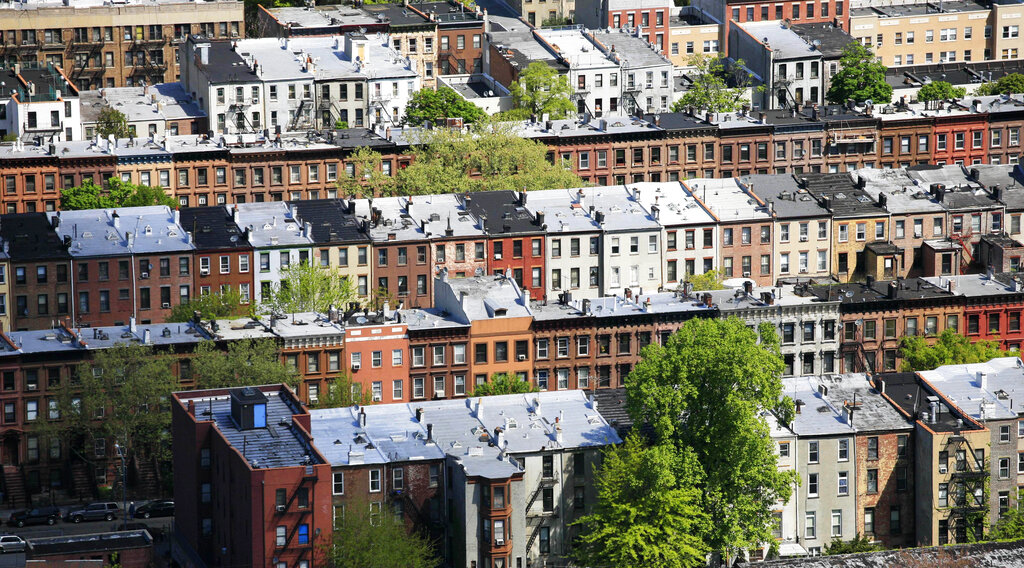
Scores of residential buildings across New York City are marketing the use of facial recognition technology as a convenient security feature for tenants to get access to their buildings, instead of needing a front-door key. The exact number of these buildings is not tracked.
“There’s no comprehensive database documenting how widespread facial recognition technology is or its scale,” said Erin McElroy, associate professor at the University of Washington and co-author of the report Landlord Technologies of Gentrification: Facial Recognition and Building Access Technologies in New York City Homes. “There’s no requirement for someone to register with the city the technology they’ve installed.”
The real estate platform StreetEasy currently lists 182 apartments rented since 2021 that explicitly touted facial recognition access as a security feature, according to a search of its listings. It also lists more than 900 currently available apartments with a “virtual doorman” — sometimes with biometric access — across the five boroughs.
To stop the proliferation of facial recognition in residential buildings, Council member Pierina Sanchez introduced a bill to ban its use in residential buildings, similar to the one banning it in businesses with public access.
The city law that currently regulates the collection and storage of biometric information by landlords states the data may be shared if required by law, although it is not always clear which requests from ICE are lawful. ICE agents have subpoenaed landlords to obtain tenants’ information, even without legal justification, according to reporting from the Associated Press.
The facial recognition expansion occurs amid a rise in complaints about landlords in New York reporting or threatening to report tenants to ICE, according to legal and immigrant rights groups that testified before the City Council in April. “We’re very concerned with the increasing number of tenants who have received threats from their landlords to call ICE or have had ICE being called on them,” said Ibrahim Ramoul, a housing attorney at the community-based organization Make the Road NY. The tactic was employed, he added, to illegally evict tenants or extract a higher rent.
In the case of residential buildings with facial recognition, landlords’ threats could also include sharing biometric information, including the image of a tenant’s face, with law enforcement agencies, advocates warn.
“New York City landlords have been accused in the past of sharing sensitive tenant data with immigration enforcement,” said William Owen, communications director at the nonprofit Surveillance Technology Oversight Project. “So, we need to absolutely protect immigrant communities across our city. We cannot let landlords have access to residents’ facial recognition data.”
Landlords have mostly installed facial recognition access as a security feature in upscale buildings, although they have also attempted to deploy it in lower-income residences. The owners of Atlantic Plaza Towers in East New York, Taino Towers in East Harlem, and Knickerbocker Village in the Lower East Side all faced organized tenants‘ resistance and backed down after trying to install biometric-controlled access.
However, there are very likely more cases of facial recognition technology in lower-income communities across the city, said McElroy, who also runs Landlord Tech Watch, a project that highlights the harms caused by tech tools in residential settings.
“We’ve been worried about both increased instances of cops being called and people being incarcerated because of false positives [wrongly matching two individuals] with this new surveillance,” said McElroy, “but also of landlords detecting really minor violations and then using that as grounds for fines or even evictions.”