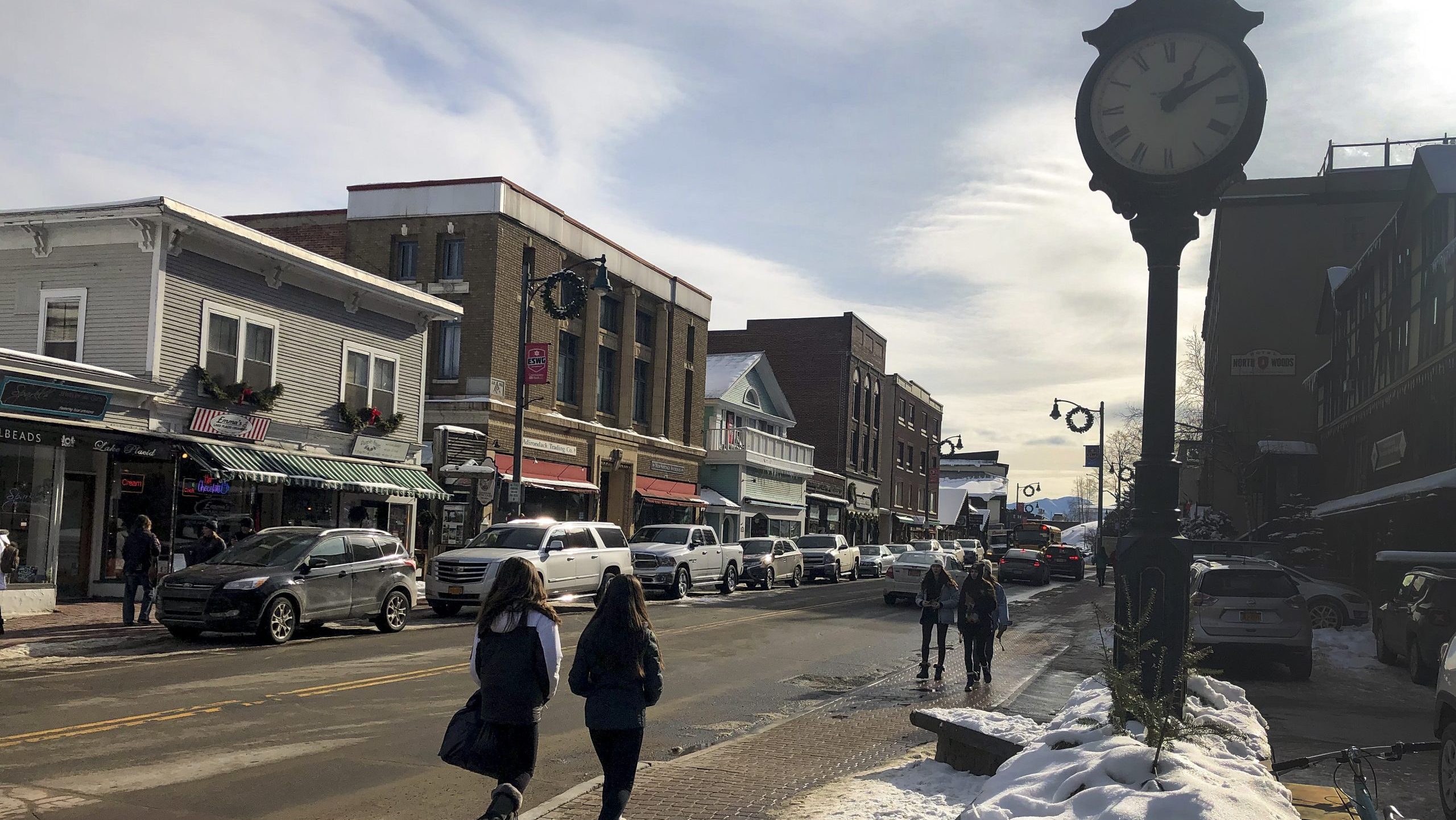


Every summer, the small, sleepy town of Lake Placid, New York, balloons in population to more than 10,000 from its usual 2,306. Nestled deep into the wilderness of the Adirondack Mountains, the rural village, renowned for twice hosting the Winter Olympics, swells partly because of its seasonal immigrant workers.
Many of the workers are on temporary J-1 Exchange Visitor Visas and help fuel the town’s summer tourist economy as Lake Placid opens itself to visitors enjoying water sports, hiking scenic trails, and sightseeing every summer.
Although immigrant workers represent a large number of the town’s workforce, they often go unnoticed as they live apart from the rest of the town’s permanent residents in workforce housing. However, on the morning of May 28, Lake Placid erupted in outrage after U.S. Immigration and Customs Enforcement (ICE) agents raided the sprawling Grandview Resort. Agents detained 14 people that morning, and several days later, on June 2, they detained seven employees who were en route to work at the Heritage Indian Grill, a restaurant in town.

The North Country Immigrant Allies (NCIA), a local immigration community group, said all of the 21 workers detained except one are being held in ICE detention facilities across the country. NCIA claims that the detained workers were not allowed to provide their documents before agents detained them and sent them to federal enforcement detention facilities.
One worker who was detained, as well as a local business owner, community advocates, and clergy, spoke exclusively to Documented, describing how the raids have brought to light a community that has otherwise remained largely unseen. Since the raids, many have retreated from public life, out of fear of deportation.
According to Keela Grimmette, a coordinator with NCIA, the ICE raids appeared to be racially motivated.
“Other than brown people in a car together? Like, I mean, it feels as blatant as that,” she said. “It feels like a very, very racist targeting. I don’t know what to say other than that, because there’s no reason we have to believe that these folks had done anything wrong. Like they just go from work, and they go back to their homes. They kind of keep close together, because they’ve got their own little cultural community, and there’s no reason that I know of that they would have been targeted other than their skin.”
One of the individuals detained, who spoke to Documented on the condition of anonymity, has since been released on $25,000 bail and was forced to wear an ankle monitor.
The worker, an immigrant from Venezuela, had lived and was employed at Lake Placid’s Grandview Resort as a maintenance worker for two and a half years. When the raids occurred, the worker was driving his truck on the resort property and noticed two unmarked trucks parked nearby. He had never seen them before and was suspicious.
“Something didn’t feel right because I hadn’t seen them before,” he said in Spanish via a translator. “When I opened up my door, I was staring and clearly saw that someone was kind of hiding, lurking behind the truck. Then two people just came from two sides and kind of just ambushed me, and started to yell at me, to raise my arms.”
He claims that he attempted to ask the ICE agents why he was being stopped, but they ignored his questions. He also said he witnessed another worker being physically hurt.
“They forcefully removed him from the car, and they threw him on the ground with their knees in his back,” he said. “They put the handcuffs really tight, and threw him in a van. He was really, really hurt, and was screaming, ‘Please help me,’ and he wanted the handcuffs to be loosened up, but they were just laughing. He kept on kicking the door of the van, and they saw the van kind of moving and shaking, and they kept on laughing.”
The worker said that he also attempted once again to ask the agents if he could take his wallet and papers from his car, but they refused and ignored him. The worker told Documented he has a pending political asylum case and current work authorization. The owner of Grandview Resort and the worker’s boss, Art Lussi, also confirmed he was legally allowed to work.
“I told them I can show my documents in the glove compartment, and basically they said no,” the worker said. “So they grabbed me, they brought me to a white van, and they put handcuffs [on me], they tied my feet and also around my waist. I tried to tell them that the documents were in the car, but no one would listen.”
Three years before, he had traveled through seven countries to make it to America for a better life. Along the way, he had to journey through the formidable Darién Gap, a remote expanse of tropical rainforest on the Colombia-Panama border. In 2023, more than half a million migrants traversed the treacherous 66-mile-long jungle; many do not survive, either succumbing to the elements or becoming victims of roaming gangs of bandits.
It took him two and a half days to cross the Darién Gap, and he barely came out alive when his group of ten was kidnapped by armed men. “It was arduous, really difficult and challenging,” he said. “They took us and went through all the bags; they took food, telephones, money. They tied us up, and basically took everything from us.”
After being bound for several hours and robbed at gunpoint, the kidnappers let them go, he said. They were then forced to run through the jungle as far away as they could from the kidnappers in the darkness of the night.
“I was really afraid because it was nighttime, and it was cold,” the worker said.
He was able to find his way out by following a trail littered with the belongings of past migrants.
“There were so many clothes and everything,” he said. “But it was really difficult, just a horrible time.”
When he finally reached the Mexico-Texas border in 2023, he was briefly detained before being released. He then traveled to Florida, where he had family, before taking the job in Lake Placid, following the path of his girlfriend who had already started working there.
But on the morning of May 28, the worker once again found himself tied up by armed men. Already traumatized from his experience in the jungle, he said being arrested in Lake Placid felt like he was being kidnapped in the jungle all over again.
“In a way it was very similar in that it came out of nowhere,” he said. “They didn’t say my name; they didn’t tell me a reason. It really seemed like I was just kidnapped. There was like no real rationale for that to happen. It evoked the same feelings of just trauma and confusion, and I was scared.”
According to Lussi, the Grandview Resort owner, ICE trespassed on his property, setting up a checkpoint with 15 to 20 vehicles on the property’s old tennis courts and did not alert him to their presence or show him a warrant.
“I know ICE has a lot of leniency, but I don’t think they can trespass on private property,” he said.
Typically, ICE is required to have a valid search warrant signed by a judge to enter private property. However, ICE is increasingly using an obscure judicial warrant known as a Blackie’s warrant that empowers ICE to search nonpublic commercial areas without probable cause. Last September, when ICE raided a nutrition bar factory in Cato, New York, they used a Blackie’s warrant to raid a worksite, which led to 57 employees being detained.
ICE did not respond to Documented’s request for comment about the worksite raid nor what warrant they may have used.
According to Lussi, most of the workers detained were contractors working on a roofing job on one of the facility’s buildings. The roofing job is still unfinished, which has affected his business, he said. More raids could put the whole season in jeopardy.
“For my fellow hotel people and me, we have numerous people who are on work authorizations, so we would be absolutely devastated if we lost all these people,” he said. “Our big season starts literally next week, and we’re hoping to have all these rooms done, and we’re still having like 30 rooms under construction.”
Since the raids, Lussi, along with community support, was able to raise the $25,000 bond to release the detained worker. Although he fears that his business will be the target of more raids, he says that he refuses to stay silent.
“I gotta tell you, I’m scared to talk about this stuff, but someone has to, because I know if I go public I’m gonna get hit by ICE every week, because I have two big hotels in Lake Placid, and I have a lot of people that are on work visas, and they all have a work authorization permission, but they’re all terrified right now,” he said.
It’s not the first time ICE has been active in the Lake Placid region.
Last year, ICE raided a lumber mill in nearby Tupper Lake, detaining and deporting nine workers. In December, ICE deported Agnes Karagiannopoulos, an owner of a local Greek restaurant. These recent raids have had ripple effects on the local economy.
It’s an impact that NCIA’s Grimmete says will have a massive economic impact on the region’s tourist economy.
“Like almost every business I’ve spoken to, especially hotels and restaurants, say they can not function without these workers,” Grimmette said. “We need people to feel like they can show up to work, right?
She added that many members of Lake Placid’s small immigrant community have contemplated moving away.
“There’s talk of leaving, of going to safer places,” she said. “People are terrified to take their kids to school and daycare; they’re terrified to show up to work, so it’s, it’s really shifting, I would say, the feeling in the area around safety, like we’ve gone from a pretty comfortable, really picturesque region, to being really on high alert and scared that we’re being really targeted.”
Eliana Godoy, a resident of Lake Placid originally from Bolivia, said the community is experiencing a collective fear.
“It has been devastating, it has been heartbreaking, because there is such a high level of anxiety and stress among the Latino community,” she said. “We feel very much under attack. We feel like we’re criminalized. We feel that we are just under the shadows.”
She told Documented that since the raids, she has seen enrollment drop significantly at the English as a Second Language class she teaches at the local library.
“I used to have 15 students; now I have only two that consistently show up, because everybody’s afraid,” she said. “I mean, aside from going to work, people feel a high level of anxiety about expressing their full identities.”
In at least one case, Godoy says the fear of deportation got so bad that one of her students was hospitalized.
“He was so stressed that he ended up passing out and called me from the hospital,” she said. “All of my students, and just people in the community, have said that their nervous systems are just on fire, that they’re just anxious, afraid, and stressed.”
At Lake Placid’s St. Agnes Catholic Church, which has served as a spiritual refuge for many Catholic immigrants in the community, Father John Yonkovig says he can feel the impact of the raids amongst his congregation.
“It’s put an anxiety into the community on just about every level, a disbelief,” he told Documented. “This is a very small town, isolated in the middle of the Adirondacks, and all of a sudden the realities of what’s happening in our country have come face to face with it, so it’s been, I would say, it’s been kind of a rattling experience for many people.”
During a recent Spanish Mass, Yonkovig, who retired on July 1, noticed many of the pews sat empty.
“Many of our Spanish families are homebound now,” he said. “I would say they really are hesitant to come outdoors.”
For the worker, his arrest and detention have caused him to live in a state of perpetual fear.
“Because of this process, I don’t feel safe or secure,” he said. “This can happen again, right? There’s no security for me now, and I feel that unsafety more so than ever.”
When reflecting on his ordeal and his initial expectation of American freedom, he can’t help but feel that life in the U.S. is not unlike his native Venezuela.
“I don’t think bad of America, but I just think that this particular government is really not demonstrating the democratic values that I thought that this country espoused,” he said. “It just kind of reminds me almost like the government that I left.”
Correction July 8, 2026: The original version of this story included a mistranslated quote about the worker’s arrest. The story has been updated to reflect his witness account. We apologize for the error.