

At Fleur de Lis Beauty & Esthetics in Flatbush, Brooklyn, clients typically arrive with an appointment. But in the nearly 10 years the luxury medical spa has been in the community, co-owner Wendy Jules says daily walk-ins weren’t unusual.
“You would get like at least five to 10 people come in and say, ‘What services do you offer over in the neighborhood’ or ‘We’re visiting from out of town,’ ” said Jules.
In recent months, those casual drop-ins have become much less common. In July, Jules said there were weeks when only about four people stopped in — a drastic change, especially in a neighborhood where summer typically brings more people outside.

“You can definitely see there’s a downturn on the activity in the street,” she said. “There’s usually more people out, more people shopping, or people stopping in to see what services are being offered.”
Jules first noticed the slowdown around the end of May, roughly the same time businesses and residents began sharing concerns about U.S. Immigration and Customs Enforcement (ICE) activity in the area.
“I haven’t seen it because I don’t know if they’re in uniform or not,” she recalled, “but there have been other businesses who would say, ‘Hey, there’s some activity on this street. Stay vigilant and keep your eyes open.’ It’s scary.”
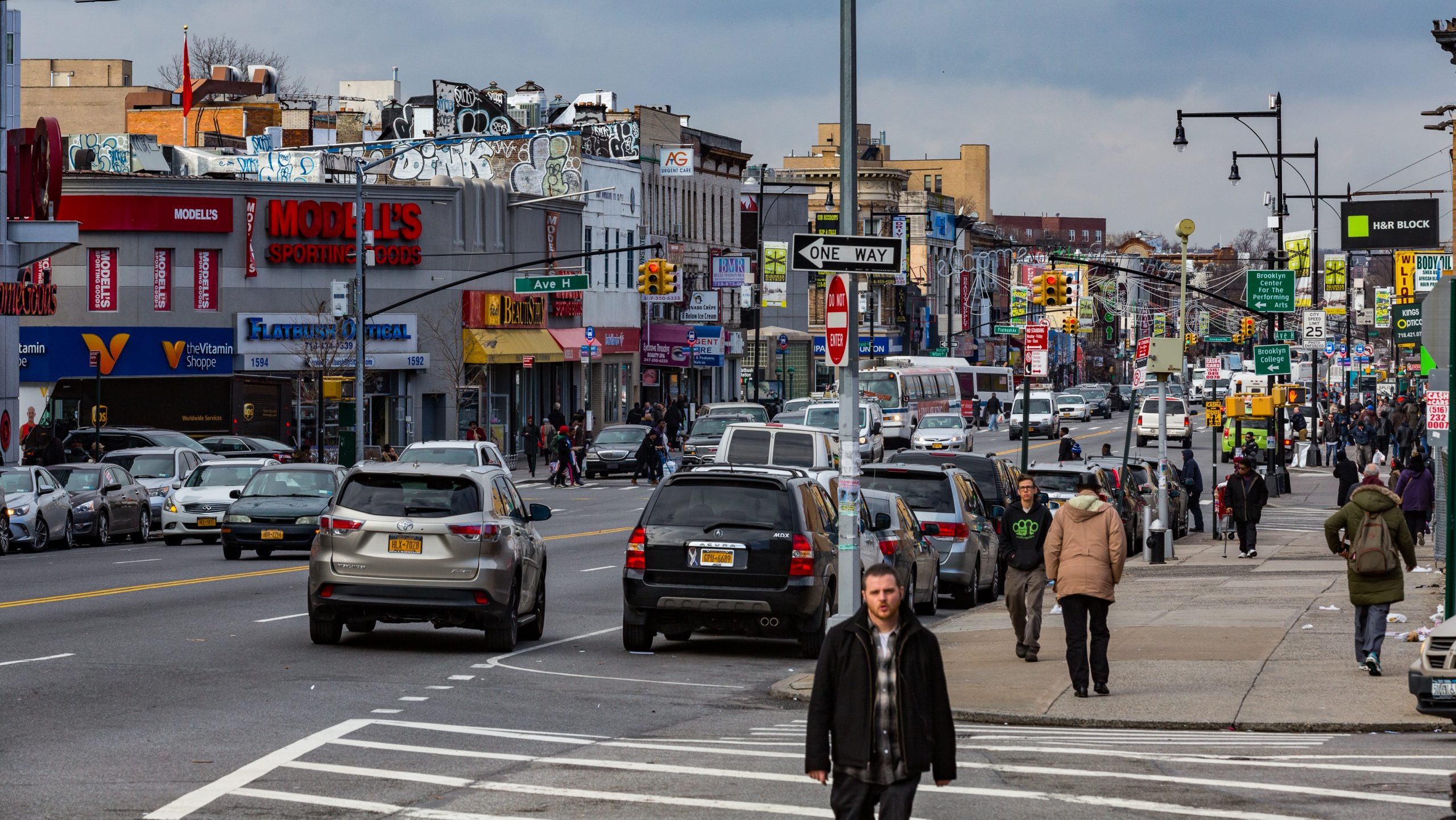
That fear extends beyond Fleur de Lis, and has affected businesses across Flatbush, one of Brooklyn’s largest immigrant communities. The neighborhood is home to roughly 20% of New York City’s Caribbean community and many of its businesses are immigrant-owned.
A recent survey conducted by the Flatbush-Nostrand Junction Business Improvement District found that 70% of local business owners who responded reported a decrease in foot traffic within the last year. Fifty percent said customers had explicitly raised concerns about ICE and 33% anticipated a likely reduction in their workforce. This has been a trend across New York City, where immigrant-heavy neighborhoods have seen a decline in business and foot traffic, Documented previously reported.
Kenneth Mbonu, president and executive director of the Flatbush-Nostrand Junction Business Improvement District, said those numbers are especially concerning for the corridor’s smallest stores.
“Many of these businesses are brick-and-mortar,so they have a location on the commercial corridor and many of them survive primarily by the foot traffic,” Mbonu told Documented.
More than 80% of businesses in the district are minority-owned, according to Mbonu, who estimates that of those minorities, more than 70% are immigrants.
Many of the businesses, Mbonu said, were already adjusting to seeing fewer customers, a trend that began during the COVID-19 pandemic.
“People were working from home, so the commute to and from work was less,” he explained. “But with those slight declines in foot traffic in the area, that affected a lot of us, more businesses that can’t really transform directly to these kinds of changes.”
Smaller businesses have fewer ways to adapt when customers stop showing up in person, Mbonu said, including limited online and social media infrastructure.
Those pressures have since been compounded by tariffs and heightened immigration enforcement under the Trump administration. The BID survey published in July asked merchants about both.
Among owners willing to disclose financial details, Mbonu said some reported significant losses.
“We saw that a lot of their revenues had dropped by even up to 50%. And that’s a drastic situation for many of these businesses because many of them would not be able to pay their rent, which is usually their biggest cost,” he said.
The decline in foot traffic has led some merchants to begin delivering products directly to people. “But that is an added cost on them,” Mbonu said. “But they don’t have a choice. They have to keep their clients happy.”
Immigration enforcement is also affecting staffing. Mbonu said some merchants have reported multiple ICE raids, while workers with pending immigration applications who are allowed to work still fear leaving home or reporting to their jobs.
“Many of them did not want to take any risk due to the indiscriminate nature of the ICE arrests and so on,” Mbonu said. “It’s just not a healthy environment for a lot of the small businesses and their challenges.”
That fear is not confined to people without legal status, he added.
“Some of them even have green cards or some of them even have their U.S. passports. They’re legal. But just the fear of being arrested in error and finding themselves in Venezuela and having to go through the process could be quite intimidating and frightening,” he said. “So they just don’t want to come out.” More than 170 U.S. citizens were detained by ICE in 2025, according to ProPublica.
In Flatbush’s large Caribbean immigrant community, these conversations have also included uncertainty surrounding Temporary Protected Status and what changes could mean for Haitians who have spent years building lives in the United States. Many businesses have lost staff or closed because of TPS work authorization terminations, as Documented previously reported.
For Jules, a child of Haitian immigrants, the end of TPS work authorization has hit particularly close to home. It has affected her business, her customers, her neighborhood, and her family.
“They [Haitians who no longer have TPS] have homes, they have cars, they have careers. Like, now does everybody just get up and go to Haiti and start over? Like, how does this work?” Jules said, adding that some have chosen to leave the country rather than risk detention.
The consequences can ripple through entire families, particularly in immigrant communities where relatives may pool resources, financially support one another or send money to family members in the Caribbean.
“Now all of the money that you’ve saved or your resources are drained through lawyers. You’re concerned about if your parent is eating, is your cousin eating? What if the person is pregnant and you know they’re not getting the best treatment? It’s not like you’re saying, ‘OK, let’s put you on a JetBlue flight and send you home.’ You’re going from facility to facility, far away to be processed and documented and all this stuff,” she said.
While immigration enforcement has not changed the services Fleur de Lis provides, Jules has found herself using the business as another place to share information with people worried about what could happen to them or their relatives.
“I always tell people who are dealing with that situation, ‘Be very careful. Make sure you’re walking with your documents. If you have to report to somewhere, please let your family know. Get a power of attorney so if something does happen that you can have someone speak on your behalf,’” she said.
For the BID, documenting those experiences is a first step toward helping merchants. Mbonu said the organization hopes to use the survey findings to work with agencies and community partners on solutions for businesses confronting lower foot traffic, staffing concerns, higher costs and an increasingly anxious customer base.
“The small micro businesses are the crux of our community and nobody really actually appreciates the impact they have on the business community and on the community and the vibrancy of the neighborhood as a whole,” Mbonu said. “But once this has been challenged, the impact is quite seen here. And it’s just that we need to come up with flexible approaches to help solve many of these problems.”