

Interviews interpreted by Emile Esmaili
The first time the soldiers came for Bah, it was nightfall in the capital city of Conakry, Guinea. Hidden inside the home he shared with his parents and two younger brothers, the 22-year-old peered into the courtyard and watched as his father pleaded with five masked men.
The armed men were part of President Mamady Doumbouya’s junta. The junta, which took power in September 2021 via military coup, is allegedly responsible for abducting journalists, restricting freedom of speech and internet access and attacking those in opposition.

Bah, who requested his full name be withheld for his safety, was a member of the Union of Democratic Forces of Guinea (UFDG), one of the largest — now suspended — opposition parties. Bah designed t-shirts and made phone calls to prospective members to promote UFDG’s mission, which covers separation of powers, women’s emancipation and better infrastructure for all.
Two days earlier, Bah had participated in a protest calling for the release of three opposition members who had been arbitrarily arrested and detained. The protest, although peaceful, was illegal, as Doumbouya had banned all demonstrations six months after gaining control of Guinea.
As noise from the courtyard grew, Bah joined his parents. When a soldier slapped his mother’s face, Bah burst forward to defend her, only for an assault rifle to crash into his eyebrow.
“Next time,” the gendarme (armed police officer) holding the rifle threatened, “It’ll be a bullet through all of your heads.”
The next time armed soldiers came to his home was two months later in July 2023. This time they arrested Bah for his political activism. For his family’s safety, Bah went quietly.
By dawn, Bah was in a cell in Labé Civil Prison over 200 miles from home. Masked militiamen with large automatic weapons strapped to their chests handed him a hot potato and ordered him to insert it into his body.
“I tried,” he recalled. “But couldn’t. So they took their cigarettes out.” The holes burnt into Bah’s back remain to this day.
Now in New York City and seeking asylum on the basis of political persecution, Bah says he endured his torture by thinking of his mother who remains in Conakry.
“I care about her body,” he explains in French. “Not mine.”
The aspiring autocrat
Over 98,000 Guineans are now forcibly displaced, a 62% increase since Doumbouya’s 2021 coup. Over 54,000 of these displaced Guineans, including Bah, are seeking asylum.
Despite the region’s rising authoritarianism, no West African country has Temporary Protected Status in the U.S., leaving most who flee the region with no recourse but to seek asylum. With the Trump administration halting all affirmative asylum decisions as of November 28th, asylum seekers like Bah are now stuck in an indefinite limbo.
Doumbouya’s coup, which prevented previous leader Alpha Condé from seeking a controversial third term, began with promises to prevent corruption and bar the junta members currently in power from running for future office.
Bah shakes his head, his usually calm face betraying frustration.
“Lots of people supported it since Condé was a fraud,” he said. “But I knew that any democracy — even one with a bad leader — was better than no democracy at all. Once you lose democracy there is no going back.”
Guinea’s government is formally recognized as a presidential republic. But, since Doumbouya was sworn in as interim president in October 2021, his junta shows no signs of relinquishing power.
This past September, after suspending opposition parties and restricting media, Doumbouya held a vote to introduce a new Guinean constitution which concentrates executive power and prevents many opposition members from running for office. Approved by over 89% of civilian voters, it paved the path for him to submit his candidacy for today’s December 28 election, which he faces with no outstanding opposition.
Doumbouya’s rise to power looks like a “classic move from the aspiring autocrat’s playbook,” said Gregory Mann, history professor and scholar of Francophone West Africa at Columbia University.
Asylum in the U.S., which is only an option for migrants if they can prove they have a credible fear of torture, may hang in the balance.
“The state might argue that ‘credible fear’ of military government no longer exists once Doumboya wears a boubou or a suit,” Mann said, referring to Doumbouya’s aspirations to shed the title of “junta leader” and present himself as the head of a democratically elected regime.
Mann cautioned against the facade, claiming that any seeming stability in Guinea is only acquired by silencing dissenters. Spokespeople for Doumbouya did not respond to requests for comment.
Amad, 29, asked to be referred to by nickname for his safety. A former two-time UFDG parliamentary delegate, he also now seeks asylum from political persecution. Although Amad and Bah were both UFGD members and arrived in New York City in the fall of 2023, they met for the first time through the Harlem-based refugee aid center Afrikana. Working in the Afrikana mailroom together, they forged a brotherhood out of shared culture, politics and dreams for the future.
Like Bah, Amad was threatened by Doumboya’s soldiers when they stormed his home in the summer of 2023. Targeted for his politics, Amad outsprinted the junta members through the humid outskirts of Conakry, beginning a five-month journey to the United States so arduous that he, once an activist, now warns Guinea’s next generation against taking up the fight.
“You’ll die fighting,” Amad says. “Or you can die trying to leave. Just take care of your families and hope people learn about us.”
The toll of seeking asylum
For Bah and Amad, fleeing brought more violence. After two days of torture in Guinea, Bah paid a guard to secure his escape. He was smuggled through a chain of airports before traveling north through Central America, where cartels and police extorted him. Amad, traveling a similar route with other West Africans, faced open racism in cartel vans. Prices were two to three times higher for African travelers. He was held by a gang in northern Mexico for three months. He finally escaped during a shootout.
In the fall of 2023, both men turned themselves in to separate ICE centers at the southern border of the United States. They both spent their days handcuffed, sleeping on the cold concrete of the detention centers until they managed to get sponsored flights to John F. Kennedy International Airport in late 2023. They arrived in New York with nothing but the clothes they wore.
The journey’s toll lingers. While Afrikana helped Bah and Amad acquire IDs, healthcare, work permits, and a place to socialize, Amad finds himself fighting depression as he navigates isolated nights in a cold Queens’ shelter. Bah battles daily with homesickness.
Bah’s new job requires long night shifts which limit his time at Afrikana. When he does stop by, he sees Amad, but his friend is tight-lipped about the outcome of his September asylum hearing. Bah can only hope for the best.
Despite his pending asylum case, he fears that ICE disregards the legal status of those they arrest. “It can be anyone next,” he says.
Still, with financial opportunity, education, and the right to a trial on the line, he wants a life in America.
Last winter, between shifts in the mailroom and as a construction site security guard, Bah learned that soldiers had returned to his Conakry house, urinated into his family’s dinner, and temporarily imprisoned his diabetic father, refusing him medicine and slicing off his heel. On his phone, Bah showed a photo of the mangled foot.
In March, his mother called. Soldiers had approached her on the street, questioned her political affiliation, and shoved her to the ground. Over 4,000 miles away, Bah hung up and considered, for the first time, going back.
Bah’s steady voice finally broke. He covered his eyes.
“Do you know what it’s really like to miss your family?” he asked.
The slow, shifting asylum system in the U.S. makes the separation harder. Bah’s asylum hearing was delayed from July 2025 to June 2026. His original judge was replaced by one who denies a whopping 72.4% of cases.
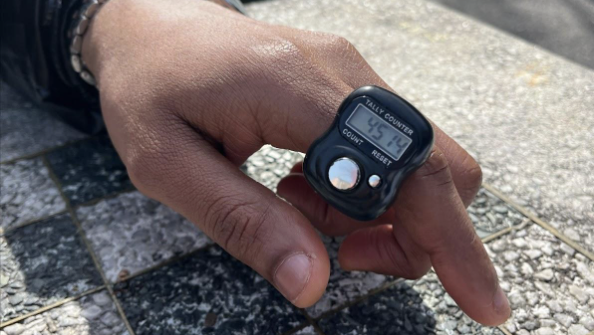
Bah says his faith helps him endure the wait. He pulled out a tally counter he received from Afrikana and slipped it on his finger. It read 4,514.
“I click it every time I am struggling,” he said. “Every time I have needed [God].”