

If you’re seeking to understand Trump’s immigration crackdown through data, Austin Kocher’s Substack should be on your radar.
Kocher, an academic researcher and geographer, has built a 12,000+ strong following on his eponymous Substack, where he covers the U.S. immigration enforcement system through a mixture of quantitative analysis and longform interviews.
He previously worked at the Transactional Records Access Clearinghouse (TRAC), a 30-year-old data research organization at Syracuse University that uses Freedom of Information Act requests to show the American public exactly what the federal government is doing on a day-to-day basis.

In addition to his work at TRAC (which has become a must-read for immigration stats) his work has been cited in The New York Times, Wall Street Journal, NPR and numerous other media outlets.
Documented spoke with Kocher recently about what immigration data can tell us about this current political moment, as well as the bright spots he looks for when the news cycle is churning with heavy headlines.
This interview has been edited for concision and clarity.
Julia Malleck: Hi Austin, great to chat with you today. To kick us off, tell us a bit about your research.
Austin Kocher: I’ve spent basically the last 17 years focused on the immigration enforcement system — everything from the first time that someone comes into contact with law enforcement of some kind, all the way through the end of that case, whether it’s deportation or asylum.
A big part of my work is focused on the police-to-deportation pipeline, so that includes interviewing immigrant communities in the U.S. South that are affected, interviewing sheriff’s offices, police departments, local elected officials, activists, government officials and also getting a lot of data.
So, I’m using Freedom of Information Act requests and state level public records requests. I’m also just always really interested in looking at what the numbers actually say about immigration enforcement, so that we can understand it from as detailed and objective a perspective as possible.
And what is the focus of your Substack?
One of the things that’s changed a lot for me as an academic is I find that the timeline of getting up-to-date research is best served by having a platform that moves as fast as the news does. In the past couple years, I’ve put more energy into writing online, and for me, that means Substack specifically.
Because a lot of my research in the past has been very qualitative, I am a big believer in first-person stories and telling stories of impacted people, but I also know that those stories can go further when we’re able to connect them to data that helps to contextualize and understand how representative certain stories are of what’s happening across the country.
Shifting gears a bit, I wanted to chat about immigration data, which is an important part of what you write about on Substack. Where do you get it, and to what extent is the current, available data under the Trump administration reliable?
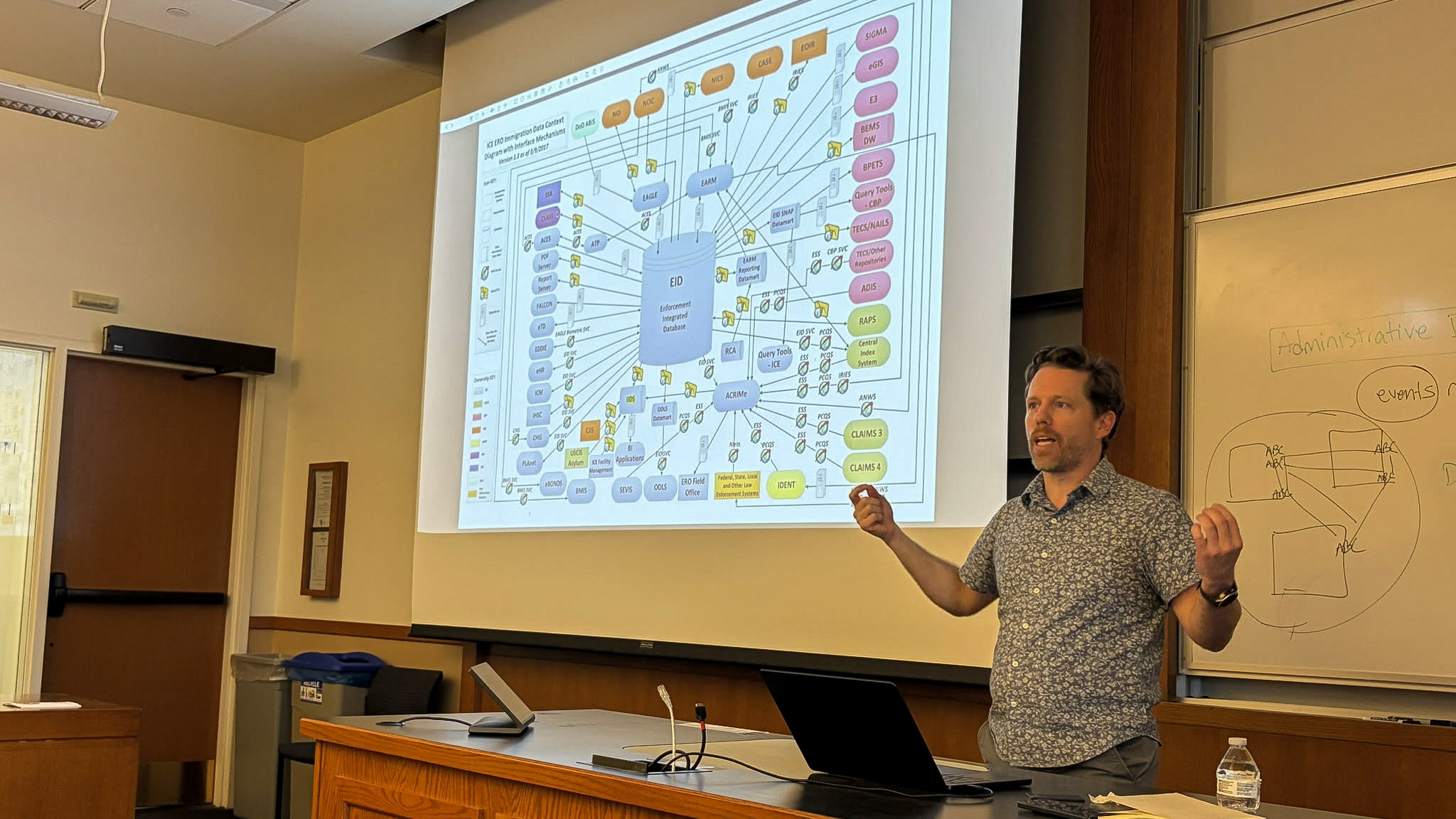
The interesting thing about immigration data is that it mostly comes from government databases themselves. It’s what we call administrative data, so it’s data that’s produced not necessarily for research purposes, but because the government needs databases to run its operations to know who it’s arresting and detaining and deporting.
So, it’s not like climate science data, where the whole data collection and cleaning and publication process is, in a way, more subject to political influence. Immigration data is not really like that. The government has to have this information, because it’s in their data systems.
When we’re able to get it out, there aren’t generally major quality issues. It’s not really something that can be tampered with in the normal way. So the data that we are getting through public records requests and litigation, as well as other, you know, data releases such as Congress, requires ICE to release detention data every two weeks. All of that data is good. There’s no issues with any of that. The real issue is that the administration is trying as much as it can not to release any of that data, so there are several data sources that in the past would have helped us to understand, you know, are there civil rights violations in detention centers? Are there other abuses? How many people are actually being deported each month?
We actually don’t have that information because those data sources have been choked off by the current administration. I believe it was [former Attorney General] Pam Bondi who claimed in a press conference that this is the most transparent administration in history, and the simple fact is, when it comes to immigration, that’s just not true.
In your research, what role can immigration data play in this current moment, and what power does it have to shape narratives?
I’ll give you two examples that I tend to write about a lot. One is, the administration has used its social media platforms to make it appear as if everyone they’re arresting are dangerous criminals: threats to public safety, threats to national security. Not only have many of those social media posts been later discovered to be factually incorrect, just on the basis of the legal case, but they also present a larger problem of a misperception or disinformation about who ICE is really arresting and detaining.
The truth is, most of the growth in ICE arrests and detentions over the past seven months have come from people with no criminal history charges or convictions. (Note: To see more of Austin’s research, read his Substack post on the topic of arrests without criminal histories.) So that’s just ICE’s own data showing that they’re not arresting more people with criminal convictions, and even those who have criminal convictions, a minority of those would come close to being something like a criminal conviction that would indicate some sort of threat to public safety. Many of them are very old convictions or charges. Many of them are not particularly serious. Many of them, if there was any time to be served, they’ve served that time and have gone on to have families and go to college and start businesses and don’t represent anything like a current threat.
Also Read: As the U.S. Was Shut Down, ICE Arrests Continued Without Documentation
So that’s one area. Another is that Immigration and Customs Enforcement (ICE) is the agency responsible for what we call “removals,” or what most of us would call “deportations.” Legally it’s called “removals,” and we know what those numbers are, over the past many years we’ve been tracking deportations for decades.
This administration, however, has fudged the language that they’re using. They’re using terms like “repatriation,” or they’re using terms like “deportation” in a general sense, and they’re not really telling us how they’re coming up with those numbers. And, they’re using these sort of much more expansive terms to make it sound like they’re doing a lot more than they actually are.

Whereas, if you actually did an apples-to-apples comparison with prior administrations, you might get different numbers, but they are in effect using language to sort of fudge the data a little bit. Now, that’s not to say that the administration isn’t doing, obviously, a lot more deportations than we’ve seen in the past. There’s no question about that. But they seem to be more committed to political rhetoric than data accuracy.
Moving on to a more New York-specific question, Governor Hochul just enacted a ban on 287(g) contracts.* What is going to happen to detainees held in local jails, and how might this be reflected in immigration data?
Yeah, it’s a great question. So there’s kind of two issues here. One is whether ICE can hold people in a county jail as a part of its detention system, and then there’s 287(g) which allows local agencies to do immigration enforcement as a part of their duties.
They’re two slightly different things, and they’re sometimes a little bit confused, but I would say, because 287(g) is about giving local law enforcement the ability to do immigration enforcement activities, sometimes agencies take on that responsibility and enroll in a 287(g) program, and it doesn’t really change the data. It doesn’t always change the data in some places.
So, a lot depends on the priorities of the law enforcement agency involved. A lot of it depends on ICE, how close ICE is collaborating on a daily and weekly basis with those agencies, and so certainly there’re cases in Florida, cases in Georgia, and North Carolina, where I’ve spent a lot of the time doing research, where those 287(g) agreements are leading to a lot of detentions and potentially deportations of people in the community. There are other places where it hasn’t led to that much, so it’s always a very local question.
* 287(g) refers to a section under the U.S. Immigration and Nationality Act that enables the federal government to deputize local authorities to carry out immigration enforcement. For more on 287(g) contracts, read Documented’s guide here.
Immigrants in detention centers across the country — California, Pennsylvania, Michigan and in New Jersey — have launched hunger strikes to protest reportedly inhumane conditions inside. Can you speak to how data can help us understand what is currently happening inside ICE detention centers?
We have some pretty good data, we have some good ideas of what’s going on. People are being held for longer, people are being packed into these detention centers to the point where they’re over capacity. People have serious medical issues in the facilities, and they’re not getting the help, the medical support they need because ICE is not prioritizing medical care and safety of people. And certainly the private detention contractors are not going to spend more money providing quality care for people in the facilities.
So all of this is really creating some major issues. There have been 47 [or] 48 people who have died in detention since the start of the Trump administration. There hasn’t been a death, thankfully, in the last two weeks or so. But for most of the first part of this year, someone was dying in detention once every six days — just the highest rate of detention that we’ve seen ever.
There have been many suicides, and there has been some recent, really important reporting about concerns about high rates of suicide. These are controlled facilities, nobody should be able to harm themselves inside of the facility. Facilities, we’re finding, have failed to meet standards when it comes to having policies and procedures in place to ensure that people cannot harm themselves.
How does this connect to the current protests we’re seeing at Delaney Hall in Newark?
Americans are fed up. They don’t want to see this happen on their watch. These aren’t jails, these are civil detention centers where people are being held for administrative processing. They’re not doing time for crimes, and they’re dying inside these facilities, and again a lot of that growth in detention is coming from people with no criminal history.
There are also just a lot of people who are saying this just crosses the line. That we shouldn’t be holding people like this, we shouldn’t be treating people like this. So it’s natural, I think, at any point in American history, wherever we’ve had what political scientists will call “democratic backsliding” or slide into authoritarianism, there have always been Americans who have been willing to stand up and go to the streets and protest and say “this isn’t right, this is not what we asked for, this is not what we want.”
So we’re seeing these clashes, and we’re seeing an administration that isn’t really listening or willing to dialogue with the opposition in that way. I’m concerned after what we saw in Minneapolis. We saw two civilians, U.S. citizens, killed on the streets. I worry that the same culture after those two events — ICE did not take a step back and reflect on its practices. In fact, they doubled down, they said that they did nothing wrong, they described these citizens as terrorists. And that kind of culture in an agency like ICE, that has very little accountability, it just makes me worried about what they might be willing to do to some of the protesters.
But again, it’s always been in our blood as Americans to get out and stand up in the face of injustice and to try to do the best we can. So I honor the people who are on the streets there.
What is your main goal with your research?
My main goal in everything I do is to help more Americans, and impacted immigrants, who, many of them are Americans at this point, to just understand how the system works and understand what’s true and what’s not true.
But I don’t necessarily go in with a lot of policy or legislative goals. I don’t advocate for any particular politician or political party in any way.
It’s really about public education, and just the deep belief that if we want to fix the problems we have, we have to have a rational, informed conversation. There’s so much misinformation out there, and unfortunately, the government under this administration and prior administrations — but certainly this one — always plays into problems of misinformation.
I wanted to end on a more positive note, since there’s a lot of negative news these days when it comes to immigration. What are some bright spots that have been giving you hope recently?
It was just a few weeks ago that Carlos Della Valle was released from Winn Detention Center in Louisiana. I had the great fortune of getting to know him and his wife Angela. They’ve been married for 24 years. He’s been in the country for 30 years. Absolutely no criminal history of any kind. They [have a son]. He’s been working at the same place for 25 years, is beloved in the community of Downingtown, Pennsylvania, and was scooped up coming back from family vacation in the U.S. Virgin Islands two years ago, literally on Christmas Day. He was in detention for nine months.
It sounds like a sad story, but what’s inspiring, what’s hopeful is that his wife just traveled wherever he went, she raised money online and from friends, and from her church to support her going. She would stay at an Airbnb or a hotel outside of all of those detention centers that he was held at. She would call. They would talk on the phone every day, she would visit almost every day, at least every day that they would let her come. She got to know the guards, and she stayed. Just incredibly, firmly committed to him. And once her story got into the news, American Families United worked on the case — and got support from a Republican senator, by the way, not a Democrat — who also advocated for him, and he was released.
It was due to the persistence and resilience of the community who refused to give up on this one man. There are thousands of people in detention, and almost every single person deserves that kind of support. But this is just one case, and there are lots of others like it. There are lots of stories in the last couple weeks of people getting out of detention because communities rallied around, and I think it sends such a clear message. You know, it feels like we can’t do anything. It feels like everybody is against immigration and against immigrants. It feels like everyone in power either doesn’t care or is opposed to it. But the truth is, it takes a lot of work.
I also think of Danitza James, who runs Repatriate Our Patriots. I’m a veteran, and there are many of my fellow veterans, people I’m sure that I served with in uniform, who have been deported or been arrested and detained, even as immigrant veterans. And veterans are coming together and saying, “look, if they’re good enough to serve in uniform, they’re good enough to live in this country.”
And so I think just seeing all of the ways that people are coming out and speaking out and actually making a real difference. We can do more than we think and we really do need those positive stories as much as we need to understand all of the awful things that are happening too.
Thanks so much for your time and insights today, Austin. I appreciate it.
Absolutely.
Correction: An earlier version of this interview stated that Carlos Della Valle had two children, but he only has one son. The article has been corrected to reflect that.