

Why do ICE agents have so much trouble pulling people over without getting anybody killed?
The short answer: No one who can stop agents from getting people killed wants to.
When the federal government won’t hold its own employees accountable, there’s little anybody else can do to fill the gap.

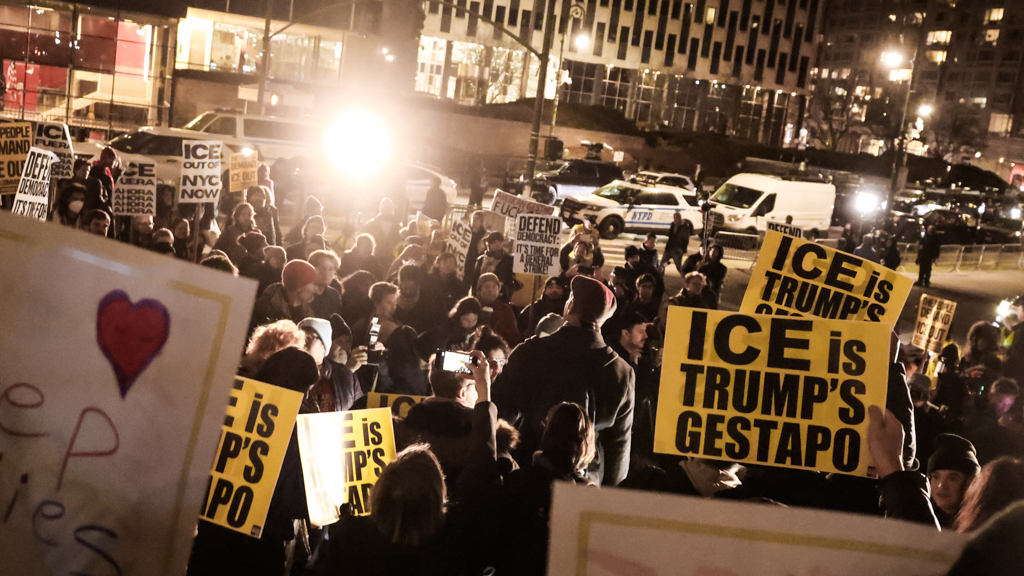
Earlier this month, Immigration and Customs Enforcement agents fatally shot two people during traffic stops — in Texas and Maine respectively — and another died in Florida when he ran into traffic trying to flee agents. Under a different president, these might have been occasions for ICE’s internal affairs division to investigate and potentially discipline any agents found to have violated department policies. But under this administration — as reporters at WIRED revealed just before the fatal shootings — internal affairs officers were instead being tasked with going after people who criticized ICE agents on the internet.
In the wake of the shootings, ICE, for one day, paused agents from conducting vehicle stops without a specific investigative reason. But then President Trump posted on Truth Social that he wanted vehicle stops to resume, and so resume they did.
The slightly longer answer to the aforementioned question is that ICE agents were never routinely engaged in street-level enforcement — like vehicle stops — until last year. Indeed, it was the sort of thing ICE preferred not to do because it is much harder to control a situation when flagging down a moving vehicle as opposed to picking someone up in a local jail.
And an even slightly longer answer is that, traditionally, lawmakers have taken a somewhat deferential approach to street-level policing. Cops are expected to have a legitimate reason for what they’re doing but they’re rarely required to articulate the reason why in advance.
There are limits to the power ICE is given by the law. But then again, this administration tends to see those limits as something to simply be worked around — some sort of test of wits.
When it comes to vehicle stops, there’s the question of when ICE agents are allowed to stop someone to begin with, and then there’s the question of what happens once they decide to pull someone over. Legally speaking, the two are separate questions — it is quite possible to pull someone over for completely legitimate law-enforcement reasons and still illegally shoot them for not getting out of the car fast enough.
Local law enforcement agents are allowed to pull people over if they have a strong enough basis to suspect that person (or someone in the vehicle) has committed a crime — the legal term for the standard is “reasonable suspicion.” There are specific guidelines that a law enforcement agent is expected to meet. But they are also allowed to pull people over for minor infractions and then question them about other crimes of which they don’t yet have reasonable suspicion. This is called a “pretextual stop,” and the Supreme Court has long said it’s legal when state or local police do it.
But ICE agents aren’t state or local police, and they’re not allowed to engage in pretextual stops. Legally, they’re only allowed to stop someone (whether in a car or not) if they have reasonable suspicion that the person has violated federal law. And while in certain contexts immigration agents are allowed to consider someone’s race as one small factor in determining whether they feel they’ve violated federal law, it is never, ever a legally sufficient reason to stop someone. But laws of the government aren’t like laws of physics — you can violate them if you try — and because ICE isn’t required to show its work documenting the individualized basis for every single arrest it makes, it’s impossible to say how often, in practice, profiling plays a legally impermissible role.
The Supreme Court’s ruling last year allowing ICE to continue conducting sweeps in Los Angeles and other cities, was built on existing case law about how much of a factor race could be in immigration enforcement. The 6-3 decision featured an instantly-famous concurrence from Justice Brett Kavanaugh asserting blithely that no one would ever be detained for terribly long if they hadn’t violated immigration law..But the fact that, in practice, “Kavanaugh stops” have become synonymous with out-and-out racial profiling perhaps indicates that much of the public doesn’t necessarily believe ICE agents are always being scrupulous about articulating a reason for stopping someone beyond their apparent race.
But ICE agents don’t even need to engage in outright racial profiling to scale up vehicle stops. There are a few other ways they’ve turned vehicle stops into a routine part of immigration enforcement.For one thing, there’s the question of what information ICE is using to determine whether someone is reasonably suspected of violating civil immigration law or committing a federal crime.
Like law enforcement agencies around the country, ICE has purchased access to private surveillance infrastructure and proprietary data. They can use those tools and information to, say, look up the vehicle owner associated with a given license plate, and cross-check that with federal databases to see if someone with that name and date of birth has been ordered removed from the country by an immigration judge. This would absolutely be considered reasonable suspicion of an immigration violation — which isn’t to say that unscrupulous agents couldn’t pull together shakier cases based on less clear-cut evidence. This is exactly what ICE has been doing on Long Island: running license-plate scanners in parking lots, and detaining people based on the results.
Secondly: In order to stop someone, ICE agents are required to have a reasonable suspicion that they have violated federal law, but it doesn’t have to be federal immigration law. Assaulting a federal officer, for example, is a federal crime.
ICE has, in fact, arrested hundreds of people for alleged assaults on officers. (For the record, arresting someone requires the agent to meet an even higher legal standard than just stopping their car.) Those cases have fallen apart in court at an absolutely astonishing rate. Nearly half of them have either lost in court or been proactively withdrawn by federal prosecutors. But if the person they arrested was then found to lack immigration status, they can be kept in federal immigration custody and placed in removal proceedings. In other words, it’s not exactly a loss for ICE if they arrest someone on ostensibly criminal grounds if they are able to deport them for immigration reasons no matter what happens to the criminal case.
And even when ICE can’t come up with a reason to perform a vehicle stop, they can sometimes call on local police to do it for them. The Trump administration has radically increased the number of agreements it’s signed with local and state law enforcement agencies to deputize immigration “task forces,” allowing those officers to enforce immigration law in the course of their efforts. And don’t forget, local police are allowed to use broken taillights as sufficient reason to pull someone over.
Local cops can be an enormous force multiplier. In May 2025, ICE agents tagging along with state police in Nashville, Tenn., pulled over 600 vehicles as part of an operation called “Flood the Zone”, without even a written task force agreement in hand. ICE claimed to have made nearly 200 arrests out of the operation — and while that operation was short-lived, ICE has retained a massively stepped-up presence in Nashville, where the cooperation of Tennessee Highway Patrol remains rather helpful.
All in all, it’s a familiar story with this administration.
Existing law gives the federal government immense power in the arena of immigration enforcement. Within and between those channels of power are gray areas that have been left to the discretion of the executive-branch officials tasked with enforcing the law — who, in this administration, are hardliners. But at the end of the day, there are also cases that appear to cross the line of what agents are allowed to do — like shooting someone simply for driving away. And notably, the administration isn’t interested in curbing those.