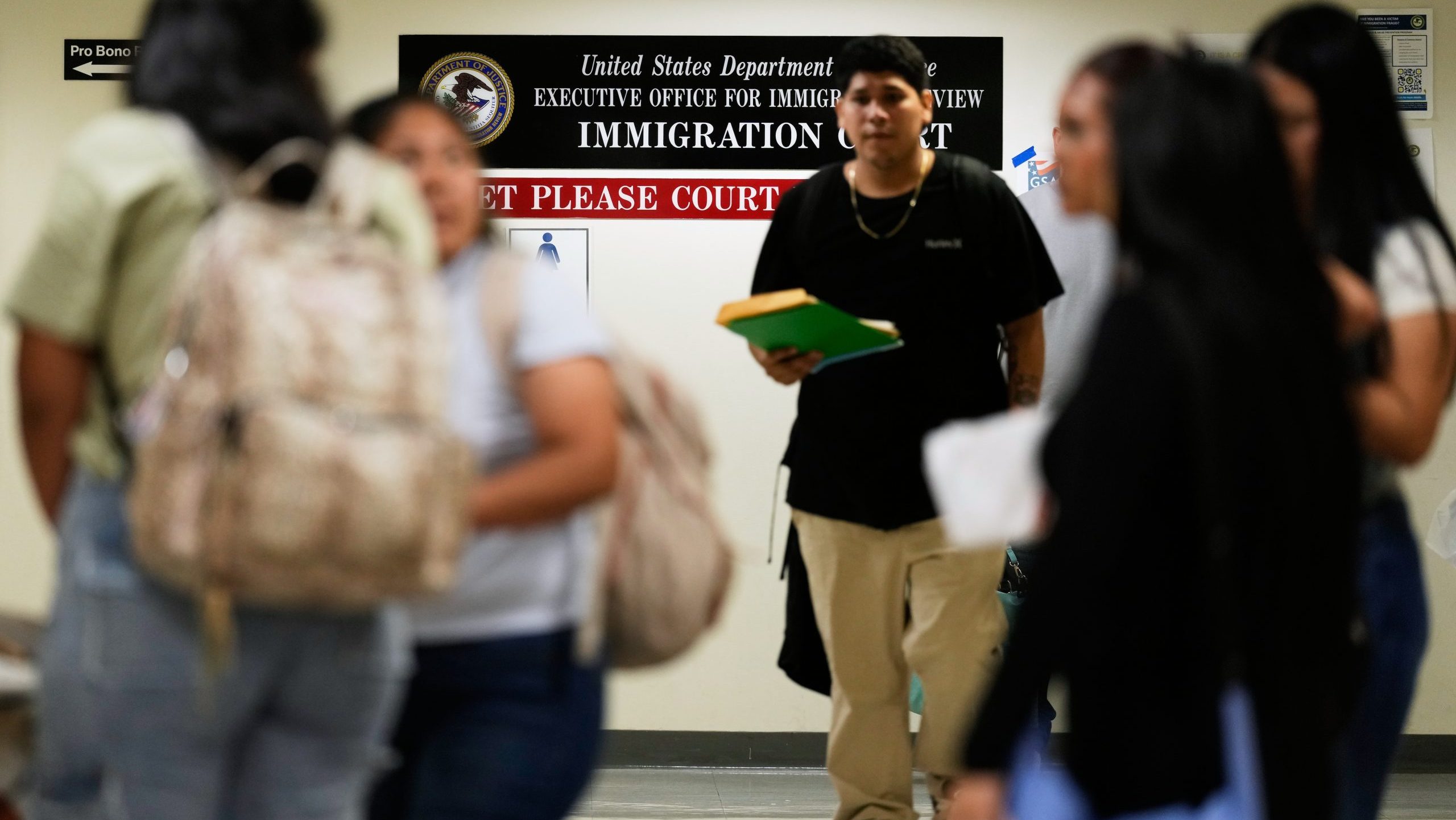


On any given weekday, hundreds of immigrant New Yorkers head to 26 Federal Plaza in Lower Manhattan, where they make their way into dozens of immigration court rooms spread across the 12th and 14th floors of the building — all of which are run by the Executive Office for Immigration Review (EOIR).
On Sept. 11, however, when four immigrant New Yorkers tried to inquire about their case at the main intake window, rather than being directed to a usual courtroom, they were handed a yellow sticky note with the words “3rd floor” scrawled in blue pen.
According to multiple sources who spoke with Documented, that day the government was due to secretly roll out a plan to send New Yorkers attending immigration court at 26 Federal Plaza to offices on the third floor of the building run by the Department of Homeland Security (DHS) — which oversees deportations and acts as prosecutor in immigration court — for their hearings.

Immigrants put on these dockets, called NY1, told Documented they received last-second notices of their new hearings, many after having attended court as recently as two weeks prior. They also cited confusing instructions on where to go for their court appearance, and said they were separated from family and supporters by staff who Documented discovered work for Immigration and Customs Enforcement (ICE) once arriving on the third floor.
The court largely seems to target those who have not hired an immigration attorney, according to dockets reviewed by Documented, making them particularly vulnerable when separated from members of their support system.
Within a few days of the roll out, Documented observed that the new court was finally running after a rocky beginning. The chaos and confusion that shrouded the court, in addition to the heightened anxiety immigrants tend to carry with them at Federal Plaza, meant that at one NY1 docket last Wednesday, set with Judge Brett Geiger, 16 of the 26 respondents never made it to their hearing, which puts them at further risk for deportation.
The new courtroom, housed in DHS offices, is not the first such alternative court location to have been discovered by advocates, but it may be the first time this tactic has been observed in New York. And it remains unclear just how many of these hearing rooms are in operation.
Advocates and elected officials have raised concerns regarding independence of the court, due process and whether the government is attempting to restart arrests at a courthouse previously wracked by violent detentions.
Katie Fleming, who runs a nationwide court watch effort at the Acacia Center for Justice, said that she had many questions for government officials.
“Why are you not informing the public about court locations that you’ve never used before and that are not listed on your website?” asked Fleming. “Why are you using DHS space for respondents when there’s clearly other space available in the building, empty courtrooms where these folks can have their hearings, where observers can go, where the media can go, where more importantly, family members can go observe the hearings?”
“There were a lot of questions, and unfortunately, a lot of questions that I couldn’t answer.”
—Daniela Crespo, attorney and volunteer court observer
Neither EOIR nor DHS responded to Documented’s detailed questions about the new courtroom, but spokespeople for both EOIR and the Department of Justice suggested the effort was related to the need to quickly adjudicate cases and underscored their willingness to continue to expand into new spaces.
“As it continues to add new immigration judges, EOIR will continue to make scheduling adjustments, to include opening new hearing locations as needed, to ensure all cases are handled in a timely and lawful manner,” read an unsigned statement sent by EOIR.
Courtroom chaos
Documented observed four different days at court during the rollout of NY1.
The initiative appeared to have a false start on Friday, Sept. 11, when four people were accidentally sent to the third floor by a front desk clerk.
On the following Monday, one man, who was separated from his fiancée, was sent to the third floor and taken into the new hearing room, according to court observers interviewed by Documented. There, he said he observed two men with green uniforms labeled “police” inside the room. However, he was eventually sent back upstairs when the WebEx connection did not work, said Peter Melck Kuttel, a detention coordinator for St. Peter’s Church who spoke with the man that day.
Two days later, the initiative appeared to be working as intended, with full dockets being sent to the third floor.
Beginning early that morning, before 9 a.m., multiple respondents were sent to a hallway on the third floor where there was a barrier which read “NO PUBLIC ACCESS BEYOND THIS POINT”. There, two women checked their IDs and escorted them into a back room. One woman identified the agency she worked with as Enforcement and Removal Operations (ERO), an arm of ICE, but would not disclose her name to Documented.
When asked about why they were overseeing an EOIR courtroom, the woman said she was only there to make sure the TV worked. Neither Documented nor observers were allowed to enter with respondents.
Hearings were allowed to be observed, however, from an empty 12th floor courtroom. Documented watched multiple appearances on a TV, showing nervous families and single parties sitting in a nondescript room with two rows of 5 office chairs facing a camera, some responding to the judge with trembling voices. The WebEx connected a judge, the immigrant courtgoers, a DHS attorney, and the court clerk, all sitting in different locations in the building.
That day, only 8 people arrived on time and in the proper place for their hearings. Two men initially missed their hearing because they had been waiting at their judge’s regular courtroom.
After being redirected down to the third floor, one of the men nervously muttered in Spanish, “This smells bad,” as he walked down the hallway to the elevator bay.
“This smells bad.”
—Immigration courtgoer at 26 Federal Plaza
One attorney and volunteer observer, Daniela Crespo, accompanied families as far as she could before being turned back and told to observe the hearing remotely on the 12th floor.
“The people I spoke to were really confused because they had just been to court,” said Crespo. “They were confused by the directions they got from the judge during their appearance, which were like, ‘You’re gonna get another notice in the mail with your individual hearing, and I can’t give you that today. And it’s gonna be with another judge, and also the government may take some action on your case before that individual hearing date.’ Just literally nothing about what happened or what would happen next was clear. So there were a lot of questions, and unfortunately, a lot of questions that I couldn’t answer.”
One man scheduled for a hearing at NY1, whose name will be kept private, told Documented that he believes the new initiative is meant to unnerve and confuse people like him.
He had only received the letter notifying him of his hearing the previous day, and despite feeling sick that morning he still arrived an hour early. He initially went to his judge’s regular courtroom — but the door was never opened. When he was finally instructed to go to the 3rd floor, DHS staff took his ID. As he told Documented, he immediately feared that he would be deported.
“All they want is to get you in there and figure out how to deport you.”
—Immigration courtgoer at 26 Federal Plaza
“It just makes you more distrustful — I mean, imagine: You try to do things the right way, exactly as they ask, but instead of acknowledging your willingness to get your paperwork in order and comply with U.S. law, they just want to hurt you. They don’t care about that; all they want is to get you in there and figure out how to deport you.”
More questions than answers
Missed hearings is just one concern about the new courtroom.
“You’re making people who are there in person to see a judge in person go downstairs and do it virtually. That makes no sense. So that begs the question: Well, why would they do that?” Congressman Dan Goldman told Documented. “And my concern is that they are trying to get around and surreptitiously evade the court order from Judge Castel, which prohibits ICE from making arrests at courthouses and outside of courtrooms.”
In May, Documented reported that a federal judge ordered a temporary halt to arrests at immigration courthouses including 26 Federal Plaza and two other Manhattan courthouses.
When Documented inquired about the presence of ICE at the new third-floor hearings, EOIR deferred any questions about ICE staff to DHS, which did not respond to Documented’s inquiry.
Goldman, who represents a district which encompasses Lower Manhattan and the courthouse, pledged to “escalate” his questioning directly with EOIR and DHS.
As of Friday, no arrests have been documented by court watchers or reporters at the new court at 26 Federal Plaza. Harold Solis, a lawyer from Make the Road who had argued for the stay on arrests, told Documented he believes the May court order still applies to the third floor of the building.
Still, the moves have unnerved advocates, who say the new site for hearings undermines due process. Many also expressed concern that immigrants, who once had access to a support network while in court, were now being forced to face court alone, without the right to accompaniment by volunteer observers, press or even family members — supporters who can calm nerves, explain processes alert help if the respondent was able to leave without being arrested.
Olivia Cassin, legal director of the ICARE Coalition and a former immigration judge in the building said holding court in a space governed by DHS gives “the appearance of impropriety” and “collusion” between DHS and EOIR.
“[EOIR] is supposed to act as an independent adjudicator,” she said. “You’re holding your hearing in the space of the prosecutor? What does that do to the process to the system? It renders the process not impartial.”
This month, other major cities have seen such courts being created in unorthodox spaces — a Federal Emergency Management Agency building in Washington DC, an EOIR headquarters in Virginia, the DHS-run basement of a Los Angeles courthouse, amongst others, said Fleming.
“They’re supposed to be an impartial tribunal,” said Fleming, of EOIR, who noted that in some other locations DHS has also been seen working at the new courtrooms. “And when folks are not given a choice and taken to, again, the prosecutor’s office to hold a court hearing without any explanation to that person or publicly, it feels like it’s going down a dangerous, dangerous path.”
“If you give up and leave just out of frustration or fear you will end up with a deportation order.”
—Immigration courtgoer at 26 Federal Plaza
As advocates scramble to understand the ultimate reason behind the use of the third floor hearing room, one courtgoer told Documented he overheard another family saying they were already dissuaded from returning at all due to their fear of arrest.
“Be patient,” he urged the other courtgoers. “If you’re uncertain about something, if the judge doesn’t arrive, ask at the information desk … If you give up and leave just out of frustration or fear you will end up with a deportation order.”