



The Department of Homeland Security (DHS) published a rule on July 17, 2026 that changes how long international students can stay in the United States. The rule was scheduled to take effect on Sep. 15, but a federal district court in Massachusetts has postponed it.
Duration of status remains in effect for now. This order is not a final ruling, and the government can appeal.
This information is not a substitute for legal advice from a qualified attorney or accredited representative. This guide was last updated Sep. 15, 2026.
What would the new DHS rule change?
International students holding an F-1 visa can remain in the United States for as long as their academic programs last, with no fixed end date. This appeared in their I-94 records and admissions stamp as “D/S” or Duration of Status.
The new rule would replace this with a fixed end date. Students would now be admitted until the academic program end date on their Form I-20, for no more than four years. The four years are counted from the program start date on the I-20, not from the day they arrive.
What else would this rule change for international students?
The rule would limit F visa holders’ ability to switch programs or schools. It would also shorten the time to leave after finishing an academic program from 60 days to 30.
Students would be able to arrive up to 30 days before their academic program starts and have 30 days to leave the U.S. after it ends. Neither window counts toward the four years of study.
When does the new DHS rule go into effect?
This new regulation was set to go into effect on Tuesday, Sep. 15, 2026. The rule, however, has been postponed by a federal district court in Massachusetts.
Who else would be affected by the new rule?
The recent changes to the D/S admission period would also affect exchange visitors who hold J visas and foreign journalists who have I visas. These nonimmigrant categories also assign an unspecified period for visa holders to remain in the United States. The new rule would apply a fixed date.
I’m an international student with OPT. Will this new rule affect me?
As of Sep. 15, the new rule does not affect students with optional practical training (OPT). Students will be admitted into the country until the end date on their work permit (EAD), plus a 60 day grace period.
What happens if I need to travel abroad?
Traveling is still allowed.
Before you travel, here’s what you would need to prepare:
- Check your visa stamp. Make sure your visa stamp covers the length of your stay. If it’s expired, you’ll need a new one from a U.S. consulate abroad before you can return.
- Get a travel signature from your designated school official (DSO) on your I-20, signed within the last 12 months, or six months if you’re on OPT.
- Check the program end date on your I-20. That date sets your new I-94 date, so an outdated I-20 shortens your stay.
- Don’t travel with a pending change-of-status application. Leaving the country means abandoning the ongoing petition.
You can also check out Documented’s guide on traveling abroad as an international student.
What happens if I need to extend my time in the U.S.?
First, you would talk to your designated school official. Colleges and universities usually have a dedicated office that focuses on international students’ matters. Here’s the link to some of them, based in NYC:
- Columbia University’s International Students & Scholars Office
- New York University’s Office of Global Services
- The City University of New York’s International Students & Scholars Services
- The New School’s International Student & Scholar Services
You can apply for an extension of stay with the U.S. Citizenship and Immigration Services (USCIS) before your status expires. This process can start as early as 180 days before the status expires. Another option is to travel abroad and re-enter to get a new admission period.
How do I file an extension to my study?
First, check your I-94 record. If the date already matches your program end date, you don’t need to do anything now.
If your program runs longer than your I-94 date, or you need more time to finish your current study, you have two options:
- Apply for an extension. Ask your DSO to update your SEVIS record and issue a new I-20 first. Then submit Form I-539 (Application to Extend/Change Nonimmigrant Status) and make sure USCIS receives it before your Admit Until Date passes. You’ll need to give biometrics. Check current fees and processing times on the USCIS website.
- F-2 dependents can be included on your application or file their own. DHS recommends filing 180 days ahead.
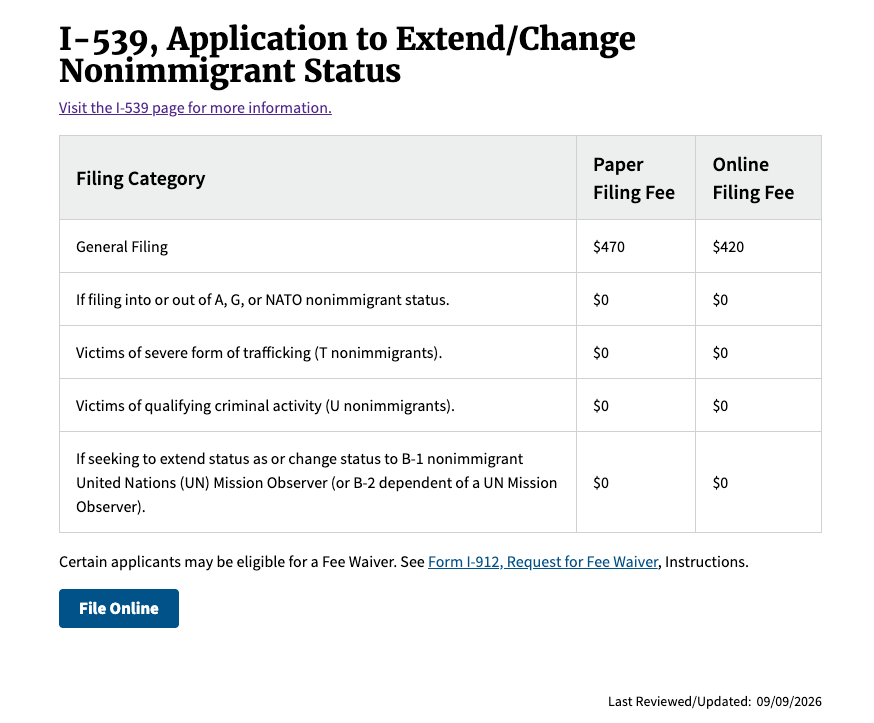
Photo: USCIS Website
- Or travel and re-enter. Leave the country and get a new I-94 and a new end date from a CBP officer when you come back. No need to file I-539. But re-entry isn’t guaranteed: if your visa stamp has or is close to expiring, you’ll need a new one, which may subject you to long appointment waits, administrative processing or a denial that leaves you stuck outside the country.
However, this new rule needs clarity as it goes into practice. “Be aware that USCIS may apply restrictive standards when reviewing I-539 petitions for extension of status. Acceptable justifications for extensions of students’ academic programs include compelling academic reasons, documented medical conditions, or circumstances beyond the student’s control,” says Cornell University’s Office of Global Learning in its analysis of the new rule.
Talk to your school’s DSO before choosing either option.


