

On the third floor of 26 Federal Plaza in New York City, nearly a dozen men and women from countries such as Venezuela, Colombia and Haiti were packed inside a small, dilapidated office room.
The immigrants sat in 12 chairs, shoulder-to-shoulder in a semi-circle so they could be seen by a judge who was watching them through a camera perched above a TV screen.
“This is the first day we’re having people come down here,” a voice in the hallway nervously chuckled, the room becoming stiflingly warm with body heat despite the chill autumn air outside.

The courtgoers were attending the new NY1 docket, part of a system of nationwide “shadow court” rooms run by the Department of Homeland Security at 26 Federal Plaza.
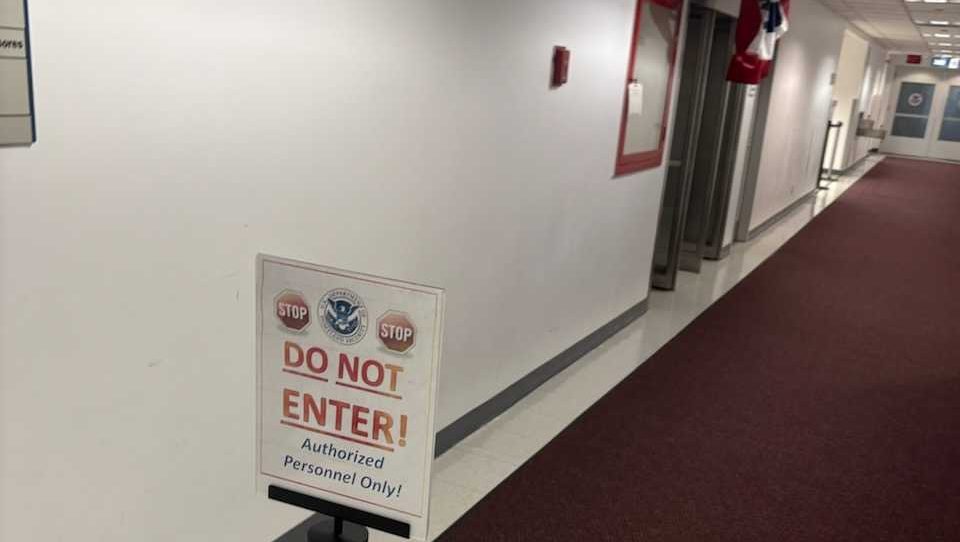
Until Monday, these third floor rooms were closed to outsiders and immigrant New Yorkers were checked in by personnel who worked for Immigration and Customs Enforcement (ICE), which advocates nationwide condemned as a threat to due process.
This week, however, the hearing rooms were opened to the public for the first time, and run by regular court staff from the Executive Office for Immigration Review (EOIR). It was one of the first such courts to be reported to have opened their doors to observers.
Some advocates called it a win for transparency. Still, they warned about other concerning practices observed by Documented: cases being processed at breakneck speed; only one person in each family being advised of their rights; a remote judge calling in from outside New York state who insisted on following legal precedents of his own federal court district, as opposed to New York’s. Hearings being held in rooms owned by DHS, which amounts to courtgoers having to attend their hearings on the prosecutor’s turf.
“It’s really highlighting the fact that we don’t have this independent adjudicatory body. We’re supposed to have the court deciding things, DHS counsel on one side, and then the respondent and their counsel if they have it on the other, and that’s really not what we’re seeing here,” she said.
EOIR declined to comment and directed questions about the hearing rooms to DHS. DHS did not respond to questions about the courtrooms or comment on Documented’s observations.
“We’re taking away due process from people,” said Van Hofwegen.
Office Room 320
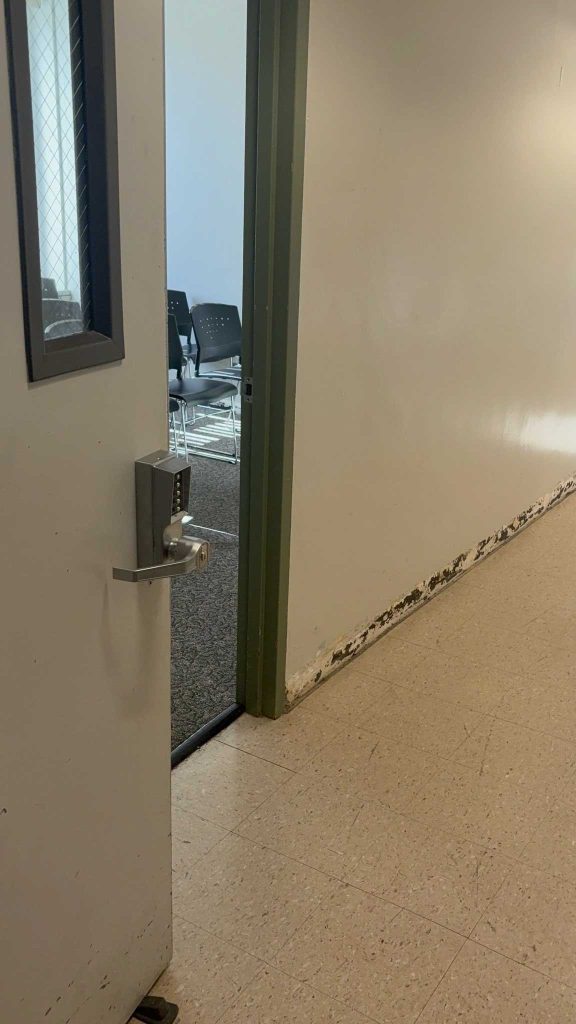
Before 9:30 a.m. a staffer who identified himself as working for EOIR, checked respondents into a small office room labeled “320” which had peeling paint and torn up baseboards. The room had 10 office chairs placed tightly in two rows, where nervous courtgoers from Venezuela, the Dominican Republic and Colombia sat, shaking their legs and rustling papers as they waited.
As more families arrived, the clerk squeezed some additional chairs into the front row, so at least the courtgoers’ legs were in view of the periphery of the judge’s camera.
The clerk only allowed one representative per family — which he told the judge was because of space restrictions — into the courtroom as women and children waited in a busy waiting room across the hall.
When the judge un-muted himself at 9:40 a.m., his face appeared on one of multiple squares split across a large TV screen: one with courtgoers in office chairs, one with a government attorney, another with a Spanish-language interpreter, and in the middle, the judge, beaming in from Virginia.
“This is Judge James Ingold of Richmond Adjudication Center on behalf of the New York Immigration Court. Respondents are present and unrepresented today,” he declared.
Ingold was the former chief deputy clerk at the U.S. Bankruptcy Court in the Eastern District of Virginia and a recent appointment by the Trump administration.
Through a Spanish interpreter, the judge walked through the rights the pro-se defendants (meaning people who represent themself in court without a lawyer) had in court, such as to hire a lawyer, to information on free legal services, to an appeal and more. However, since only one family member was allowed in the room, these verbal reminders were not provided to the several other family members who were being kept across the hall — a reality which Sara Van Hofwegen, managing director of programs at the Acacia Center for Justice, found especially troubling.
“Each adult right needs to be able to speak for themselves and have a right to respond to the notice to appear themselves, and if they aren’t getting the advisals, then they aren’t going to be aware, even minimally, of what their rights are and what the situation is,” Van Hofwegen said.
“Ma’am, where is your son, Joel David?” Ingold asked one woman from Venezuela. A staff member opened the door, bringing in Joel David from a large waiting room across the hall.
After swearing the family in, he asked: “Do you agree that you arrived illegally in Presidio, Texas in or about April 16, 2024?”
“Yes,” Joel David said.
He and his mother were found removable by the judge. They were one of multiple families subject to similar questioning.
“Are you afraid to return to your home country?” Judge Ingold also asked.
“Yes,” Joel David replied.
The ‘Third Floor Phenomenon’
The first few cases of the day moved extremely quickly — each taking less than a minute — as the judge simply asked, “Do you want more time to find a lawyer?” before scheduling the respondent’s next hearings when they answered in the affirmative.
Respondents’ next court dates were scheduled with quick turnarounds. For example, some were given only two weeks to find an attorney ahead of their next scheduled court date. This expedited timeline to find an attorney would be “if not impossible, unbelievably difficult,” said Benjamin Remy, who works as a rapid-response attorney in 26 Federal Plaza with the New York Legal Assistance Group.
As the judge quickly cycled through cases in the cramped office space in New York City, the judge insisted on using fourth circuit case law — based in Virginia, where he sat — which has different standards than New York on things like how to apply asylum law. This is also something that differentiates the third floor courts from the traditional ones upstairs in Federal Plaza.
A paper rack, which in regular courtrooms would normally be full of information on free attorneys and how to apply for various legal statuses or forms for changes of address, sat empty.
“I think it kind of raises a really fundamental question about this entire third floor phenomenon … You know, you could go upstairs and find an empty courtroom that does have all that paperwork in it already, right?” said Remy.
From the start, the change in venue disorientated staff and courtgoers. The rollout of these third floor hearings has been tumultuous, adding even more barriers to navigating an already stressful system. Immigrants have reported late hearing notices and being misdirected by staff with the risk of deportation on the line.
As recently as last Wednesday, a pregnant Haitian woman, dressed in a smart blue and black suit for her court hearing at 11:30 a.m., kneeled down to the floor of 26 Federal Plaza. Exasperated, she wiped her face as a nearby courtgoer consoled her.
“I came here at 9 a.m.,” she told Documented in Haitian Creole. It was 12:30 p.m., and she had been locked out of her courtroom. A removal order had been placed on her name and her case was closed after she had been misdirected by staff multiple times to the location of her hearing.
The woman, whose identity Documented is not sharing for privacy reasons, had received a notice mailed to her dated Sept. 11 indicating she had to appear at the courthouse — but it did not name the judge or courtroom where her case would be heard.
Advocates like Remy note that all of these events underscore how even small bureaucratic changes can have significant impacts on whether a person is allowed to stay in the United States, or is deported.
“It’s this evolution of impossible situations. And that can be these really big ones, such as getting detained if you walk inside a court, right?” said Remy. “Or it can be something, you know, certainly more technical and more minor, but just as insidious. … that might put someone in a position where they are more likely to get an order of removal and abstention.”
Still, he called the opening of the third floor courtroom “vindicating.”
“I was certainly very pleased to hear that it’s been opened up, and at least there can be eyes-on in terms of what’s happening down there,” he said.