

Last year, urban farm workers at Brooklyn Grange made history when all 15 workers voted unanimously to join the United Farm Workers union. It was the first time an urban farm union was formed in New York City.
Now, a year later, the workers say contract negotiations have stalled. The company’s management, which operates four commercial rooftop farms across the city, refuses to meet the workers’ demands, including wage increases, stable work schedules, hazard pay, and healthcare benefits.
“We didn’t expect this much pushback and opposition because of their very progressive image they put out,” said Joan Hwang, a 29-year-old farm worker and immigrant from Korea, who has worked at Brooklyn Grange’s Sunset Park location since 2020.

Hwang added that the company has been dragging its feet in meeting the workers’ demands during negotiations.
Read More: Forming a Union: A Guide for Immigrant Workers
“It’s been this long because we have had obstacles from almost every step of the way.”
The union filed for impasse and mediation with the New York State Public Employment Relations Board (PERB), the state agency that enforces New York State’s landmark Farm Laborers Fair Labor Practices Act (FLFLPA), in July, and the date of the first mediation session was held on Oct. 16. Mediation is ongoing.
“Stalling has been their go-to tactic,” said Hwang. “When it comes to increasing pay, they are refusing to meet us on that.”
Yana Wu Feng, a 33-year-old worker at Brooklyn Grange’s Sunset Park farm and an immigrant from Venezuela, says the fight for a fair contract is part of a larger battle for farm workers’ rights.
“It started with a very direct desire to get better pay and better benefits across the board,” Feng said. “But as we started organizing and talking to each other more, it evolved into this bigger picture where we want to support and be part of this collective liberation for all farm workers.”
Most workers file for union recognition with the National Labor Relations Board (NLRB), but because agricultural and farm workers are not protected under the federal National Labor Relations Act (NLRA) of 1935, a decision many have said was rooted in systematic racism, PERB was the workers’ only option for union recognition.
Lawmakers passed FLSA in 2019, and the law took effect in 2021. The bill spurred a surge in farm worker organizing across the state as workers were given the right to organize a union without fear of retaliation.
Since 2021, United Farm Workers (UFW) has taken the lead in unionization efforts, organizing five farms in Upstate New York, as well as the four urban farms at Brooklyn Grange.
And while Brooklyn Grange’s union drive may have marked UFW’s organizing muscle in New York City, it also represents the growing strength of the farm worker movement in the state.
“Whether in the fields of California, the orchards of Upstate New York, or rooftop farms in the heart of New York City, our struggle is one,” said Armando Elenes, UFW secretary treasurer. “Every farm worker deserves to be able to afford to live comfortably in the communities they feed. The first UFW contract in New York City limits shows there is nowhere the UFW will not go to fight for farm workers.”
Still, for workers at Brooklyn Grange, the heart of their fight — increased wages and job security — remains unsettled.
The workers, who only work roughly six months out of the year on both part-time and full-time basis, earn about $21 an hour. They are seeking to raise the wage to $26 an hour. They also want to have set schedules throughout the 6-month growing season.
“There is some inherent peculiarity in terms of job security,” said Hwang. “One of our main goals is to guarantee our season lengths as well as the shift because it’s already a seasonal job, so we would like for our job security to be guaranteed.”
Feng agrees.
“It’s very challenging for seasonal workers, because it’s our main source of income, so if they claim there’s not enough work and cut our shift, it makes a big difference.”
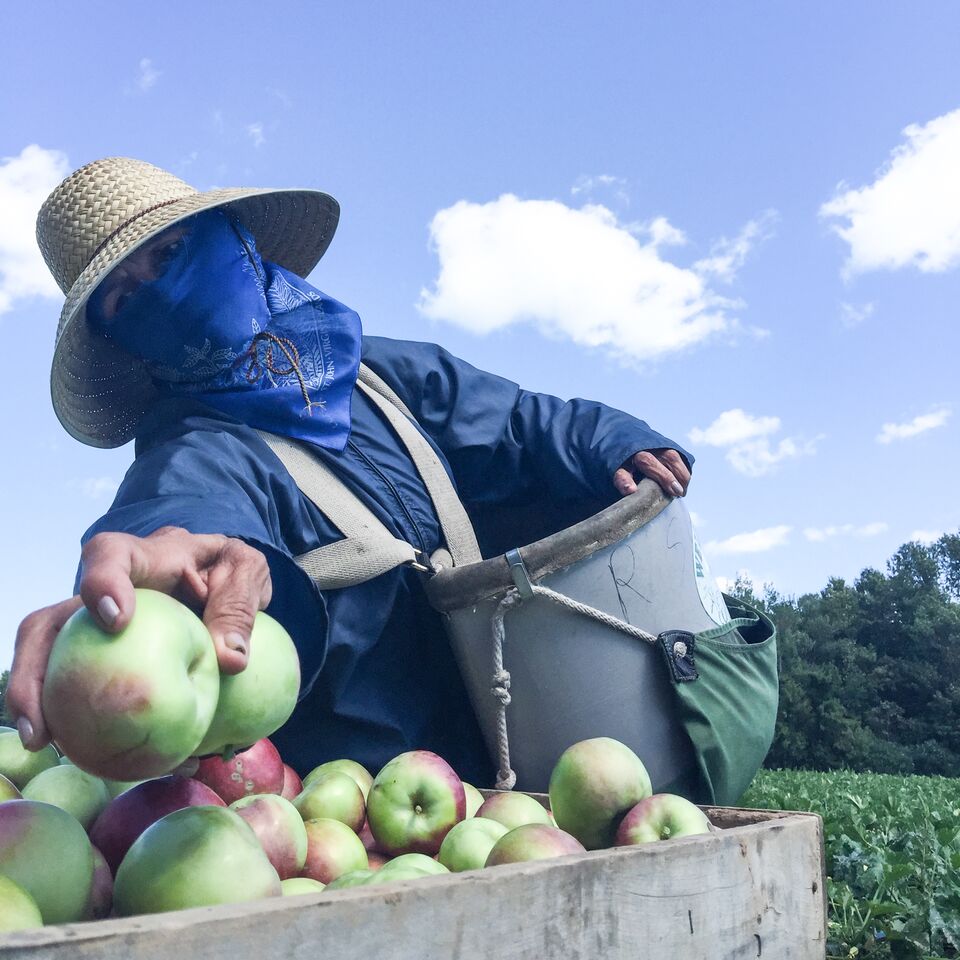
Employee-provided health care is also a vital demand given the physically demanding nature of the job. Most of the work on the farm, like planting and harvesting, is done by hand.
“Season after season, my body is getting more tired,” said Feng. “The pains and aches are getting worse every year.”
Brooklyn Grange runs two rooftop farms in Brooklyn, one in Sunset Park and the other at the Navy Yard. It also operates a farm on Staten Island and on top of the Jacob Javits Center in Manhattan.
It’s two farms in Brooklyn span nearly five acres and produce over 80,000 lbs of organically-grown vegetables per year. According to Brooklyn Grange’s website, most of its produce is sold at green markets across the city, with nearly 60% of its annual yields distributed to New Yorkers at no or low cost.
Its sprawling Sunset Park farm, which sits atop an industrial warehouse, is reminiscent of Mount Roraima, the South American flat-topped mountain that served as inspiration for Arthur Conan Doyle’s novel “The Lost World.” At 3.2 acres, it’s by far Brooklyn Grange’s largest farm that stands out as a lush green island oasis floating amidst a gray urban industrial sea.
Neighboring Sunset Park’s vibrant Chinese community, Brooklyn Grange focuses the Sunset Park farm on growing crops like choy sum, bok choy, and chrysanthemum greens — common ingredients in Chinese cuisine.
For Feng, the struggle at Brooklyn Grange is also about laying the groundwork for others to join their movement.
“Not only are we farming, but we are serving the community of Sunset Park, which is a largely immigrant and working-class community,” said Hwang. “We distribute the vast majority of produce we grow right into the community.”
Brooklyn Grange’s mission to expand access to locally grown produce for New York City communities is what drew Hwang to the job and inspired her to form the union.
“Unionizing allows us to have job security, increase wages, job protection, and increased voice in the workplace, but we take this work seriously,” she said. “We love our jobs, and this started because we care about the future of the company that we have devoted so many years to.”
Representatives for Brooklyn Grange did not respond to Documented’s multiple requests for comment.
Correction November 5, 2025: An earlier version of this story misidentified the Farm Laborers Fair Labor Practices Act as the Farm Laborers Fair Labor Standards Act. This story has also been updated to include the correct dates for the union’s request for mediation.