

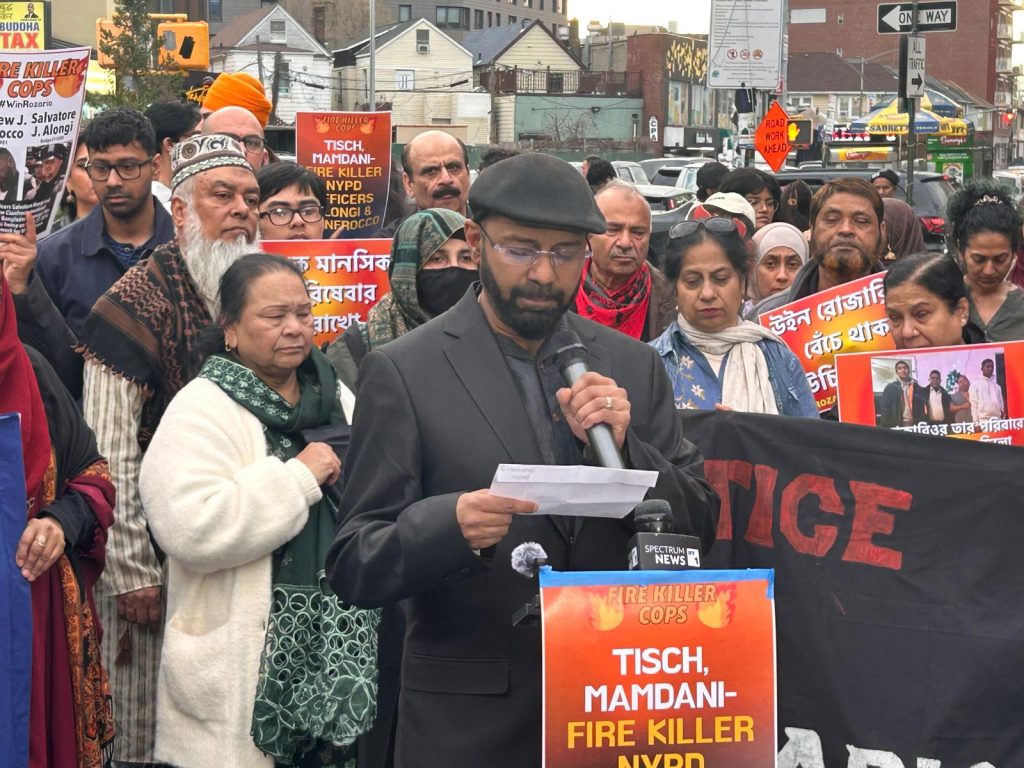
Hector Chakraborty is no stranger to public speaking — he has been the pastor of the First Bangla Baptist Church in Queens since 2020. But when addressing 50 South Asian community members at an event one April evening, his voice was quiet.
He had been asked to speak at a remembrance event for Win Rozario — a 19-year-old Bangladeshi man from Queens who had struggled all his life with anxiety and depression, and who was shot dead by the NYPD two years earlier after he called 911 while experiencing a mental health crisis. The officers opened fire after Rozario picked up scissors from a kitchen drawer and moved towards them.
The remembrance was held just weeks after Chakraborty’s son, Jabez, 22, who was diagnosed with schizophrenia, was shot four times by NYPD officers responding to his family’s 911 call requesting an ambulance during his mental health crisis. Bodycam footage released by the NYPD in February showed two police officers entering the house after a family member answered the door. Jabez Chakraborty, who was in the kitchen holding a knife, is seen on the video moving toward the officers. The police officers retreated to the entryway of the house before shooting at Jabez when he opened the door. Jabez is recovering from his injuries at a hospital in Queens, where he faces charges of attempted assault and criminal weapons possession.
The two cases have prompted calls within New York’s Bangladeshi community for alternative responses to mental health crisis calls — ones that do not involve police officers. “How can we live in the richest country in the world and not have a better solution for people struggling with their mental health?” Hector Chakraborty asked the crowd at the remembrance event.

Mamdani’s promise to the community
For some South Asian New Yorkers, the two strikingly similar incidents have become the standard against which they plan to measure Mayor Zohran Mamdani. They see this as a moment to assess how he will navigate the needs and expectations of the South Asian and immigrant communities that were central to his mayoral victory, as well as the campaign promises he made to them on policing and mental health.
Over 40% of the estimated 270,000 Bangladeshi Americans nationwide live in New York City — a population that has grown more than sixfold since 2000, according to Pew Research Center. This growing community proved to be a force in the 2025 NYC mayoral election, where it asserted itself politically — not only at the polls but also in the streets — with scores of Bangladeshi aunties canvassing their neighborhoods and speaking at public forums in support of Mamdani.
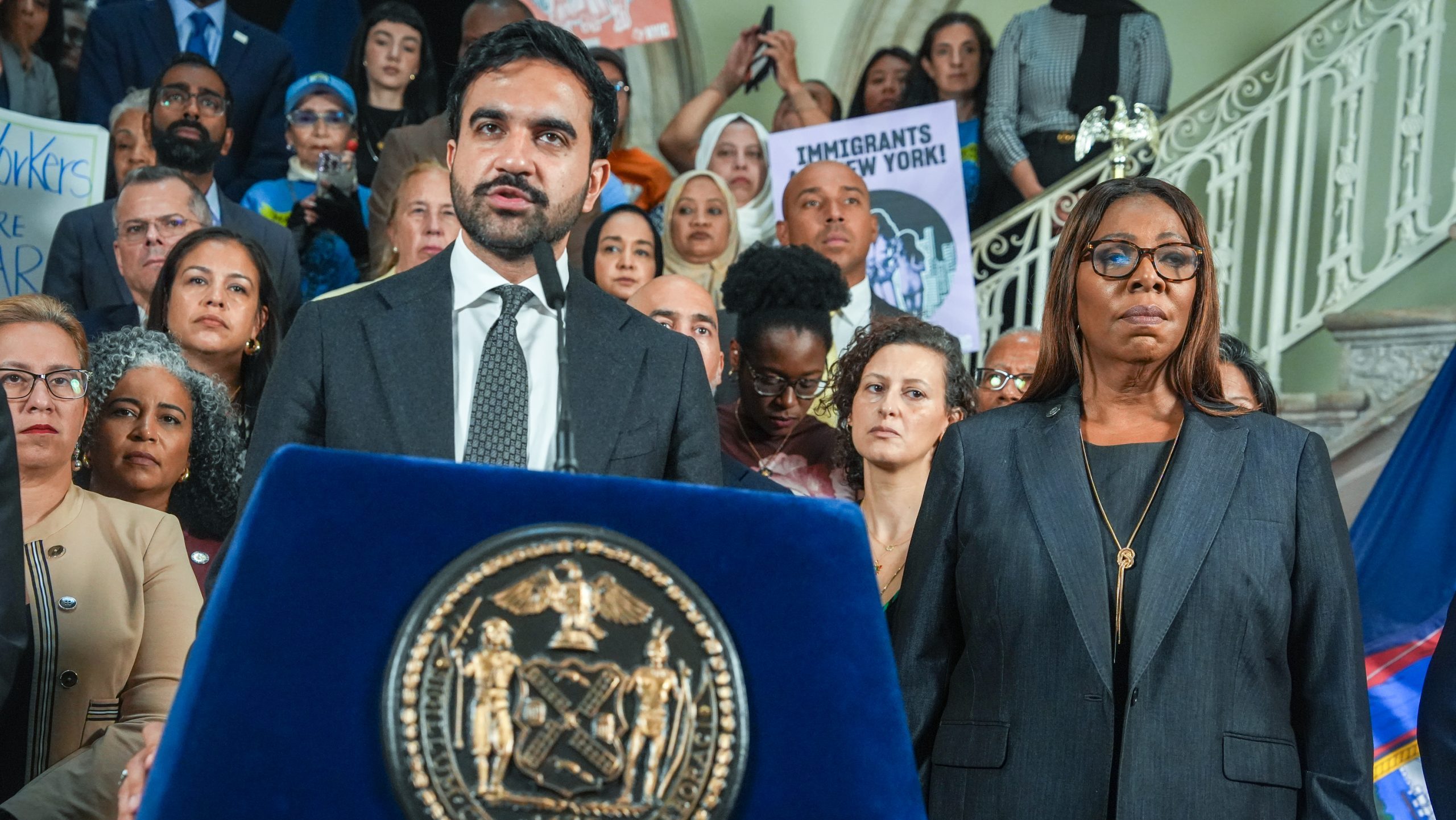
Last year, Mamdani spoke out about Rozario’s death during his mayoral campaign, and a key part of his platform hinged on a proposal to send mental health workers and paramedics to crisis calls instead of police. The program, he vowed, would be executed through a new Department of Community Safety (DCS) and by expanding B-HEARD — the Behavioral Health Emergency Assistance Response Division, a pilot program that dispatches mental health clinicians and paramedics to crisis calls. The program currently runs in 31 of the city’s 78 NYPD precincts, which does not include the Queens precincts in which Chakraborty and Rozario were shot.
Since taking office, Mamdani has appointed a Deputy Mayor for Community Safety but has yet to announce specific plans for how the city plans to change the response system. The mayor’s office did not respond to questions about how the Department of Community Safety would handle mental health crisis calls. Just two weeks ago, the City Council passed legislation requiring the Mamdani administration to submit regular performance reports on B-HEARD, including data on call volume, response times, and outcomes.
‘People call for help and they’re killed’
In the weeks before Jabez Chakraborty was shot, his family said they had tried every avenue for mental health help the city offered. According to a report by THE CITY, after Chakraborty attempted suicide by drinking bleach back in December, his sister called 988, the city’s non-police mental health line, and requested a mobile crisis team. The team arrived two days later, stood outside the family home, asked Chakraborty a few basic questions, and left without transporting him to hospital, as reported by THE CITY.
On the advice of his psychiatrist, the family then called 911 requesting an ambulance for an involuntary transfer to hospital. Police arrived instead and Chakraborty was taken to Queens Hospital, where his family was told he would qualify for longer-term inpatient treatment — but he was discharged after three days. The family then applied to an intensive daily treatment program at another hospital and was put on a waiting list. Chakraborty was accepted the day after he was shot, according to THE CITY.
“We are at a point where this refrain is too common, where people call for help and they’re killed, or their family member is killed, and there’s no accountability for the people who kill them and no change in the system that caused those people to be there in the first place,” said Jumaane D. Willians, New York City’s Public Advocate. “Right now, our system is best equipped to provide a criminal response for someone who needs a health response.”
Activists with Desis Rising Up and Moving (DRUM), which organizes low income South Asian and Indo-Caribbean immigrant communities in New York, said the two cases point to a deeper problem. DRUM was among the first organizations to endorse Mamdani’s mayoral campaign, and their members canvassed heavily for him in South Asian neighborhoods in the city.
The activists acknowledge that police officers responding to a mental health call and finding someone holding a weapon face a difficult situation. But they say this is precisely why trained mental health professionals should be responding to crisis calls and not armed officers.
“The fact that the same incident with the same pattern keeps happening over and over again indicates to us that there is a systematic problem, said Fahd Ahmed, executive director of DRUM. “The very presence of the police escalates the situation, and the police then fire their guns, either killing or severely injuring the people that needed help.”
In Jamaica Hills, the Queens neighborhood where the Chakraborty family lives, 67% of voters supported Mamdani in the mayoral election. Hillside Avenue, the neighborhood’s busy thoroughfare, is speckled with businesses owned by Bangladeshi New Yorkers.
“There has been a lot of conversation in our community about this especially after Jabez was shot and people are more afraid to call 911 for help,” said Sady Mahmudulla, who runs a restaurant in Jamaica Hills. “This is happening at a time when there are already fears about [Immigration and Customs Enforcement] within our communities. We hope that the mayor can bring a change to the way these cases are handled.”
More Bangladeshi American Officers Join NYPD
Rozario is among 24 people killed by the NYPD while experiencing a mental health crisis in the last decade, the same period in which the number of Bangladeshi Americans joining the NYPD has grown rapidly. Around 1,000 of the department’s roughly 34,000 uniformed police officers are now Bangladeshi Americans, according to the Bangladeshi American Police Association (BAPA) — a growing fraternal organization within the force.
“We were told that the presence of these officers would make our communities safer. That’s still quite up for debate,” Ahmed said, before adding, “What should not be up for debate is that when these instances happen, those officers and people in our communities should be clear on whose side they stand. Are they going to stand with the people that were victimized and who deserve justice?”
Others from the community noted that when NYPD officer Didarul Islam, a Bangladeshi American police officer, was killed in the line of duty last year, BAPA helped raise over $500,000 in an online fundraiser in support of the slain officer’s family. Some in the community pointed out that BAPA has not spoken out about both Rozario and Jabez Chakraborty’s shootings. “We’ve seen electeds preach about issues like police accountability, but now they’re silent for incidents like these when it happens to be for a Bangladeshi, South Asian household,” said Mahtab Khan, an organizer with Muslims for Progress based in Queens.
DRUM established a GoFundMe campaign for the Rozario family, aimed at helping them pay for wake and burial expenses as well as to cover the costs associated with moving homes — something they chose to do so that they would not have to relive the death of their son each day. The fundraiser barely met its $25,000 goal.
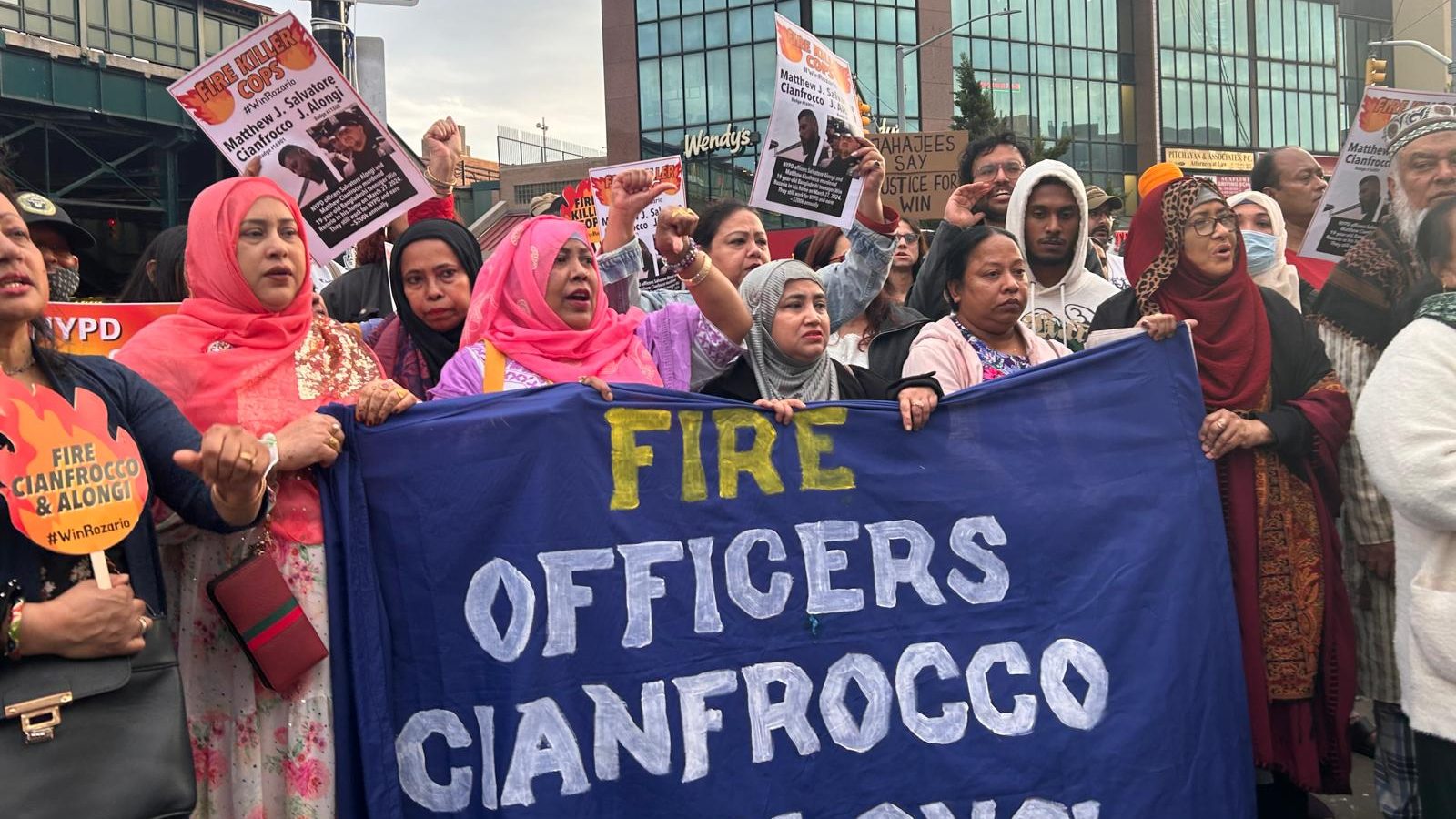
Many in the community also point out that the officers who killed Rozario have not faced consequences. Two years after Rozario was shot dead in the family’s Ozone Park home, the officers involved in the shooting — Salvatore Alongi and Matthew Cianfrocco — remain on the force. Last September, the Civilian Complaint Review Board (CCRB), the city’s independent oversight body for police misconduct, substantiated four allegations against each of them, including excessive force and abuse of authority, and filed disciplinary charges. In December, New York State Attorney General Letitia James declined to pursue criminal charges, saying the officers’ use of force could not be disproved as unreasonable beyond a reasonable doubt.
The NYPD did not respond to questions about the status of disciplinary proceedings against the officers involved in the death of Rozario. On the shooting of Jabez Chakraborty, they directed Documented to the release of body camera footage. The Bangladeshi American Police Association did not respond to a request for comment.
‘Police are not the solution’
In the wake of their son’s death, Rosario’s family said that the fear of calling 911 has spread through the community.
“I cannot explain the deep pain and suffering we are living with after losing Win,” said Eva Costa, Rozario’s mother. “These systems need to be changed. Otherwise, more families like mine will be forced to live with this emptiness and grief. People call 911 to get help. But because of this broken system, many are now afraid to call 911,” she added.
Similarly, the Chakraborty family remains gripped by frustration and worry.
“Our family spent years trying to navigate this city’s mental health system, and it was only after Jabez was shot by the NYPD that he received a seat at a treatment program,” Hector told the gathering at Diversity Plaza. “The police are not the solution. People struggling with mental health issues deserve to be treated as human beings facing a problem.”