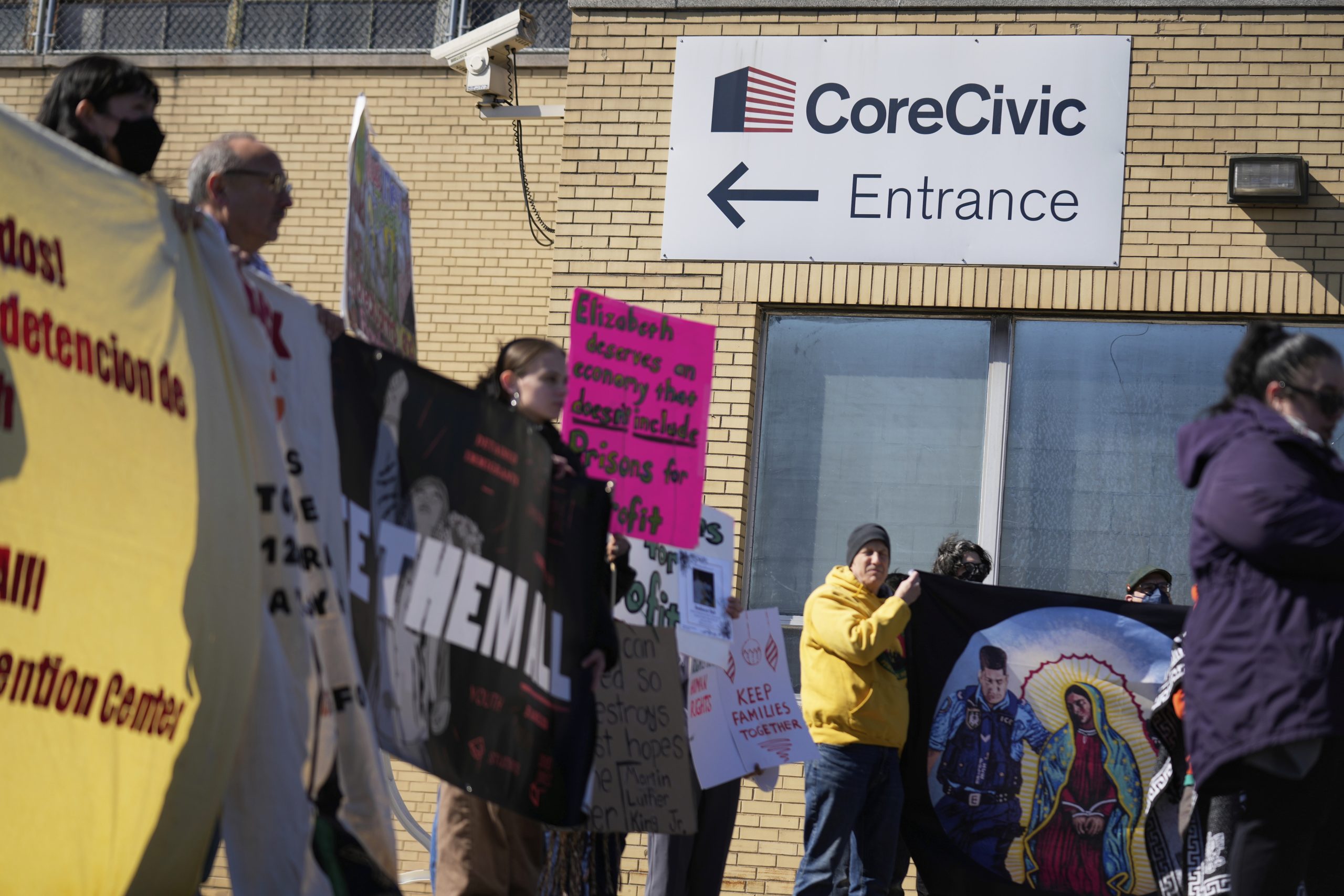


John M., a Romanian man from Flushing, Queens, was recovering from cardiac bypass surgery last July when he was unexpectedly detained by U.S. Immigration and Customs Enforcement agents who were looking for his ex-girlfriend.
ICE sought to deport him, but couldn’t send him to his native Romania: In 2020, an immigration judge had denied asylum to John M. but granted him withholding from removal to his homeland based on evidence that he would likely be persecuted there. The agency couldn’t find a third country to send him to, and he was released.
Now, five years later, ICE justified rejailing him at the Elizabeth Detention Center in New Jersey by claiming it could “expeditiously” find a third country to deport him to “in the reasonably foreseeable future.” But that was false, and John M. was left to languish in ICE detention for months while facing a life-threatening health crisis.

During the 128 days ICE jailed John M. on the erroneous assumption that Germany, where he had briefly lived, would accept him, the agency had to hospitalize him six times with life-threatening complications from his diabetes and serious heart disease, according to court documents. ICE sent him back to jail even after a doctor wrote that he “has been hospitalized for an acute stroke with severe speech and swallowing deficits and is not fit to return to the ICE detention facility.” Two months later, on Oct. 23, he was hospitalized again with a painful blood clot in his leg that left him unable to walk. A judge then ordered his release. (John M.’s lawyer asked that Documented not use his full name for safety reasons.)
John M.’s case is one of hundreds in which ICE has tried to deport people who won a decision in immigration court granting withholding of removal to a country where they would likely be persecuted or tortured. They’re being re-arrested and jailed long-term based on ICE’s assertion that the government will soon have another country to deport them to — a claim that often turns out to be false when tested in federal court, and part of a pattern of due-process violations that Documented has found in a survey of similar court cases across the country.
His story, in particular, shows the lengths the Trump administration is willing to go in pushing its policy of immigration detention “to the extent permitted by law.”
Since Jan. 1 of this year, federal courts have issued at least 167 orders freeing people like John M. — who’d proved they’d likely be persecuted or tortured in their homeland — mainly because ICE, contrary to its claims, had no reasonable chance of finding a third country for them any time soon. The government prevailed in 35 cases, mostly because judges said the petitions were brought prematurely.
When judges ordered that the government submit evidence for its claims, they often determined there isn’t any at all, Documented found in a review of federal court records. “Vague,” “bald assertions,” “nearly weightless,” “language vague to the point of boilerplate”: this is how federal judges described ICE’s basis for detention in these cases.
Upon an inquiry into John M.’s case — including a review of his medical care while in custody — Judge Esther Salas of U.S. District Court in Newark ordered his release. After months of claiming otherwise, the office of then-U.S. Attorney Alina Habba told the judge on Oct. 29 that Germany, where John M. had once lived, wasn’t willing to accept him. Habba’s office then asked to continue detaining the man while ICE searched for another country. The judge rejected that and ordered John M.’s release. (His attorney declined to comment.)
ICE began sharply escalating its third-country removals in the weeks before Donald Trump officially began his second term, in anticipation of the new administration’s policies. From January 2025 through March 10 of this year, ICE deported at least 1,670 people to countries that were not their own, according to Documented’s analysis of ICE data gathered by the Deportation Data Project. For 2025, the number shot up 117% from the previous calendar year. This includes all third-country deportations, not only those involving people who’d been granted withholding from removal.
The government seeks out third-country removals for a variety of reasons: for people who are stateless, for example, or those whose native land won’t accept them because of a criminal conviction or frayed diplomatic relations with the United States.
“There were always certain groups of people — people with very serious criminal records — who even past administrations would have tried to send to another country,” said Rebecca Press, an attorney at the nonprofit legal organization Co-Counsel NYC.
But, historically, a grant of withholding from removal has essentially been a permanent protection against deportation, she said. “The widespread use of third country removals has never been seen before.”
The new emphasis on jailing people who’ve been at liberty for years has been especially jarring for those protected by an immigration judge’s order of withholding from removal. To obtain that order, they’ve proved in immigration court that their lives or freedom would likely be endangered in their native land.
Their horrific past experience “adds a whole level of trauma,” Press said. “It can put them right back in that place.” For her client Aissatou Diallo, a 52-year-old home health aide from Corona, Queens, who’s lived in the United States for close to a quarter-century, the arrest “was terribly shocking. It really does take a long time to recover from this terrifying experience,” Press said.
An immigration judge had ordered Diallo’s removal in 2012, but ruled she could not be sent to her native Guinea, based on proof that she would be persecuted there for her gender and politics.
In 2025, federal agents arrested her at LaGuardia Airport two days before Thanksgiving as she prepared to board a flight to see relatives in Texas. ICE quickly transported her to a jail in southern Louisiana, where it planned to hold her until it identified a third country willing to accept her.
A federal judge ruled that ICE didn’t actually have such a country. “Diallo was arrested and detained for no discernible reason, with no identified risk of flight or danger, no prior outreach, and with no country identified that she could even be sent to,” Judge Arun Subramanian ruled at the U.S. District Court in Manhattan. A government attorney contended in court on Dec. 5 that ICE could jail Diallo for up to six months as long as her deportation was “reasonably foreseeable.” But she couldn’t explain why ICE had to detain Diallo.
“The government’s actions leading up to this case were not only illegal, they were inhumane,” Subramanian later wrote. “And they aren’t unique to this case. This district has been flooded with petitions for relief with similar stories — families ripped apart, and people who pose no danger or risk of fleeing imprisoned with no end in sight, flown to far off detention centers for reasons that the government lawyers who appear in court themselves can’t explain.”
Diallo was eventually released.
A spokesperson for ICE did not comment on the specific cases Documented asked about, but responded with a statement that ICE is “applying the law as written” to deport people with a final order of removal, and that it is respecting their due process rights. “These third country agreements, which ensure due process under the U.S. Constitution, are essential to the safety of our homeland and the American people,” the spokesperson said.
Federal law allows ICE to detain people for a mandatory 90 days after they are issued a final order of removal, giving the agency time to arrange deportation. The Supreme Court’s 2001 ruling in Zadvydas v. Davis held that it’s “presumptively reasonable,” in general, for the U.S. government to hold someone six months before it must demonstrate that deportation is “reasonably foreseeable.” Still, the Supreme Court ruled that the U.S. could not hold non-citizens indefinitely while it searched for a country to deport them to.
Federal court records show that it’s common for people who’ve experienced persecution in their homelands to suffer depression and Post-Traumatic Stress Disorder while incarcerated. That was the case for Ovbokhan Odiase, a 41-year-old mother of two fled from Nigeria after her ex-husband and in-laws wanted to force her daughter to submit to female genital mutilation. Odiase had suffered that same painful vaginal mutilation when she was six years old, she said in court records. She wanted to protect her daughter from that.
Odiase arrived under a temporary visa with her daughter and son in 2020, settling in Newark and working as a home health aide. After she witnessed a fight between a friend and another person in February 2024, Odiase was arrested with her friend and charged with robbery. The New Jersey court released her the next day, but ICE agents took her into custody. Although the criminal charge was later dismissed — her attorney said she was a bystander, not a participant in the dispute she witnessed — it led to more than two years of ICE incarceration at the Moshannon Valley Processing Center in western Pennsylvania.
From the start, Moshannon was a horrific experience, beginning with her arrival in an emotionally fraught state. “Instead of helping me, the guards at Moshannon forced off all of my clothes off until I was naked, while recording me on video,” she said in a sworn statement. “I felt so violated, especially because of my experience when I was younger.”
On Jan. 10, 2025, an immigration judge in Elizabeth granted Odiase withholding of removal to Nigeria. ICE continued to jail her while seeking a third country.
As her detention lengthened, lawyers for Odiase filed habeas petitions, seeking her release. The first, in Newark federal court, was dismissed as premature. Then a case was filed at U.S. District Court in Johnstown, Pennsylvania. Judge Stephanie Haines wrote on July 31, 2025, that Brazil, France, Spain, and Japan had all rejected ICE’s request to accept Odiase — but she denied the release order under ICE’s assertion that Odiase’s removal to some other country was “imminent.”
In early September 2025, officers at Moshannon awoke Odiase at 3 a.m. to transport her to a jail in southern Louisiana. Odiase said in an affidavit that she later learned that a Nigerian woman she met in the Louisiana lockup had been deported to Ghana, which then sent her to Nigeria despite fears of persecution. Odiase appeared destined for the same, she thought, but her pro bono lawyers, Evan Benz of Amica Center for Immigrant Rights and Shira Wisotsky of Legal Services of New Jersey, were able to get a federal court order returning her to Moshannon before the flight left for Ghana.
ICE had, in fact, planned to transport Odiase to Ghana, Assistant U.S. Attorney David Lew acknowledged during a hearing before Judge Haines days later.
Haines said she was troubled that Lew couldn’t explain whether ICE was following its own rules for Odiase. The judge described the process this way: “You’re getting on the plane, we’re not telling you where you’re going, we’re not giving the opportunity basically to be heard on whether or not you have fear of this country or to basically talk to your lawyers about it. … Is that how we’re doing business here?”
She also asked if ICE had any evidence “to refute that Ghana was just sort of a stopover” on the way to Nigeria. Lew responded that the government didn’t have to provide notice if the third country gave “credible” assurances that it would treat the new arrivals properly. He asserted that courts can’t second-guess the government on this. But the judge asked how Lew could claim there were “credible” assurances without any evidence. “I do not have that information,” Lew said.
Despite her misgivings, Haines ruled on Sept. 18, 2025 that she lacked jurisdiction to decide if ICE was violating Odiase’s constitutional rights. She suggested that Odiase instead go back to immigration court to reopen her case there.
Her lawyers had already begun that process. Looking downcast and weary, she appeared by video before Immigration Judge Tamar Wilson in Elizabeth, New Jersey, on Dec. 18, 2025. In the hearing, ICE’s attorney contended there was no evidence that ICE planned at that point in time to deport Odiase to Ghana.
“She’s been detained for years at this time,” Odiase’s lawyer countered.
Wilson paused to consider what was still an unusual request for a third-country removal: “It’s kind of a novel thing even though it’s been on the books a long time,” she said. Wilson later issued a ruling that said she lacked jurisdiction to reopen the case.
Odiase was desperate to get out of Moshannon, where she said she was twice put in solitary confinement. She sought refuge in Canada, where her twin sister is a naturalized citizen. “I am terrified that I will be killed if ICE takes me to Ghana,” she said in an affidavit. “But I am also afraid that I will die in detention. I know of other people who have died at Moshannon recently. Some days, I wish I were dead, rather than be here.”
At least two detainees have died at Moshannon since August, when Chinese national Chaofeng Ge was found hanging in a shower stall with his hands and feet bound behind his back, as Documented previously reported. Some inmates staged a hunger strike last month in protest of conditions at the facility, which is the largest in the northeast United States with more than 1,600 detainees.
By March, Wisotsky, Odiase’s attorney, had been pressing an ICE official for nearly seven months to bring Odiase to the Canadian border so she could request humanitarian protections, the attorney said in court records. Wisotsky brought Odiase’s case to Canadian authorities with help from the UN Refugee Agency, UNHCR. On March 26, an ICE official agreed to let Odiase try to enter Canada.
On April 14, ICE agents awakened Odiase at 3 a.m. and drove her the 175 miles from the Moshannon jail to the Peace Bridge near Buffalo. The Canadian border agents gave her pizza, water, medication, and blankets while she waited to be processed, she said.
When it came time for her interview with the border officers, she was crying and shaking because she thought she might be detained again, she said in a telephone interview with Documented. Fortunately for her, the criminal charge in Newark was formally dismissed the day before, and Canadian authorities were given a copy of the New Jersey court record.
An officer told her, “You don’t need to cry. You don’t need to be scared. Don’t worry, we are here to help you,” she said, adding, “At the end of the day they said, `Okay, you can go.’”
By 9 p.m., she was free after 784 days of confinement. To her surprise, her twin sister Odion was there to meet her and, in a second surprise, in a late stage of pregnancy. The next morning, they flew to Calgary, where Odion lives.
She’s grateful for her pro bono counsel — Odiase said she never could have afforded an attorney. But she’s still longing to be with her children, who are 13 and 11 and living with a family friend in the United States. She said she has trouble walking because of pain in her leg. And she’s haunted by her harrowing last few years in the United States.
“I can’t just let go like that,” she said. “I keep thinking about it, which is affecting me. I lost everything that I ever had, everything that I lived for, that I worked for in the United States.”