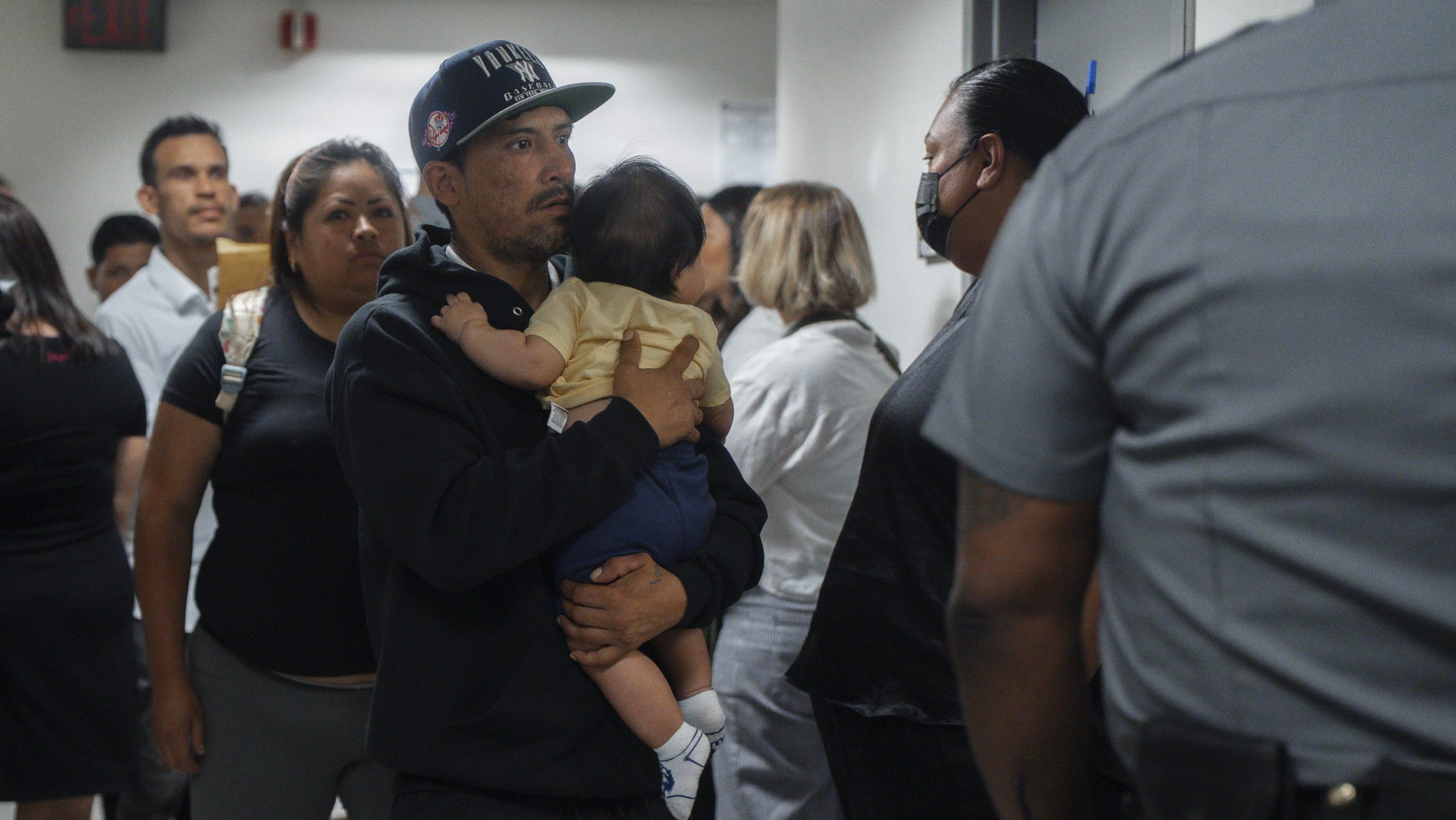


For nearly eight hours, a group of Haitian immigrants and asylum seekers had waited at the Manhattan immigration courthouse on Broadway last Tuesday before they found out it had all been for naught. They would have to come back another time to see the judge.
One man rocked with his head between his hands as the judge explained that all the Haitian interpreters had dropped off their calls.
The dozen or so men, women, and children had received notice as little as a week prior that they would have to appear for a bulk immigration appointment instead of their planned hearings. Many had their hearings suddenly accelerated by multiple months without warning. Some came from as far as Spring Valley, in upstate New York.
Since the beginning of June, immigration courts in New York have adopted a new style of hearing meant to speed up President Donald Trump’s deportation machine. Nicknamed the mega master hearing by the immigration legal community, the hearings adjudicate dozens of people in one day whose appointments have been advanced by months.
A master calendar hearing is an initial hearing where people answer to allegations by the government against them or where sometimes a judge may determine if they may qualify for protection like asylum. But the new, sudden mega master hearings have been catching both immigrants and the courtrooms their cases are adjudicated in off-guard.

Experts say the hearings are meant to speed New Yorkers’ cases toward a removal order and deportation, and erode due process. That is because, in part, many New Yorkers in immigration proceedings aren’t receiving notice in time — and they aren’t showing up. If they miss the hearing, they are likely to be ordered deported, something immigration advocates have called out as the true goal of the policy. This leaves advocates scrambling to spread the news to immigrant New Yorkers to prepare by consistently checking their court dates online and updating their address.
The government’s newest tactic has also burdened judges nationwide with immense single-day caseloads that can include well over a hundred individuals — many times the amount of people they’d see on a normal docket.
Even before this new practice, in-absentia removal orders had already skyrocketed to the highest numbers seen in a decade, in part driven by fear over mass arrests at immigration courthouses.
While data has not yet been released that shows the ultimate impact of the policy, Documented’s visit of one such mega master hearing at New York’s Broadway Immigration Court reveals the impact on the dozens immigrant New Yorkers whose cases were called up that day.
Court in Session
Early on the morning of June 9 at 8:30 a.m., Judge ShaSha Xu’s court came to session. Meanwhile, a line stretched around the block of the Ted Weiss Federal Building at 290 Broadway in Lower Manhattan.
Nervous families, lawyers and advocates were still waiting to enter the courthouse under banners of the African Burial Ground National Monument, housed in the same federal complex.
Nearby, a frustrated security guard began yelling in English. “Guys, let’s have the appointment ready guys!” he said, attempting to call families with morning appointments at the front of the line.
People with paper appointments in hand, discussing what he could be saying in a variety of languages, were eventually encouraged to come forward by those who understood the guard.
One lawyer in line refused to be advanced into the courthouse to hold place for her tardy client.
By 9:30 a.m., all but court observers were left waiting on the street.
The waiting room
Past the dozens of people packing a windowless waiting room, Xu’s small courtroom held three rows of wooden benches. There sat the lucky few with appointments that day who also had legal representation.
But of the cases advanced to Xu’s mega-master hearing last week roughly 40 people were without lawyers, nearly twice the amount of represented immigrants, and roughly 16 no-showed, according to I-ARC and statements by the judge.
Also Read: Immigration News Today: Lawyers Band Together to Fight Trump’s Deportation Machine
“I know I saw some of you less than two months ago. I recognize that,” Judge Xu told attorneys inside her courtroom at 9:30 a.m. “And, here we are.”
Inside the courtroom, many clutched folders or briefcases with documentation about their case, using their documents as makeshift fans in the stale air. Multiple screens on the wall showed the call-ins of various interpreters, waiting for their turn to help the judge communicate with courtgoers.
There was no clock on the wall, however, to mark the passage of time as children — and their parents — grew restless on the wooden benches and lawyers secretly checked their phones.
That day, Immigrant-ARC (I-ARC), a non-profit that functioned as friend of the court for Xu’s courtroom, had helped canvas the waiting room to both help organize the day’s attendees and split them into groups expected to enter the courtroom separately. This included roughly 40 pro-se defendants — or those representing themselves — who spoke a mix of Spanish, Haitian Creole, and the West African language Wolof.
In the group were families and individuals who, with little notice, had to attend hearings from places as far away as Las Vegas, New Jersey, and Chicago due to the fact that they had not yet changed their address. One man had been moved to New York City’s court system from New Jersey by accident by his previous judge, and had also shown up at court.
The entire process has “got to be frustrating on both sides,” said Gillian Rowland-Kain, the director of programs for I-ARC, noting that most judges who presided over mega master hearings were left to navigate the litany of different languages and cases thrown onto their docket alone.
Rowland-Kain said Xu’s court that day was smoother than the other mega masters that had happened the previous week. For one, more people who were called to appear had shown up in court that day than in other places. In one mega-master hearing in San Antonio earlier this month, fewer than two dozen of the 143 people on the docket showed up to their hearing, The Washington Post reported.
According to statements by the Executive Office of Immigration Review, the federal office that runs immigration courts, the hearings are meant to speed up the backlog of cases in immigration court.
But Rowland-Kain questioned the government’s motives, and said she worried about the far-reaching impacts of fast-tracked cases— from creating chaos in buildings that hold other important immigration appointments like asylum hearings, to the erosion of due process rights.
“Getting a removal order seems to be the intents and purposes are for immigration courts these days,” Rowland-Kain said.
Also Read: The Throughline: Don’t Lose Sight of Detention Atrocities
The pressure on Judge Xu was evident: She quickly began to run out of available future court appointments before she even finished the initial wave of cases.
“I haven’t even started pro-se’s yet and I’m on the last trial date,” Xu told her aide, frustrated, as time ticked past 11:00 a.m.
As the cases moved before her, Xu repeatedly stressed that any insufficiency in an asylum application could result in an automatic dismissal of the case and movement toward deportation. A new policy created under the Trump administration now advises judges to summarily dismiss applications that include even minor mistakes or omissions.
Multiple pro-se families were advised that they had problems with their asylum applications, with Xu giving a short, one-month deadline to many of them to resubmit. Asylum applications typically take weeks, or even months to prepare, according to the National Immigration Forum.
At one point, a lawyer asked for a continuance in the case to apply for asylum because he had only just been retained.
“No,” Xu said, explaining that she had already told his client at his last hearing that he had to file or he would be ordered deported. “You can file and sign it today.”
Outside in the waiting room, Jurando, who is Haitian and worked as a home health aide, was sitting with his fiancée and other Haitian Creole speakers as he waited to be heard. He asked to use only his first name out of concern for his immigration case.
Jurando, who had traveled from upstate New York for his hearing, told Documented that his first immigration court hearing was in late November of 2025. And at the time, he was given until October 2026 to return to court and find a lawyer and present his case for staying in the United States.
But earlier this month, he received an urgent call from an old neighbor: a letter from the government had arrived saying his date had been moved up four months — and that he had to be in New York City in a week.
“It’s very stressful,” Jurando said in Spanish, his second language. “When [the neighbor] sent me the picture I was like, ‘Why did they change it?’ I had until October,’ ” he said — stressing that finding a lawyer and getting an appointment and the money to pay one in the short time period was difficult.
“I had a lot of appointments, they always changed them,” he said. Jurando is not alone. Under the Trump administration, New York immigrants have struggled to secure representation from overburdened immigration lawyers, Documented previously reported.
By just before noon, the first group of pro-se Spanish-speakers — people without lawyers— were set to begin.
Xu explained the rules of the court to the crowd through an interpreter: that they have a right to a lawyer, but not a right to help finding one; that if they are late they will be ordered deported; that if they move addresses, they must file a change of address within one week, and more.
In case after case, Xu confirmed with families their citizenship and that they had crossed the border without permission. Then, she largely granted charges by the government and designated a country of removal, often moving the case swiftly toward a final trial date.
(Many lawyered families declined to answer such questions, and some were able to stave off charges.)
At around 1 p.m., a representative of I-ARC interjected to say the professional caretaker of an elderly Haitian man with apparent severe Parkinson’s disease could not stay any longer.
Xu agreed to see the man, and after much back and forth and a call with an interpreter, granted the man — whose hands and face trembled — a month more to file for protection from deportation, and insisted he bring medical records.
“I want to be very, very clear. If at the next hearing I don’t have an application to adjudicate, I will order you removed,” she said.
The man hobbled out slowly with the help of his health aide to begin the hour and a half journey home.
Xu called for recess, and I-ARC workers passed out Funions and and other snacks to those waiting — some of whom shifted uncomfortably, calmed children, and checked their breath as they waited for the judge to return to court at 1:45 p.m. While the judge took lunch, they would have to wait.
‘Thank them for their patience’
Shortly before 3 p.m., Judge Xu saw J.B., the last Spanish speaker left on the docket, and admonished him for an incomplete asylum application. Like many others that day, J.B. looked confused when the judge noted he did not say why he was harmed in his home country — and also said a pending family petition by his mother does not give him legal status now.
She set a court date for early 2028, and gave him a short deadline to submit a completed application for asylum or he would be ordered removed.
By that time, roughly 16 people had been marked absent from the proceeding.
Five minutes after 3 p.m., around a dozen Haitian individuals and families, and one lone Wolof-speaking man, entered the court. It had been seven hours since most had first arrived at the building.
All interpreters had left the call and the room for other appointments. Xu dialed in a Haitian interpreter over the loudspeaker, and classical piano hold music blasted out of the speaker.
“Thank them for their patience, it’s been a very long day,” Xu said before the tinny voice of a translator boomed from above her, and then described their rights and expectations at court.
The voice, seemingly far away, made listeners lean forward on the benches, straining to hear.
Then, both the chaos and the stress of the courtroom came to a head: as the first family to speak with the judge in Haitian Creole struggled to understand the judge.
The interpreter call dropped and piano hold music filled the room once more. The room broke out in whispers as the judge, with increasing frustration, called another interpreter line.
When an interpreter did not pick up, she suddenly turned, seeking anyone who might be able to translate to Creole for her — not for court, but to cancel it.
There were shrugs around the room as a representative from I-ARC attempted to translate in broken Spanish — the second language of only some of the people in the pews.
She reset their cases to the following week. Someone physically pointed at a calendar for a man who spoke Wolof, for which there were no interpreters left either.
Jurando, who had been waiting for nearly eight hours, was among the group who shuffled out at 3:50 p.m., with a new appointment in hand.