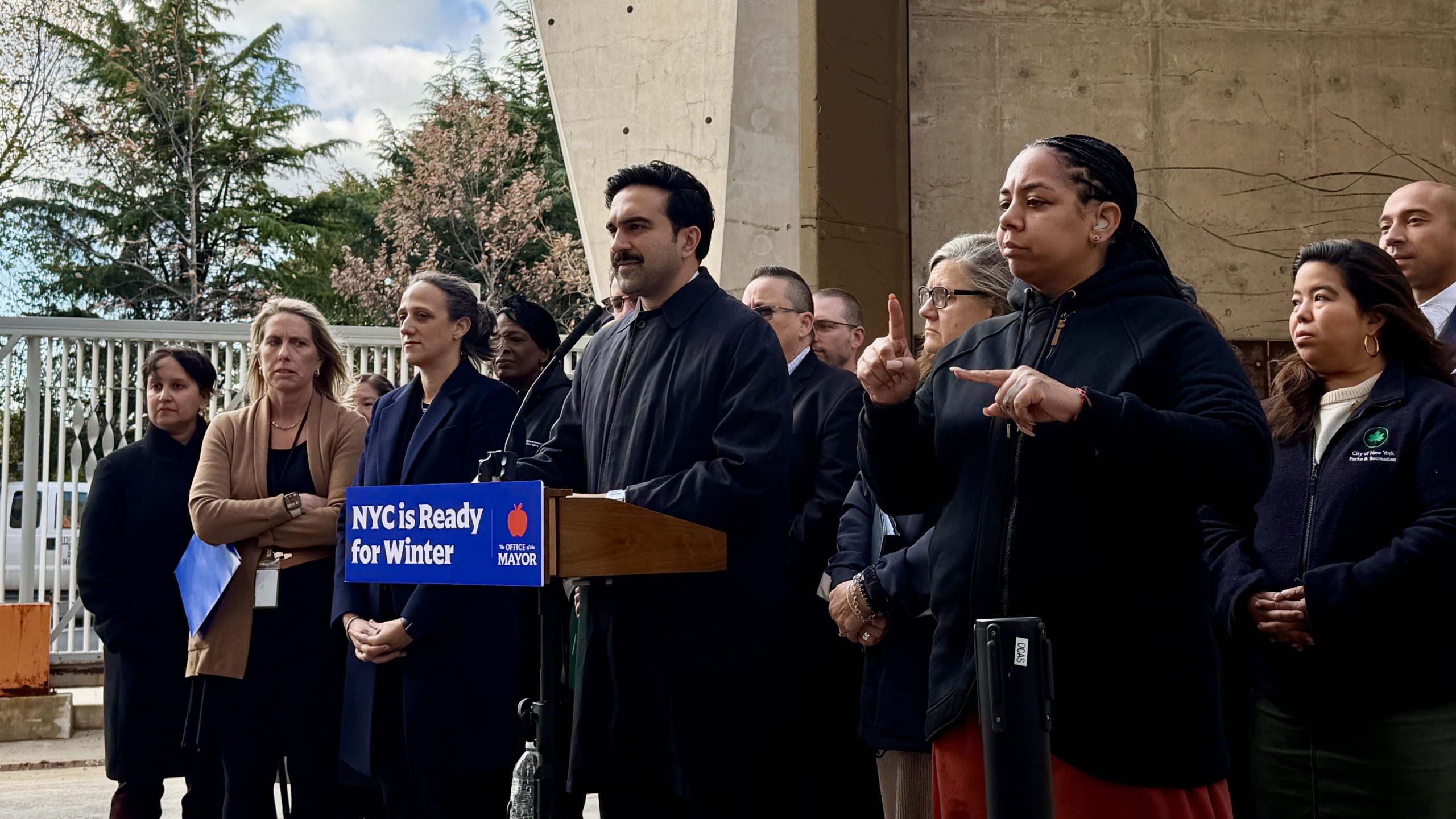


As New York City prepares for winter, Mayor Zohran Mamdani has laid out his administration’s plan to support city residents during severe weather. On Monday, the mayor announced an investment of $25 million to the city’s Code Blue system and snow and ice removal operations to clear pedestrian infrastructure, including bike lanes.
Cleared bike lanes and crosswalks are crucial for the approximately 70,000 delivery workers who work during cold and inclement weather. Delivery workers interviewed by Documented said snow-covered bike lanes and icy streets make their jobs more dangerous, and sometimes force them to ride alongside cars. The city should prioritize cleaning the bike lanes during a snowstorm, they said.
“When the city plows the streets, snow often gets pushed into the bike lanes and stays there for days,” Gustavo Ajche, co-founder of the delivery worker advocacy group Los Deliveristas Unidos, told Documented, adding that snow in bike lanes then forces delivery workers into traffic, which makes the job more dangerous. “Clearing bike lanes at the same time as the streets would help us get around more safely.”

Sergio Solano, 43, who has been doing delivery work for the past 16 years, is familiar with how challenging bad weather conditions can be for workers already on tight deadlines to deliver goods.
“When the lanes are closed we have had to use the roads,” Solano told Documented in Spanish.
In 2020, Solano and his family founded the group El Diario de los Deliveryboys en la Gran Manzana (“The Journal of the Delivery Boys in the Big Apple”) to provide information to delivery workers around the city. Since its founding, the group has gained more than 66,000 members on Facebook.
Solano said that roads covered with snow or ice are more difficult to brake and slow down on, which can be dangerous for delivery workers who do not have the right equipment, such as studded tires, to deal with the elements.
After Mamdani’s announcement Monday, Documented asked the mayor about the measures the city is taking to protect delivery workers during the winter. Mamdani acknowledged the unique challenges delivery workers face when most New Yorkers are encouraged to stay indoors.
“They don’t have the luxury of staying home,” Mamdani said. They don’t have the luxury of staying at their workplace. Their workplace is our city.”
He told Documented that the New York City Department of Sanitation (DSNY) plans to use almost 50 different pieces of equipment that specialize in clearing out snow from bike lanes and cross walks. Earlier this year the DSNY said that it had 44 specialized bike lane spreaders.
“For the first time, we are incorporating not just bus stops, but also crosswalks as parts of official DSNY routes for snow removal,” he said. He added that clearing crosswalks is critical for delivery workers to navigate intersections. Mamdani did not specify how quickly the city would clear bike lanes following a storm.
DSNY Commissioner Gregory Anderson also reiterated the department’s commitment and capacity to clean up the streets. “We are prepared, equipped and ready to keep all New Yorkers safe and moving this winter, whether they drive, walk, ride, bike or roll,” Anderson said during the press conference Monday.
Aside from the snow covered bike lanes, Solano said that having an indoor space to charge his phone is crucial to avoid delays or missing deliveries, especially during cold weather when charging becomes difficult and batteries are worse at holding charge.
“The phone is the most important thing to get orders,” he said. “During the cold you cannot charge it because it does not charge, so you have to look for an indoor space where you can charge.”
When asked if the city would open more warming sites or expand their hours for delivery workers to use, Mamdani pointed to the more than 100 warming sites already across the city, part of the $25 million investment into the city’s Code Blue System.
He also praised the Workers Justice Project and Los Deliveristas Unidos for organizing to advocate for the city’s first Deliverista Hub, outside of City Hall, where workers can seek shelter from severe weather, use the restroom, and charge their phones and e-bike batteries.
The mayor encouraged all New Yorkers to subscribe to the Notify NYC system to receive information during a severe weather emergency. “It now has more than 13 different languages,” Mamdani said of Notify NYC. “And that is critically important to actually getting the word out.”