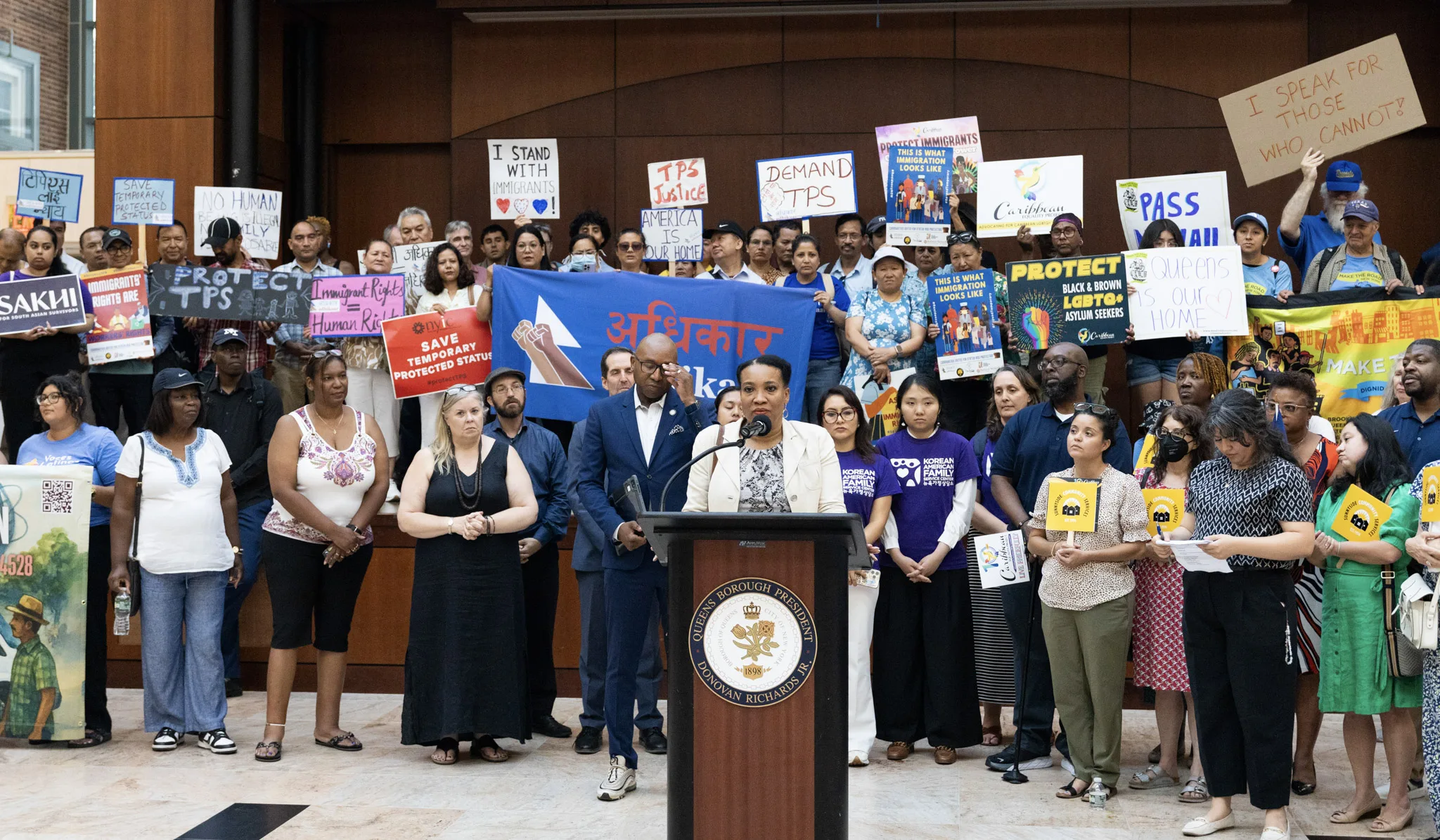


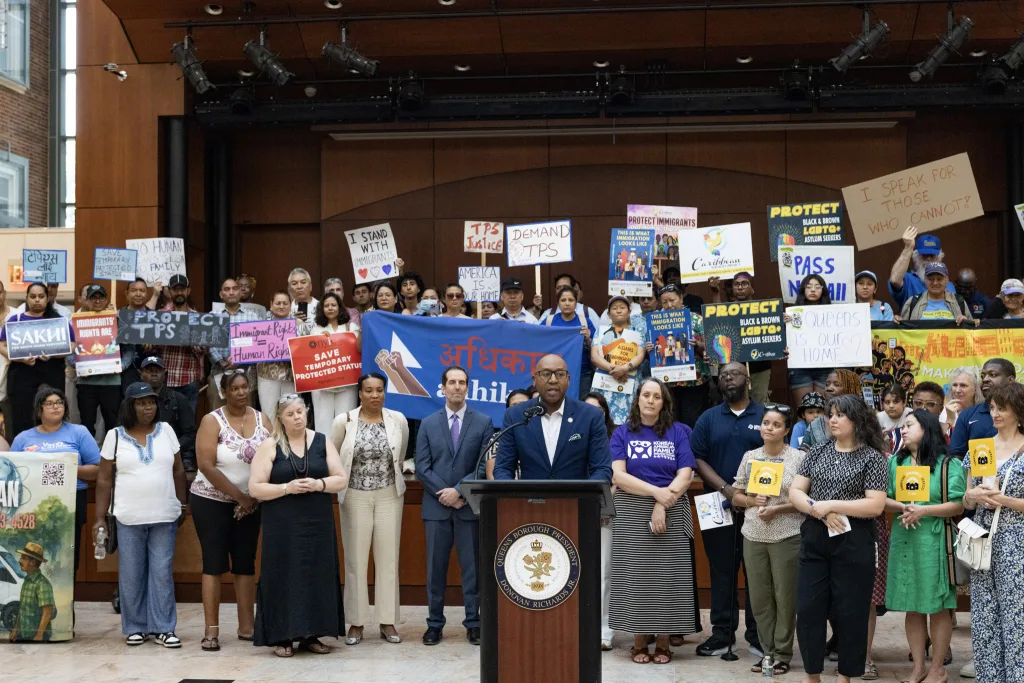
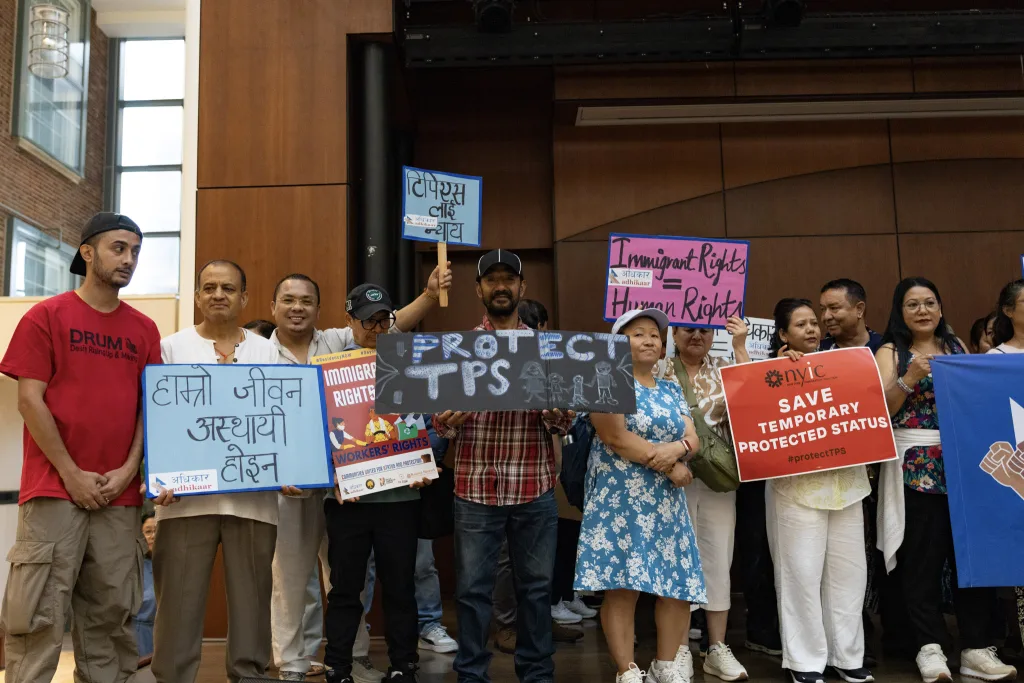
As the Trump administration moves to revoke Temporary Protected Status (TPS) from hundreds of thousands of immigrants, dozens of community leaders, advocates and TPS holders gathered at Queens Borough Hall earlier this week to send a message of solidarity.
Queens Borough President Donovan Richards Jr. gathered advocates from across New York city, representing immigrants from Haiti, Nepal, Afghanistan and other TPS-designated countries now in legal limbo. “We will not cower in fear in Queens County — we stand in solidarity with our immigrant communities,” said Richards who added that his Jamaican immigrant father became a U.S. citizen in 2020. “We say no to xenophobia and racism. We say no to mass agents with no badges kidnapping people off our streets. And that’s exactly what fascism looks like.”
Since President Trump returned to office in January, his administration has been actively engaged in terminating TPS protections for hundreds of thousands of immigrants who hail from countries affected by conflict, poverty, natural disaster and political instability. These revocations have impacted about 600,000 Venezuelans, over half a million Haitians and tens of thousands immigrants from Honduras, Nicaragua, Nepal, Cameroon and Afghanistan.

Although some cases are still being litigated and the revocations cannot take effect on the dates announced by the Department of Homeland Security, the policy has sparked fear and instability within immigrant families and communities. Termination of TPS protections threatens to separate families, disrupt local economies, and leave individuals vulnerable to removal despite deep community ties according to community leaders.
TPS was established in 1990, under President George H.W. Bush, to grant temporary relief to foreign nationals who could not safely return home due to war, disaster or instability. The program does not grant a path to citizenship, but it does allow beneficiaries to work legally and live lawfully in the United States for designated periods of time.
Under the Biden administration, TPS designations were expanded and extended for many countries. Many of those extensions have since been rescinded by Secretary of Homeland Security Kristi Noem as part of the Trump administration’s immigration agenda and campaign promise.
As of June, there are 16 countries under TPS, and according to a 2024 Fwd.us report, TPS holders contribute about $21 billion annually to the U.S. economy. During President Trump’s first term, the National Immigration Forum, a nonprofit advocacy organization, reported that in 2021, TPS holders contributed more than $2.2 billion in taxes.
Also Read: TPS Extension for Haiti Slashed, Leaving Thousands Vulnerable to Deportation
Many residents in Queens — the borough with the largest foreign-born population in New York City — are among those facing legal precarity and uncertain futures.
“This year, we saw less people at the Colombian Day Parade and we believe it has to do a lot with people going into hiding,” Richards said. “People are fearful that ICE is going to drag them off the streets and ICE is doing it. We’re seeing people being kidnapped.”
Richards mentioned a recent case in which Immigration and Customs Enforcement (ICE) agents allegedly detained a U.S. citizen working at a car wash, after having mistaken him as undocumented. “They literally took him from the car wash,” Richards said. “He’s a U.S. citizen. Then they tried to speak Spanish to him. He said, ‘I don’t speak Spanish.’ ”
“Silence is consent and we do not consent to this”
Namal Rimal, a TPS holder from Nepal who has lived in the U.S. for two decades who attended the rally, described the burden of living in such uncertainty.
Another speaker, Marie Adam-Ovide, district manager of Queens Community Board 8 and a Haitian American, lamented the changes she is witnessing in the United States.
Documented.
“Three decades ago, while I was still in college, I decided to become a United States citizen… It saddens me that I no longer recognize the country that I now call my own.”
“The administration is attacking migrants, green card holders, naturalized citizens, and even the American-born,” Adam-Ovide added. “We have to speak up. We have to join together. We cannot remain silent, because silence is consent and we do not consent to this.”
Herold Dasque, a Community Liaison officer at the Haitian American United For Progress (HAUP), attended the rally to speak on the growing fear and uncertainty he’s witnessing among the immigrants HAUP is serving across the city. “There are people who’ve had TPS since 2010. Some even own homes, their kids are in school, they pay taxes,” he said. “Instead of helping people legalize their status, this creates mayhem. It disrupts families. It’s not justice.”
“I started my business. I have run a business for almost eight years. After COVID, I lost my business, I lost my health,” she said. “I live 20 years with my rules, my community and I pay tax. I have no protection. We deserve dignity, we deserve protection, we deserve justice.”
Dasque noted that the TPS revocation has already had a profound impact on immigrant communities, disrupting daily life and access to basic services. He said the fear has taken a visible toll on the people he works with.
“I used to teach an ESL class with 23 students. Now I have seven or eight. When I call them, they say they’re scared,” he said.
Legislative action
Advocates at the rally emphasized the need for both state and federal responses.
“We need to pass New York for All,” said Abigail Regalado of Make the Road New York, speaking through an interpreter. The proposed state legislation would prohibit local officials from cooperating with federal immigration enforcement and sharing sensitive data.
Regalado, an Ecuadorian immigrant, recounted how immigrants are taken off the streets and are separated from their families, homes and communities. “This is not right. We left our country full of dreams, leaving our loved ones behind,” she said. “We came to this country in search of better opportunities and a better quality of life.”
Also Read: ‘My Future Is Uncertain’: Venezuelans React to End of TPS Protections
Public Advocate Jumaane Williams criticized what he described as willful ignorance among voters. “Too many of us drank the orange Kool-Aid,” he said. “They are literally trying to figure out how to deport and get rid of as many Black and Brown people as possible.”
Williams called the federal immigration agenda “vile,” saying, “This is not about public safety at all, even a little bit. It just isn’t.”
He added: “Now that it is in your face, it is hard for me to believe that you couldn’t see when he was running. But there’s no reason you cannot see it now.”
David Pecoraro, a U.S. citizen and local civic leader, shared how fear has impacted his own household. “My wife is scared witless. She carries her passport card now because she doesn’t know if, because of her brown skin, she’s going to be picked up,” he said. “This is not the America that I was born in.”
He had a message for his fellow New Yorkers. “If you see a masked person without a badge kidnapping a fellow New Yorker, call 911,” he told Documented. “You’re witnessing a kidnapping.”
Matt Abrams Gerber of the Jewish Community Relations Council drew comparisons to his own family’s immigrant past. “Over 100 years ago, my great-grandparents fled the pogroms against the Jews in Kishinev,” he said. “They were fortunate to escape to the United States, but not all of their family were so lucky.”
“We must protect everyone in our city, those who are citizens and those who seek sanctuary,” he said. “New York City is what it is today because it has been a place of refuge, acceptance and diversity.”
Legal challenges are underway
The National TPS Alliance and CASA, a national immigration advocacy and service organization, have filed suits alleging procedural violations and racial bias in DHS decisions. Thus far, courts have issued mixed rulings, with some temporary injunctions being granted and other terminations allowed to proceed by higher courts.
“Because this administration is content with breaking up and kidnapping people, the legal strategy is really where I’m focused,” Richards told Documented. “We’re going to continue to march and rally. We will be doing some court watching too. There has to be a multitude of strategies. We need to see our sanctuary laws protected, and that’s one of the reasons why I’m speaking out today as well.”
In the meantime, Queens Borough Hall will continue operating its Immigrant Welcome Center, which helps immigrants access public services. Borough President Richards also stated that his office will keep hosting Know Your Rights workshops and expand outreach to faith-based and community organizations.
Richards noted a drop in the number of cases reported to his office due to deportation fears, he said. “People are living in the shadows and they’re scared.”