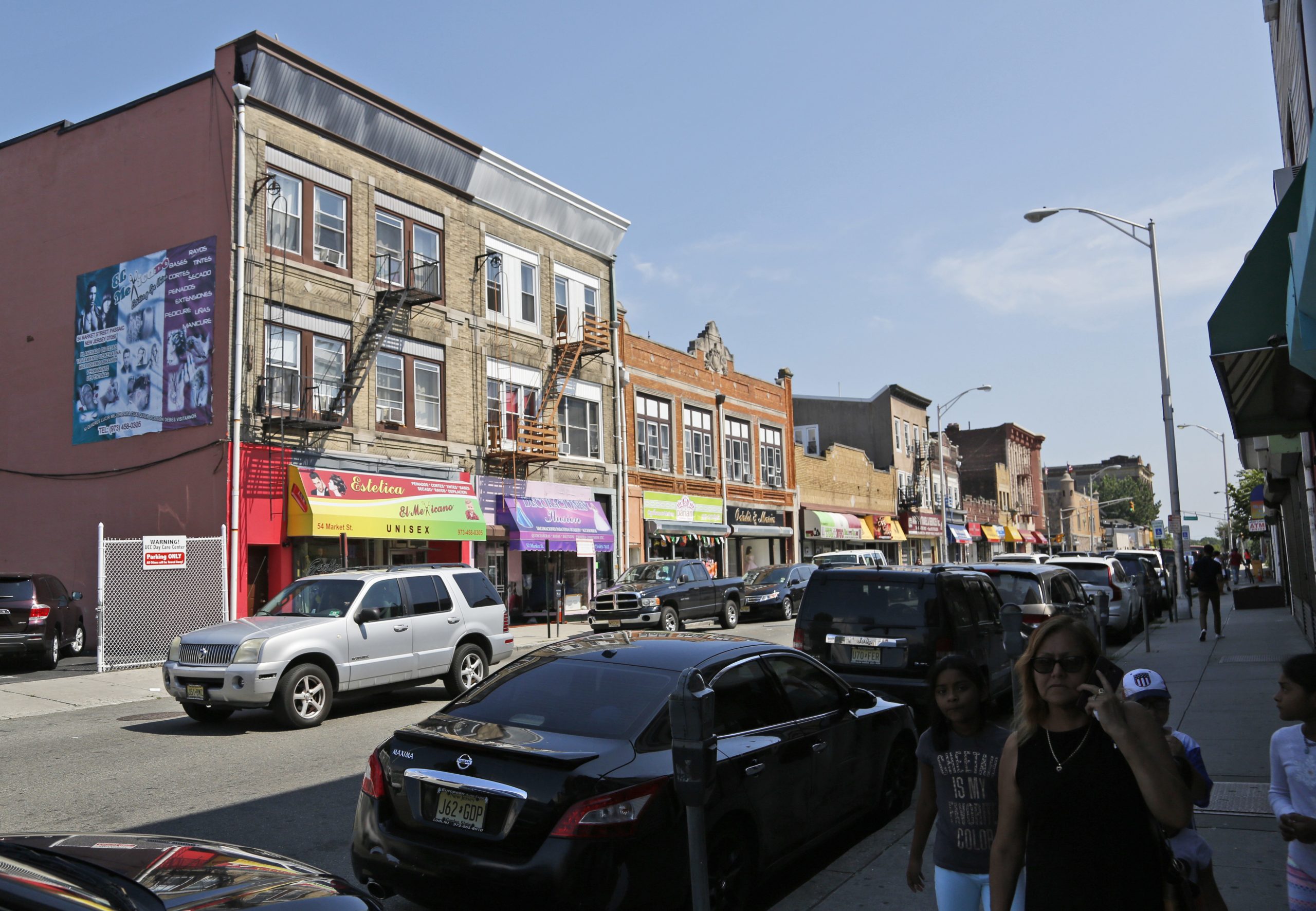


Anthony Cepeda, 55, remembers the moment when the once bustling corridor of small businesses on Monroe Street, in Passaic, New Jersey, went completely silent. In mid-July, federal immigration agents descended on the streets of the tight-knit majority-Latino town and grabbed men from in front of their homes and from street corners.
Over several days, and wearing black masks, hats, and green vests with “ERO” in yellow letters, officers tackled residents on streetcorners, handcuffed men and loaded them into cars, according to videos viewed by Documented and interviews with residents.
By the time arrests hit a high on July 18, “it was all like turning on a stove,” said Cepeda, who has lived in the area for 15 years and works at a barber shop near the Monroe Street corridor. “People sent me messages: they took someone here, they took someone over there. It was out of control, and in my own home.”

Among the more than a dozen people detained in Passaic that day was José Efraín Chajón Raxón, a Guatemalan national who was then transferred to the Delaney Hall immigrant detention facility in Newark. Less than four days later, Chajón Raxón would be dead — the second known person detained at Delaney Hall to die in less than a month.
While Chajón Raxón’s death made headlines, it took weeks for his death to be discovered in part because of new rules by the Trump administration that stopped recording if a person died shortly after being released from U.S. Immigration and Customs Enforcement (ICE) custody. In Chajón Raxón’s case, he died at nearby University Hospital in Newark after suffering a medical emergency at Delaney Hall, as Documented previously reported, and so U.S. officials did not announce his death.
Together, the fear of immigration raids and death of a community member have remade the DNA of what was once a bustling city, Passaic residents told Documented. Busy parks now sit empty; businesses have lost patrons; and main streets have turned into ghost towns. Still, many community members have organized efforts to assist immigrant families in response — monitoring ICE activity and looking out for their loved ones’ safety.
Fifteen people would be taken from Passaic that Saturday, capping off a week in which immigration arrests increased by 4,200% compared to the previous year, according to a Documented analysis of ICE arrest data by the Deportation Data Project. In the state of New Jersey that month, arrests doubled.
In total, at least 75 community members, including one U.S. citizen, were arrested by ICE in Passaic in the month of July, the most since President Trump took office in January 2025. Of those arrests, 42 occurred during the week of July 12th, according to the data.
“Immigrant communities across New Jersey are terrified right now,” said Molly Linhorst, staff attorney at ACLU of New Jersey. “They’re seeing and hearing story after story about loved ones being taken off the street, who were often driving to work, who were driving to appointments, and who are then subjected to the horrific conditions at Delaney Hall for no reason.”
The vast majority of people arrested nationwide by ICE in July have no criminal history, according to recently released federal data. Many entered the U.S. through legal channels or had pending asylum cases. Others were arrested while attending immigration court or mandated check-ins with ICE.
“Folks are really afraid, and knowing that we have this [Delaney Hall] in our backyard, that this is where people are going, and that [Delaney Hall] has such horrific conditions and is now responsible for at least three deaths, just adds to that level of terror,” Linhorst said.
As Documented previously reported, Delaney Hall has seen at least three deaths of immigrants who were detained there in the last eight months, hunger strikes led by individuals protesting conditions at the facility, and allegations of medical neglect. Recently, the ACLU of New Jersey sent a letter alleging cruel and punitive visitation policies.
“When enforcement creates an environment where people are afraid simply because of who they are or where they come from, we have lost sight of what public safety is supposed to mean,” Hector C. Lora, the mayor of Passaic, said in a statement to Documented.
His administration worked with residents and Make the Road New Jersey to host a packed, standing-room-only, Know Your Rights and family preparedness seminar at City Hall in late July. It also made free rideshare and taxi voucher programs available to residents needing safe transportation, amongst more efforts.
“There is a fundamental difference between enforcing the law and instilling fear across an entire community,” he said.
Lora added that his thoughts were with the Chajón Raxón family, and that the city was “built and strengthened by generations of immigrants.” He said that Passaic was not provided notice of a specific ICE operation in July. However, City Hall “became aware of increased federal immigration enforcement activity taking place in Passaic.”
A spokesperson for GEO Group, the company that manages private prisons including the Delaney Hall immigrant detention facility, referred Documented to ICE for comment. ICE did not return a request for comment about the allegations surrounding conditions at Delaney Hall or the rise in arrests in Passaic.
A Changed City
One Passaic resident, Gama, said he has seen a big shift in the community since returning home from U.S. military service in May. He has been living in the area since he was six years old and described the neighborhood as very Hispanic. Census data shows that 73% of residents are of Hispanic or Latino origin. Gama, who is 34, requested to use a nickname due to privacy concerns, said that the community includes a mix of people from Guatemala, Peru, Mexico, El Salvador, and other countries from South America.
During a visit to the Paluski Park with his wife and children on Sunday, Aug. 16, Gama said the park was considerably emptier than when it used to be crowded with families, children, and spectators who cheered for the teams playing soccer or baseball in the park. Gama stood with his family under a statue of the famous Mexican general Ignacio Zaragoza.
“This whole fence would be surrounded by people just enjoying [themselves],” Gama said. “It’d be hard to find parking.”
Sandy Hernandez, whose 12-year-old son plays soccer in the park, told Documented that the park had seen a huge decline in attendance since ICE enforcement had entered the area.
“Sometimes the soccer coaches tell us not to come here because they have seen la migra in the area,” Hernandez said, using the Spanish slang for immigration enforcement agents. She has been in the United States for three years since migrating from Colombia. “Sometimes when I hear that they [ICE] are in the area, I tell my kid: ‘Baby, you have to go alone.’”
She said that during her bike commute at work at a supermarket nearby, she is always scanning her surroundings, to ensure that she doesn’t run into ICE agents. “Sometimes I am looking all around me, and it could make me lose control,” she said. She described avoiding the main streets where ICE presence had been sighted, and, sometimes, even driving in the opposite direction on streets.
“No one wants to come out, everyone is scared,” Gama said.
His family too has been impacted directly. According to Gama, his father in law was detained by ICE and deported. “He is living his life in Mexico now, so he is happy,” he said. “But the whole process was very stressful when it was going through.”
‘It’s the People That Save the People’
Rosaline Martinez, 36, who was born in Brooklyn but grew up in Passaic, said her own family was safe but many friends had experienced losses after she started to notice an uptick of ICE presence at the end of June.
“They started coming more and more, and then it was just every day,” “ she said. “Every day they were coming, and they were literally just picking up people, and then it got to the point where they … wouldn’t ask anymore. They would just grab them.”
One video, previously reported by Univisión, confirmed this, showing ICE arresting a man without asking for his identification. “Hector, bring my ID!” he screamed.
Martinez remembered Passaic once as a safe town, where hardworking people greeted each other in the street. Many, like her own parents, had emigrated to the U.S. for a better life, she said. But with the ICE operation, the feeling of safety turned into intense anxiety.
Martinez began nervously tracking her parents’ location and couldn’t escape the flood of videos of local arrests popping up on her phone. Martinez remembered watching one video in particular, where a woman was clinging to a pole and crying as ICE agents arrested her.
Suddenly, she decided she could no longer stand the idea of standing idle. She wanted to find a way to fight back and share information with her neighbors on how to protect themselves.
“So I said, you know what? Let’s start a protest,” Martinez told Documented. “And I said, I’m gonna post it, and whoever wants to join, whoever wants to help out, is gonna help out.”
News spread quickly across social media, leading major immigrant rights organizations like Make the Road New Jersey and Movimiento Cosecha to reach out to help her organize and reach out to local elected officials and police.
“I felt like we’re gonna fight together and we’re gonna stand up for our parents or stand up for our grandparents, and that’s why I said,’ you know what? I’m just gonna do it,’” she said. ”It just pushed me.”
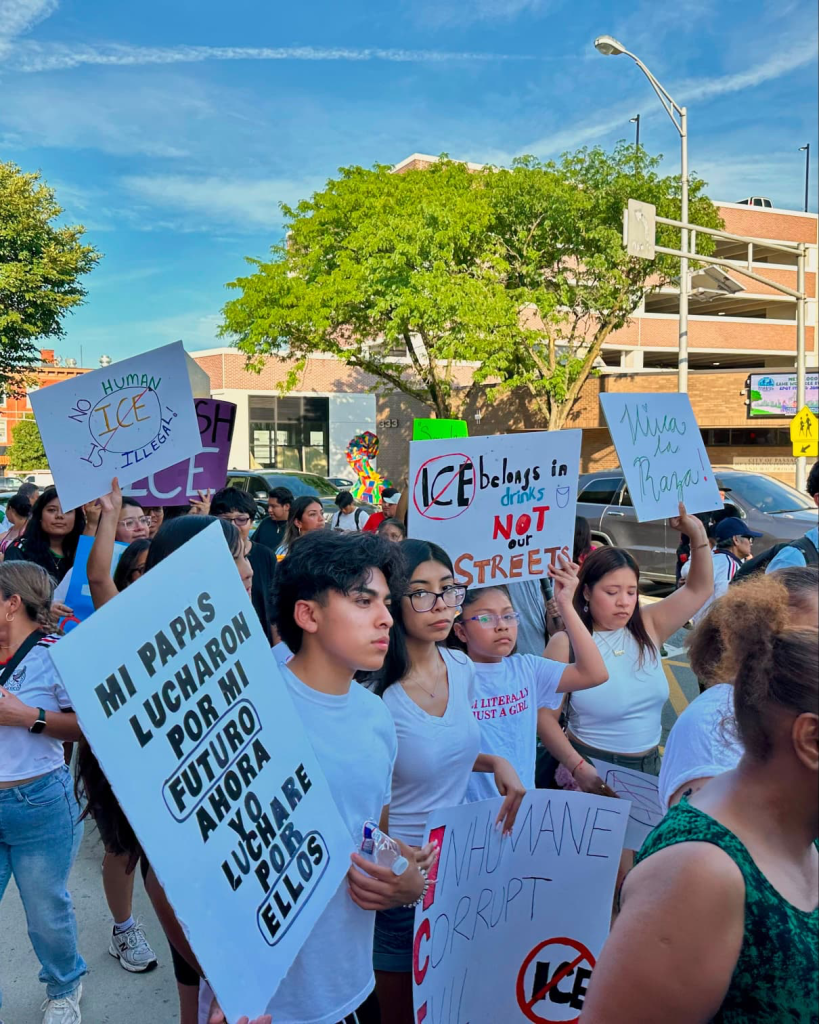
On Friday July 17, a day before the height of the arrests and Chajón Raxón’s detention, dozens of Passaic residents protested in front of City Hall — carrying colorful, hand-drawn signs with pro-immigrant messages, waving different Latin American flags, and retelling their experiences from the past week. Even the mayor spoke, she said.
“Speak up for your parents, for your mom, for your dad. They need us,” Martinez yelled through a bullhorn before switching to Spanish. “They took care of us. They gave us life. They worked hard. Now it’s our turn. Now we have to fight for them.”
It was one of the first of many community responses, she said: Restaurants began organizing food donations for affected families, grocery stores began delivering straight to homes of those fearful to leave them, and community patrols and WhatsApp groups sprang up across town to alert residents to ICE activity.
“Now I feel like we’re more alert, we’re willing to help each other out,” Martinez said.
The community patrols are made up of U.S. citizens who can notify others of ICE presence in the area, said Tiburicio Cuautle, who has been an organizer for eight years with the organization Movimiento Cosecha, a nonprofit that has assisted immigrant families impacted by immigration enforcement.
“People check the streets where they live and let us know,” he said, adding that people with lawful immigration status are most likely to make noise on the streets to alert neighbors, and even follow the cars of ICE officers. “That is how we live, we are out there watching.”
Cuautle emphasized the importance of the involvement of the neighbors, because he believes that local government or houses of worship are limited due to their relationship with the federal government. “As I tell you, we are not being paid because we do not have any political parties,” he said. “But in the end, it’s the people that save the people.”
Additional reporting by Lam Thuy Vo.