

New York City has long been a place where immigrants from all over the world seek a better life for themselves. For immigrants fleeing persecution, the city is also a place of hopeful refuge where they live with their future on hold until their humanitarian case is decided by a judge.
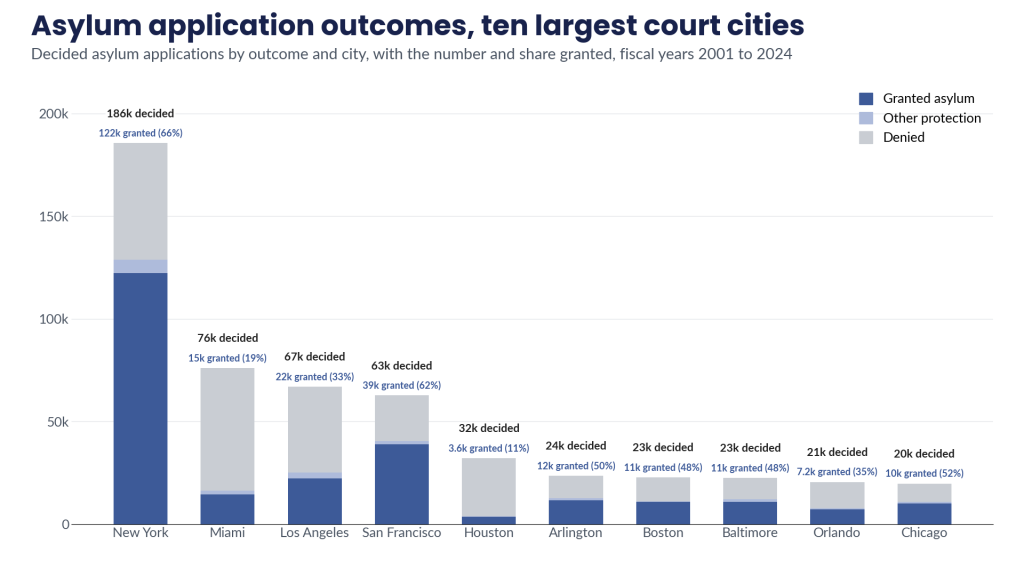
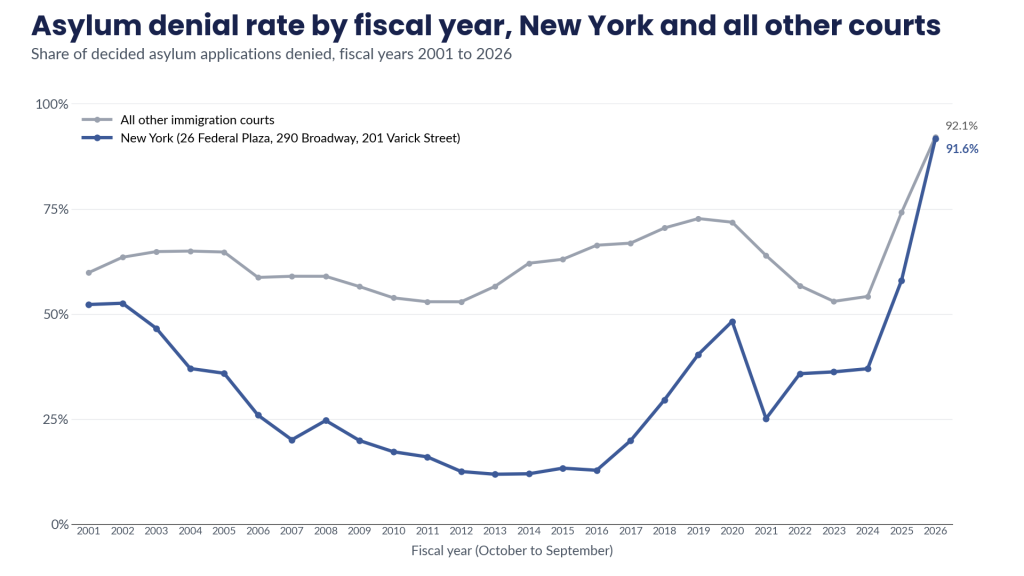
Historically, New York’s immigration courts have stood out in the United States as a place where asylum seekers could get a fair hearing in a system plagued by procedural and substantive injustices. Between 2001 and 2024, when asylum was all but impossible at other major courts in Miami, Atlanta, and Houston — where judges denied 79%, 86%, and 88% of asylum applications, respectively — New York immigration judges denied just 31% of all asylum applications.
A grant means a judge has found that the person qualifies as a refugee and may stay in the United States, with a path to permanent residence; a denial usually ends with an order of deportation. A small share of people denied asylum receive a narrower form of protection, such as withholding of removal, which bars their deportation to the country they fled but offers no path to permanent status.

But then, something strange happened a year ago in December 2025: New York City’s immigration courts ceased to be special. In that month, New York’s judges granted just 10% of asylum applications, the same percentage that was granted in all other immigration courts across the country. The trend has continued through the end of fiscal year 2026 in September, when, again, the New York City courts denied 92% of the asylum applications for the year, mirroring the rest of the courts in the country.
The data on this momentous surge in asylum denial rates illustrates how distinctive New York City had been for so long, and how powerless any single immigration court is to resist the barrage of changes implemented by an aggressively deportation-obsessed administration.
It also forces us to confront legal and ethical questions about what counts as normal. If we treat the 2001 to 2024 period as one baseline and the current trend as a possible new one, then choosing which to normalize is not simply a question of data — it’s a choice between the conditions that produced each one: representation and due process on one side, and the policies dismantling them on the other.
These are not abstract questions. As of Oct. 1, 2026, about 219,000 asylum applications — including more than 26,000 children under the age of 18 — were still waiting for a decision in New York’s three courts, more than in any other city and more applications than New York’s judges decided in the near quarter century from 2001 to 2024. How we think about what counts as justice for them depends on where we lay our baseline.
New York as the Center of Asylum
Although New York is the country’s quintessential immigrant gateway city with its three immigration courts, its history as a hub of grassroots efforts to help those fleeing persecution is far less recognized. It is the birthplace of several national organizations that prioritized legal support for asylum seekers and other humanitarian migrants long before the courts took their present form.
These include Hebrew Immigrant Aid Society (HIAS), whose roots go back to the 1880s, when its predecessors began aiding Jews fleeing persecution in Eastern Europe; the International Rescue Committee, formed in 1933 at Albert Einstein’s request; the American Immigration Lawyers Association, founded by 19 immigration lawyers in Manhattan in 1946; and Human Rights First, founded in 1978, which has long paired asylum seekers with pro bono lawyers; and many other organizations, legal clinics, and government-funded programs.
This history is essential context for yet another overlooked fact: New York’s immigration courts have processed an enormous number of deportation and removal cases, not just asylum cases.
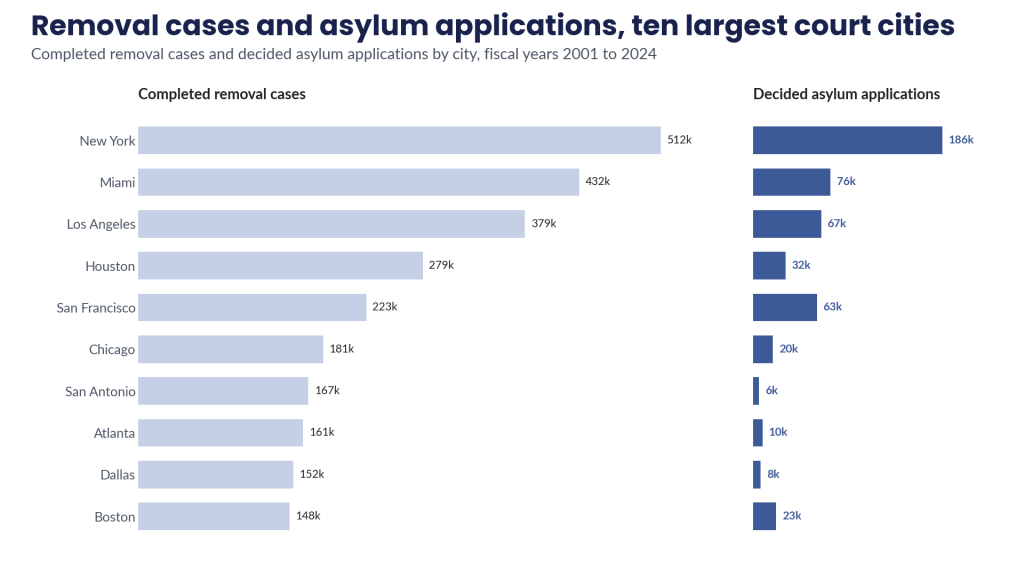
Between fiscal years 2001 and 2024, New York’s three immigration courts completed about 512,000 removal cases, nearly 9% of all those completed nationwide, and decided about 186,000 asylum applications, more than one in five decided anywhere in the country and far more than any other court. 26 Federal Plaza alone completed about 380,000 of those removal cases, more than any other single court in the country, and decided about 157,000 asylum applications, more than twice as many as Miami, the next-busiest court.
Not only did New York decide more asylum applications than anywhere else in this period — it granted more of them. New York’s judges granted about 122,000 asylum applications over this period, roughly one in three asylum applications granted nationwide from 2001 to 2024. In fact, for four straight years, fiscal years 2012 through 2015, more than half of all the asylum grants in the United States came from New York City’s courts alone. Among the ten courts that decided the most asylum applications, only San Francisco denied a share nearly as small as New York’s.
The three courts did not decide cases the same way. Asylum applications decided at 26 Federal Plaza, which hears mostly non-detained cases, were denied 26% of the time, compared with 59% at 201 Varick Street, whose building once held an immigration detention center and where much of the city’s detained docket is heard. At 290 Broadway, 50% of asylum applications were denied from its first full year in 2020 through 2024.
Despite these caveats, it is fair to say that for people seeking protection in the United States, New York was not one court among many — it was the court that, more than any other, decided who would receive asylum.
New York Becomes Average
Despite their generally higher-than-average asylum grant rates, New York City’s immigration courts were never immune from broader national trends. Denial rates in New York rose during the first Trump administration, from 13% in fiscal year 2016 to 48% in fiscal year 2020, and fell again in the early Biden years.
Yet through every swing in policy, New York maintained its own center of gravity. Between fiscal years 2022 and 2024, New York’s judges denied between 36% and 37% of asylum applications each year, while all other immigration courts denied between 53% and 57%.
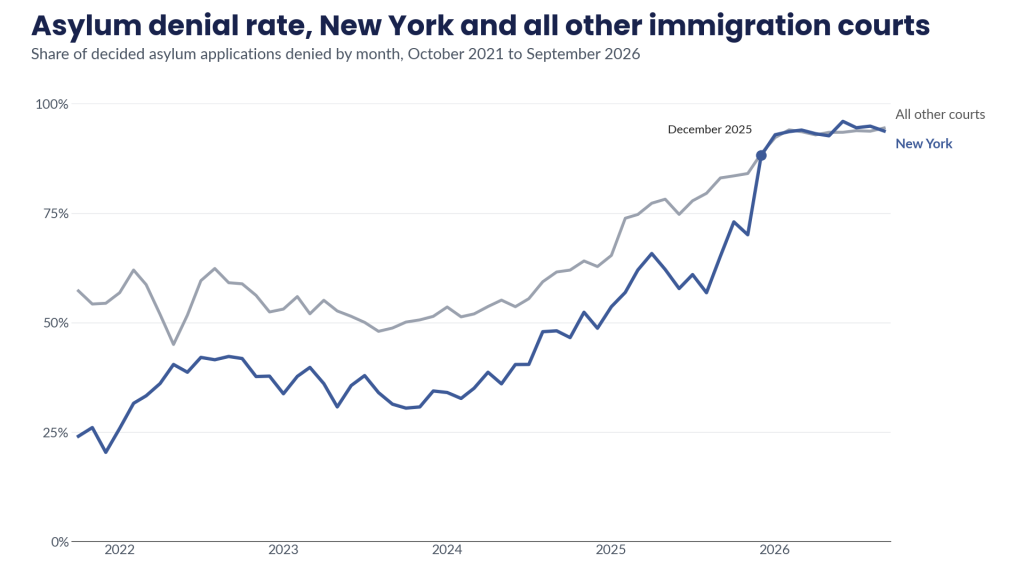
Starting in 2024, still under the Biden administration, denial rates began to increase across the country and in New York City. In New York, they rose from 40% in July 2024 to 49% that December, and to 70% by November 2025. But for many months, including most of the first year of the second Trump administration, New York courts were still more favorable to asylum seekers than those in other cities.
New York City’s distinctiveness ended in December 2025 when grant rates plummeted to 10% and denial rates spiked to 88% — matching all other immigration courts. (A small number of cases were given other types of humanitarian protection.) Since then, New York City’s asylum denial rates have remained indistinguishable from the rest of the country.
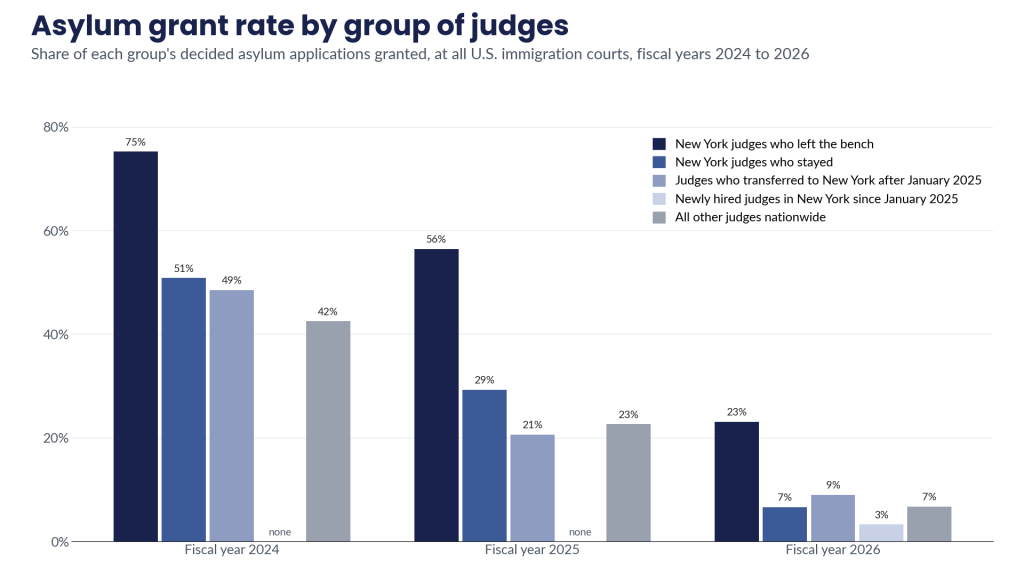
The collapse corresponds to an overhaul in who is deciding these cases. Indeed, New York judges who have left the bench entirely — through firing, quitting, or retiring — had noticeably higher grant rates than judges who stayed on the bench since Trump took office. New judges hired since January 2025 have the lowest rates of asylum grants — but not by much. Prior judges who remained and judges who transferred into New York from elsewhere have approval rates of around 7% and 9%, respectively.
The turnover in judges explains part of the drop in approval rates, but the change can also be attributed to judges who are still on the bench and who have, as a cohort, dramatically changed how they are ruling. And even the high-approving judges no longer on the bench saw dramatic declines in approval rates before they left.
The decline in New York’s asylum grant rate is not just a story of sympathetic judges being replaced with apathetic ones. Rather, the decline is the result of a multifront assault on the immigration courts that so severely undermines what little due process and independence the courts possessed that it threatens the future of the immigration court model as we know it.
For decades, New York built the infrastructure needed to compensate for the court’s well-established deficiencies in due process. But no amount of local infrastructure can compensate for what has happened since. Political firings of judges, mass deportation hearings, hidden hearings, courthouse arrests, ending basic legal support for unaccompanied children, terminating asylum cases before they ever see the light of a courtroom — these are just a few of the tactics that are sending asylum denials through the roof.
If asylum seekers cannot get to court because they are detained, or will not go because they are afraid of being detained before their hearing, judges have no choice but to order them deported in absentia. In fiscal year 2026, 23% of the asylum applications decided in New York were decided in absentia, compared with about 1% between 2001 and 2024.
Many of these policies are nationwide, so I don’t think we can say with any degree of confidence whether New York’s immigration courts were a specific target. The dismantling of the San Francisco immigration court earlier this year suggests that the administration is not opposed to singling out courts that are not functioning in lockstep with Stephen Miller’s deportation-at-all-costs approach. Whether New York City was intentionally targeted or not, the data is clear on one thing: the era of New York City’s immigration courts functioning as an exception to the national rule is over.
A New Average Does Not Have to Be the New Normal
In 2007, immigration scholar Stephen Legomsky wrote a prophetic essay in response to research that showed a concerning amount of inconsistency in how asylum was decided across the country. Legomsky’s argument was: yes, inconsistency in the discretionary asylum adjudication system is a problem — but be careful what you wish for. A bigger problem could be a forced adherence to an artificial statistical mean. Legomsky was right. In barely 12 months, this is what happened to the New York courts.
At the beginning of this essay, I said that a baseline is a choice, not just a statistical choice but an ethical and moral choice that 219,000 people will have to deal with, as will the roughly 189,000 New York City residents with asylum applications pending in immigration court. If every one of those cases were decided under the previous baseline, with all of its fluctuations and imperfections, about 145,000 of these people would be granted asylum, including more than 20,000 children. Under the new baseline, a fraction of that, around 16,000 would, including about 2,000 children.
A new average does not have to be a new normal. We get to choose as a city and as a country what we accept as our baseline for measuring progress. Choose wisely.
Data note: All numbers and figures in this article come from analysis by the author of the Executive Office for Immigration Review’s CASE data published in October and current through the end of September 2026. Different valid methodological choices can produce slightly different numbers.