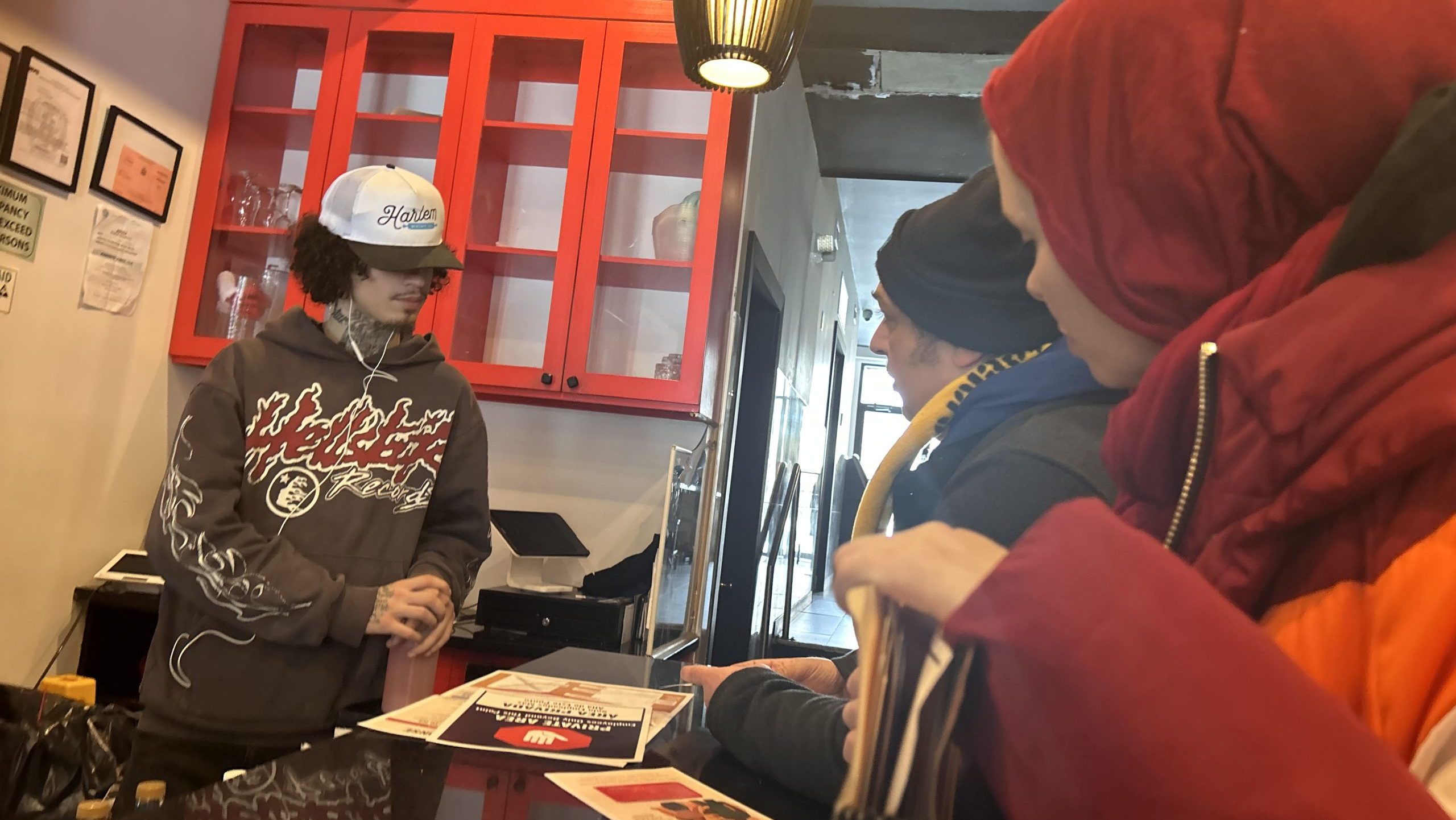


Two days after the last major snowstorm blanketed New York, a group of four neighbors gathered inside the Featuring the Café in central Harlem with a simple goal: help businesses know their rights.
The group — comprised of a retired psychiatrist, a teacher, a young woman and a father, who all live in the area — would soon bundle up and spend the day knocking on the doors of salons, restaurants and mom-and-pop shops, handing out material in multiple languages, and explaining what to do if Immigration and Customs Enforcement (ICE) agents arrive at their doorstep.
And this wasn’t their first time pounding the pavement together. These volunteers have been doing this kind of activism work in Harlem since August 2025, as part of a broader strategy expanding across the city: bringing basic legal information directly to workplaces, where encounters with ICE can often usher in confusion and fear through misinformation and deceptive tactics.

Their group — Indivisible Harlem — which is part of the Indivisible, a nationwide movement whose goal is to defend democracy by organizing and empowering individuals and communities through civic knowledge and action — is one of more than 30 groups that are distributing materials across the city. According to Indivisible, these volunteer troupes have logged over 8,000 visits to NYC businesses.
Their work comes at a time when ICE arrests have increased by 212% in the New York metropolitan area, including arrests of people with no criminal convictions, according to an analysis by Documented based on data from the Deportation Data Project at the University of California.
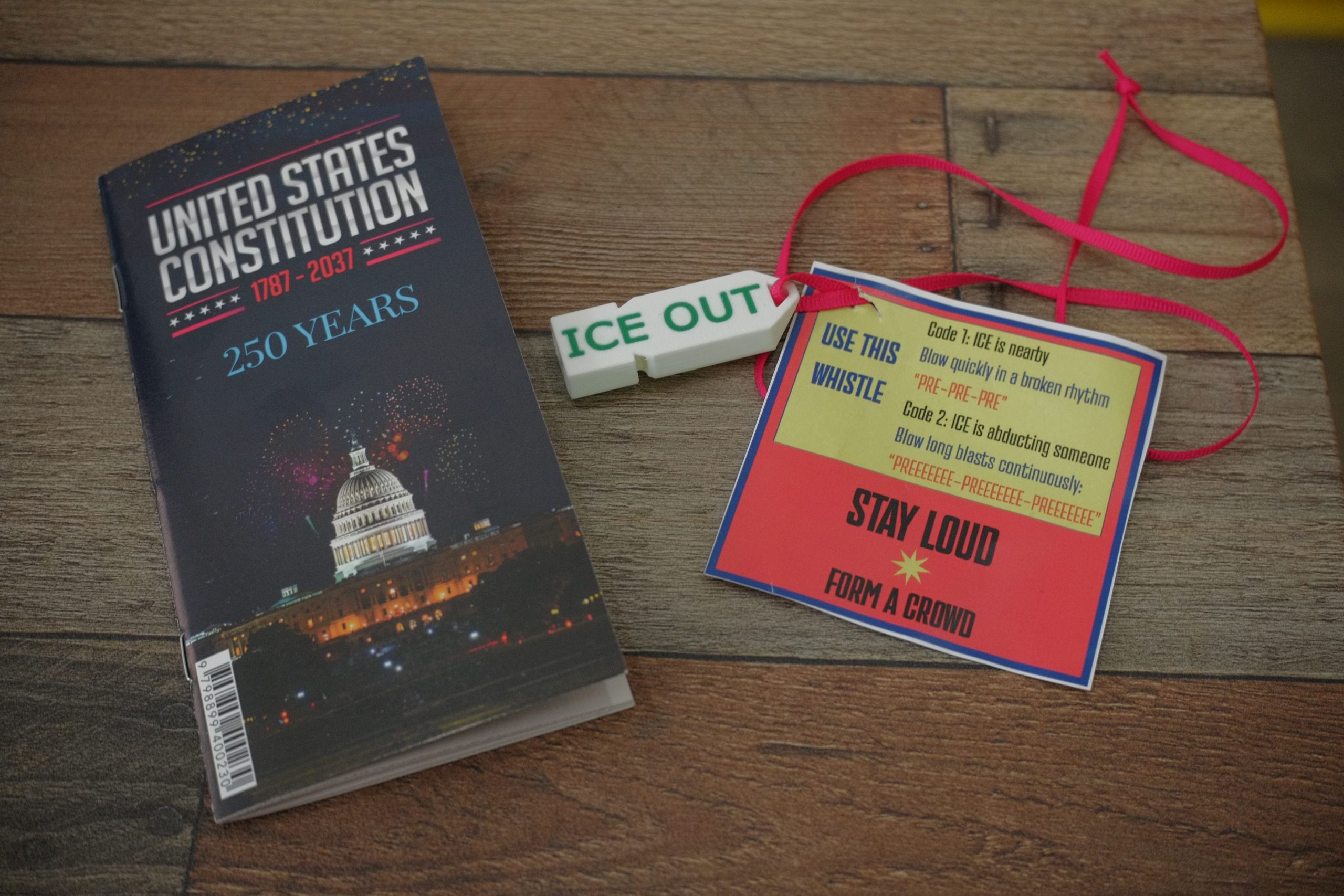
Ben, one of the Indivisible Harlem leaders, said that this work is essential for his community, especially right now.
“I think the rights that we have under the Constitution are important and I think people ought to know,” he said. “It’s been good for me, personally, because there’s a lot in the news to get angry and upset [about]. Doing this work has helped me feel better about the country and about the future.”
Knocking on doors before ICE does
That cold morning, Ben and a young woman named Amy, who both asked that their last names not be made public for fear of retaliation from ICE, walked into a hair salon where dozens of women were perched next to clients, skillfully braiding African hair. Ben offered a warm greeting and introduced himself — a few quietly looked up, but no one moved from their position. The smell of hairspray and the buzz of conversations in French and English fill the air. Then, one of the workers asked Ben and Amy to come closer, gesturing toward the back of the salon.
As she continued to attend to her client, who does not take her eyes off the infinite scroll of reels playing on her phone, the worker listens. Ben shows her three documents and starts talking about what to do if ICE shows up at their business — and thus begins his lesson. He proceeds to point to a poster, which includes a picture of a signed judicial warrant and an administrative warrant.
“One of the tricks ICE is using is showing an administrative warrant instead of a judicial warrant,” he explains. “They present it like it’s the same thing, but it’s not.” He then shows her examples of what each one looks like, line by line, so she can recognize them in the moment. He emphasizes that ICE should only be allowed to enter a business to arrest somebody if they present a judicial warrant.
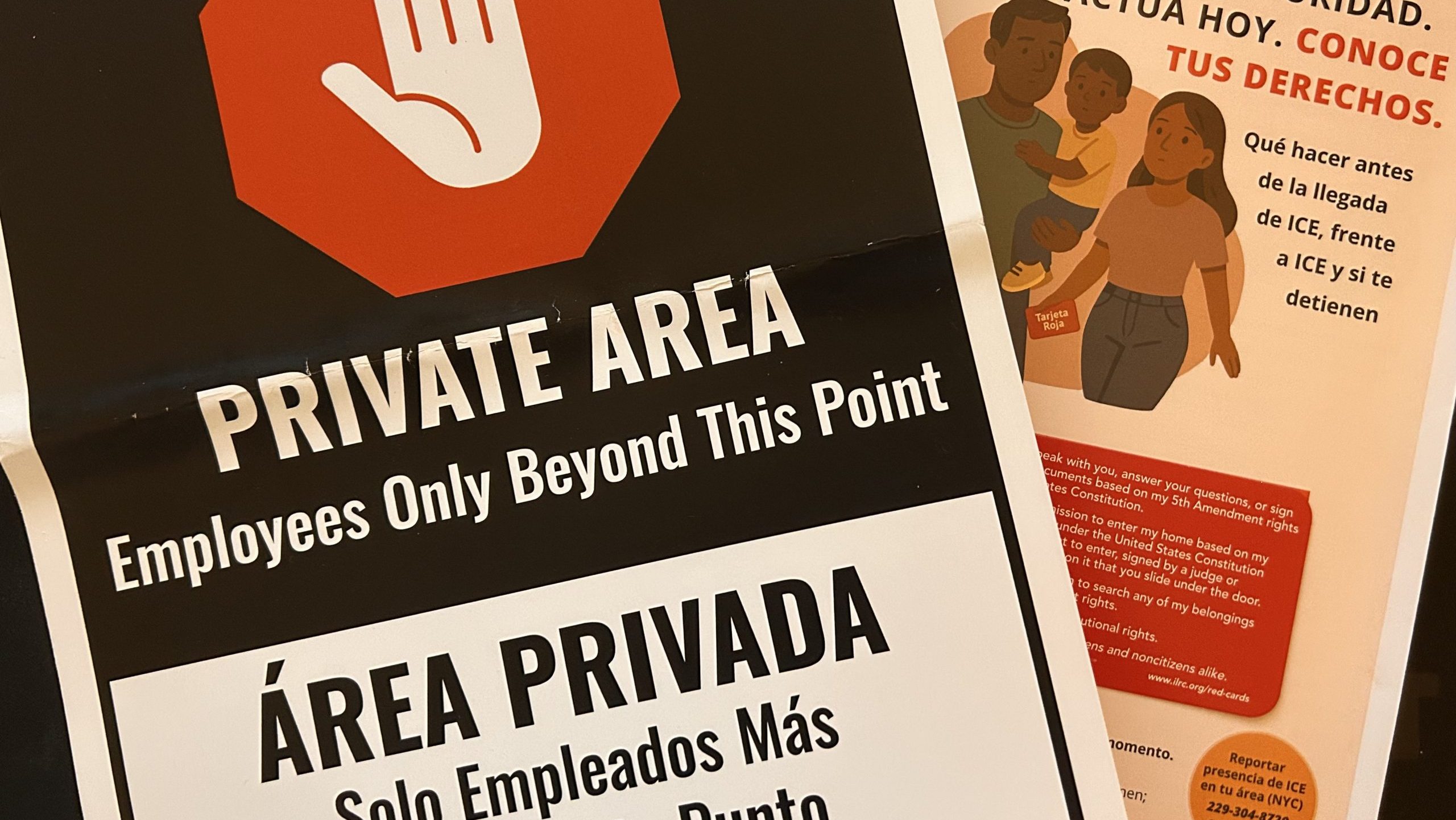
Then he takes out another sign that reads: “Welcome, we are a private business, please wait to be let in, entry by staff authorization only.” He explains that this notice can be placed in a private area of the business, such as a back room or break space, where employees could remain protected if agents arrive. ICE can enter public areas, but not private ones without a judicial warrant.
“If anything happens, record it,” Amy says. “That can be important later, especially if there’s a case.” The worker nods as she looks at the papers.
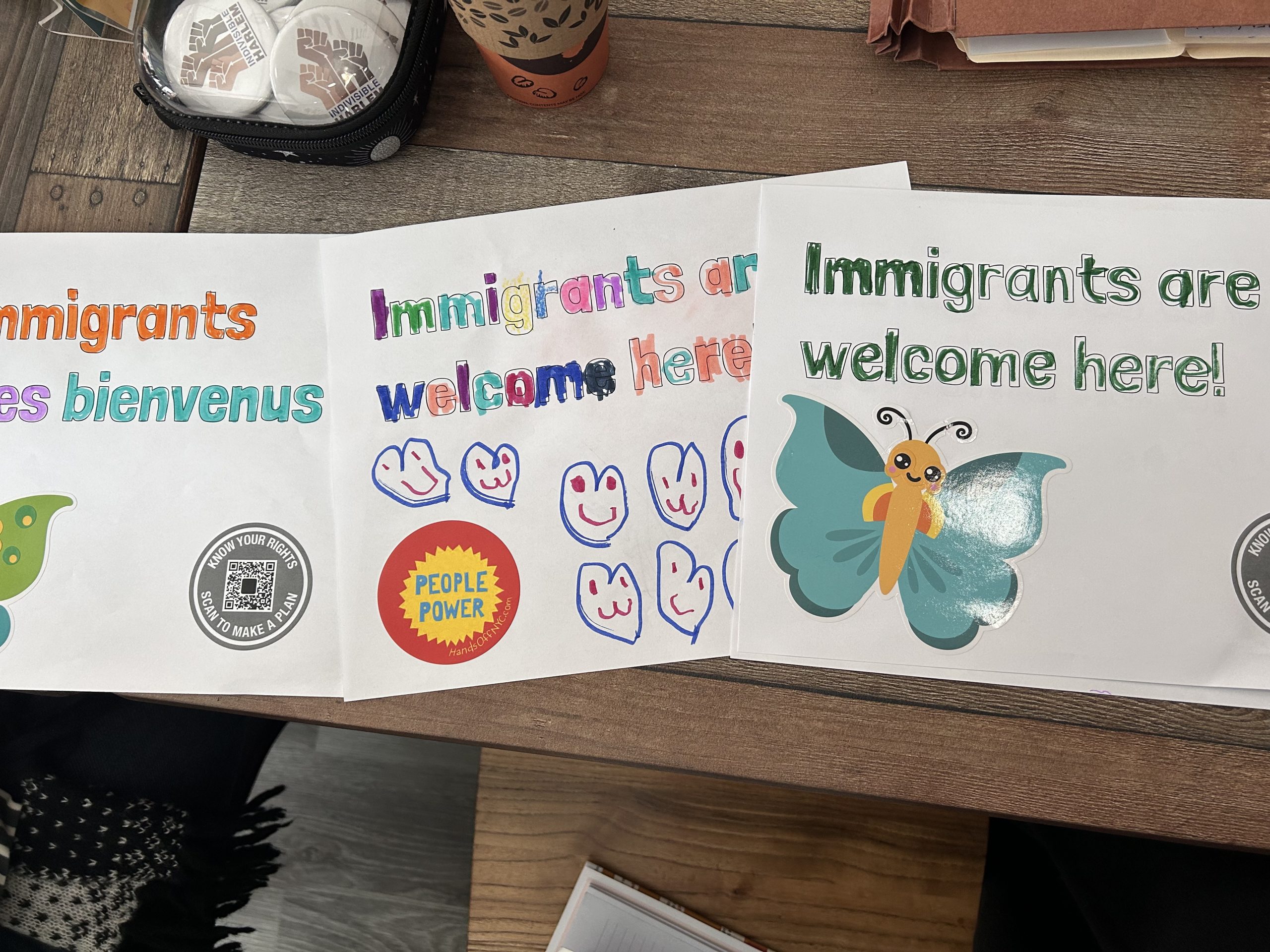
Before Amy and Ben leave, the worker who they have been speaking to asks them for copies of the summarized information. “Give me three in English and in French too,” she says. She wants them to share the information with her clients. Ben then shows her some drawings that read “Immigrants are welcome here,” colored in by children from his son’s school. “Maybe you can put it up in front of the business so people can see that immigrants are supported here,” he said and the employee agreed.
Reactions like this — words of trust and gratitude — have become commonplace, says Dianne, 70, a teacher and one of the volunteers who also asked Documented not to use her last name. “Everyone wants their employees to be safe and they’re really appreciative.” Unlike other forms of canvassing, she adds, there is no resistance. “It’s not like, ‘who are you to tell us?’ It’s more like, ‘thank you, we really need this.’”
For Duncan, a 75-year-old retired psychiatrist, that moment, when the conversation shifts, is key. “Once people understand what we’re talking about, they open up,” he says. “They realize this is something practical. Something they can actually use.”
Part of what they are trying to correct is misinformation. Ben says that in January he heard rumors in the community that ICE was operating inside the subway system. “That’s not true,” he said. He explains that what people were seeing was National Guard presence — something that has existed since 9/11 and was expanded in 2024 to improve subway safety at certain stations, including 125th Street. “People saw that and got confused. They thought it was ICE.”
Empowerment through education
On a rainy morning in March, Arnyce Foster-Hernandez, 55, owner of the Featuring the Café, is working at the same cafe table where the Indivisible volunteers had gathered three weeks before.
If ICE were to come to her door, she says she would know exactly how to respond. “They would never be able to come in here,” she says, adding that she would stand her ground, demand a valid judicial warrant, and verify that the information matches. She also says that she would try to protect anyone who was impacted by the encounter: get them a lawyer, find out where they are being taken and prevent the situation from becoming humiliating.
For her, the biggest issue is the fear that has been paralyzing other business owners, especially immigrants. “It’s very intimidating for them not to know what to do,” she says. That lack of knowledge, she insists, is what allows abuses to happen. “People should understand that civil rights is not optional. Ever.”
For Foster-Hernandez, that conviction has deep roots. Over the years, she said she has built a network with organizations that are working on civil rights. “What’s happening in the immigrant community now has always been prevalent in the African-American community,” she says. “Being an African-American woman … we have always been targeted despite our contributions.”
From that perspective, what is happening to immigrant communities is neither new nor unfamiliar. She says she sees who is watched, who is detained, who does not know how to respond. That’s why, she says, it is not enough for each business to protect itself individually. Information and the courage to use it has to circulate.
Many of the volunteers similarly feel compelled to help as neighbors. The need for information-sharing motivated Duncan to join Indivisible Harlem, saying that he saw canvassing as a more tangible way to help protect immigrants in his neighborhood, rather than going to protests.
“We’ve been kind of stuck at the stage of protests,” he said. “Where we just say, ‘This is wrong’, we are not doing anything specific to not cooperate.”
Dianne said that she started volunteering mainly because her students, parents and grandparents are immigrants.
“One of the things that makes New York City a special place is that people from all different cultures … get to know each other,” she said. “For this administration not to recognize that, and to be explicitly racist in how it chooses to target people, is unconscionable.”
For now, the volunteers say they’re staying focused on their mission of helping their immigrant neighbors and taking things one day, and one door-knocking at a time.
“There’s two societies,” Duncan said. “There’s one where people are going out to dinner and living their normal lives and then there’s another where masked gunmen are taking people off the street.” For him, knocking on doors is a way to not ignore that second reality.