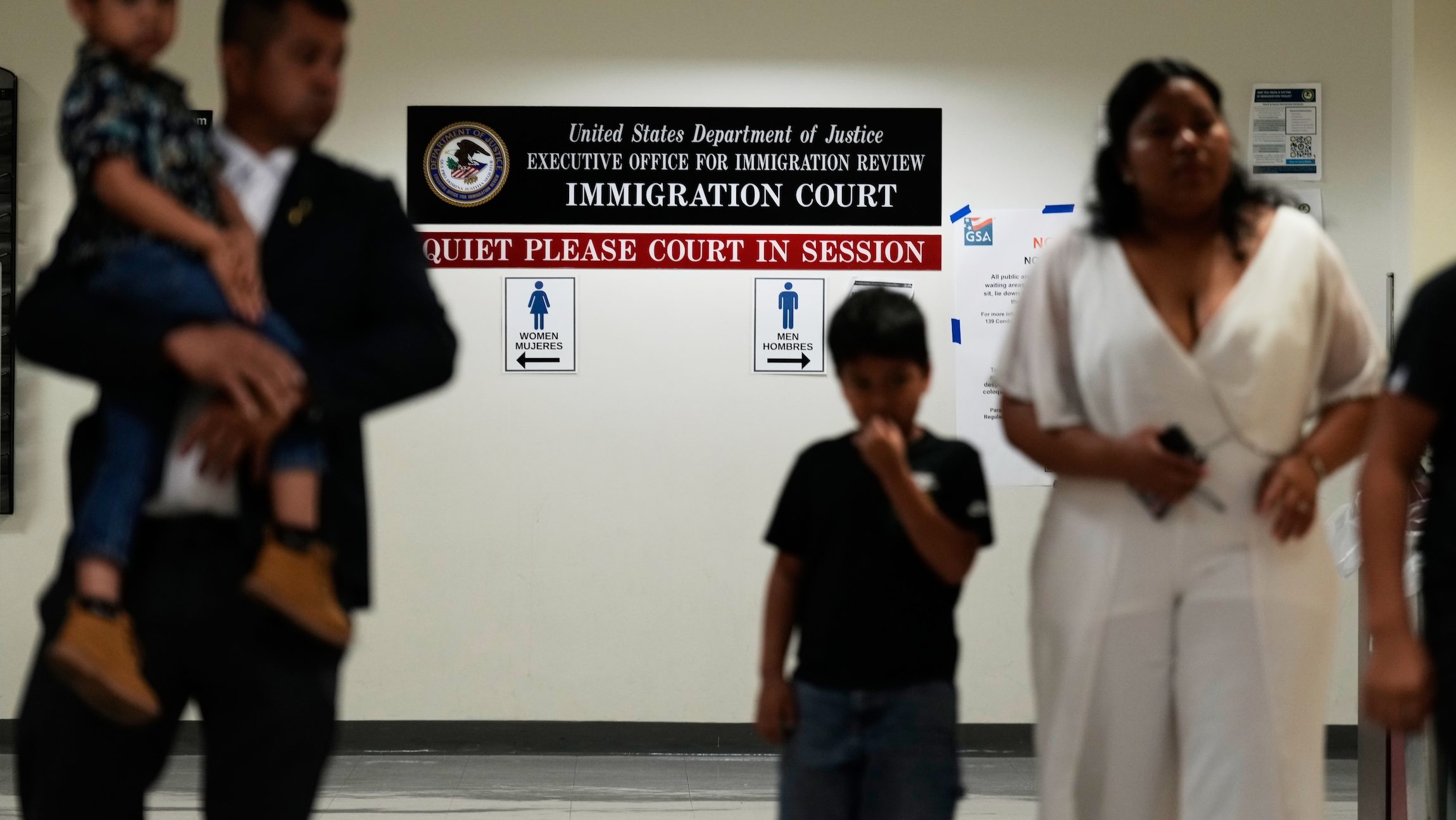


At immigration court for detained children in New York City on Wednesday, a boy named Diego represented himself in front of the judge, Lisa Ling.
“I don’t know how to do it,” said Diego, referring to the asylum application that Ling asked him to fill out in English. “I don’t know if you can help me fill it out.” Diego’s face was hidden as he looked down and away from a web camera aimed at his head.
The boy, whose age is unknown, had repeatedly stressed that he was afraid to return to Guatemala in his native K’iche’, translated through two interpreters relaying his words from K’iche’ to Spanish, then Spanish to English.

He attended his hearing via video call on a TV screen in the courtroom on the fifth floor of Varick Street Immigration court, one of the dozens of unaccompanied children due in court that morning. He is being detained in a New York shelter run by the Office of Refugee Resettlement.
Ling directed Diego, who had no lawyer, to file the application within the next two and a half weeks or face deportation.
“Unfortunately I can’t help you,” Ling said.
Dozens of children, who, like Diego, have been detained by U.S. Immigration and Customs Enforcement (ICE), appeared in person and over video call on Wednesday in Ling’s immigration court. Most did not have a lawyer, and few had an adult to speak up for them. Many did not give their ages; those who did were as young as 11.
It was the first docket for detained youth since a federal contract funding legal services expired on July 31, leaving tens of thousands of immigrant children who arrived in the country — and over a thousand in New York — alone to often fend for themselves in front of immigration judges who have been told by the federal government to fast-track deportations.
The contract — which had previously been held by the D.C.-based nonprofit Acacia Center for Justice, which subcontracted with roughly 100 providers nationwide — is set to be partially replaced in mid-August by a newly reported agreement with a 26-person law firm from Houston, Texas, criticized by advocates who say the private company has no obvious background in immigration law.
Earlier in the day, two sisters in crisp, blue collared shirts leaned toward the web camera after Ling asked if they had a lawyer.
“My father keeps looking for one, and he’s not able to find,” one of the girls said in Haitian Creole through a translator. Ling gave them 13 days until their next hearing.
The judge, a former ICE prosecutor who was appointed by President Trump in his first term, continued through the children’s cases at break-neck speed, despite the fact that multiple advocates requested continuances until after the new contract begins.
Two other children, who appeared at separate times that day, couldn’t remember the name of the lawyers they thought they had, as they faced court alone.
Hours into the hearing, another young girl, with her camera turned off, attempted to answer why she hadn’t filed for asylum.
“The day before yesterday I was going to talk to a lawyer but he didn’t call,” said the girl, Zoila, in her small, sweet voice.
“This is the third chance I gave you to submit an asylum application,” replied Ling. “I know it’s difficult, but with or without an attorney you need to submit the application in English.”
She gave the child a week to file the application, a process that can often take months even for experienced lawyers.
While legal organizations had already struggled to meet the needs of detained adults and children, attorneys and politicians attending the hearing said it showed a marked deterioration in due process. The majority of the 47 children whose cases were scheduled to be heard on Wednesday were done without a lawyer, and more children than ever were forced to speak for themselves, according to advocates.
“They’re hitting them on all sides, right?” said Meena Shah, managing director of nonprofit The Door’s legal services center.
Shah named a litany of changes that have squeezed youth since the beginning of the second Trump administration’s mass deportation drive: the deportation of parents and sponsors; the slow-walking of reuniting detained unaccompanied minors with loved ones who can support them; the firing of experienced immigration judges and hiring of so-called deportation judges; and the end of a contract which paid child advocates and attorneys to help unaccompanied children navigate the system.
“Why should a child face a deportation judge?” Shah said. “Every time I go to court and I see a child with pigtails, that should make every single person here physically sick.”
She added: “I don’t want us ever to get used to that fact that this is something that’s happening here in New York City.”
The city’s response
Unlike other U.S. courts, immigration defendants are not entitled to a lawyer free-of-charge. Local advocates and politicians have long struggled for answers to pro bono attorney backlogs, which have been made worse by the Trump administration’s mass-deportation agenda and left many immigrants — including thousands of children — without representation.
A 2021 congressional research report found that immigration judges are 100 times more likely to grant relief to unaccompanied children with attorneys than those without it, according to reporting by ABC News. Similarly, judges were four times as likely to issue a removal order for a child without a lawyer, according to a 2024 report.
Sierra Kraft, executive director at I-Care, a coalition of legal groups representing immigrant children, said that she supported the passing of the Access to Representation Act in the New York State Legislature. The bill would attempt to fund support for the majority of immigration defendants who are not entitled to a free lawyer.
“These contracts with the [federal] government, we can’t rely on them,” said Kraft. “The government’s failed these children, and what we really need to do is coordinate among city and state partners to create a longer-term solution.”
In Congress, another bill has also been under consideration — the Fair Day in Court for Kids Act — which would further enshrine and extend required legal support for children.
A contract expires, a new one takes its place
Last week, the federal government let a $356 million dollar contract with nonprofit organization the Acacia Center for Justice expire after withholding payment to the organization for months.
Since becoming the primary contract holder in 2023, the organization subcontracted with multiple local nonprofits in New York City such as The Door, Safe Passage Project, and others to ensure that 20,000 unaccompanied immigrant minors nationwide had access to an adult advocate in court or a lawyer.
For roughly two decades, the government has been required to protect children who immigrated alone to the United States. A 2008 law states that the Department of Health and Human Services must ensure that most unaccompanied children have legal counsel to represent them in court “to the greatest extent practicable.”
But last year, the Trump administration attempted to end the contract — though the order was halted by a federal judge, who said it undermined due process.
Still, it was only the beginning of what many legal advocates considered a legal maelstrom. The federal government began withholding funds and demanding information about children under legal representation, which became the subject of an additional lawsuit filed in 2025.
And on Monday, the Trump administration posted a new, one-year, $150 million HHS contract to Burke Law Group, apparently taking over the duties once held by Acacia. Burke Law Group, which received the contract, is a 26-person law firm in Texas. Advocates have criticized its ownership of the contract, arguing the firm does not have experience in immigration and questioning its motivation. The firm’s co-founder, Marcella Burke, is an energy lawyer who previously worked in the Trump administration, and founding partner Jeffrey Hall is current assistant administrator in the Environmental Protection Agency, NPR earlier reported.
The contract has not yet come into effect and is set to begin Aug. 15.
“[The Office of Refugee Resettlement] announces the intent to award a single-source cooperative agreement to Burke Law Group to provide legal orientation, legal consultation, and attorney-of-record representation services, as required … for eligible [Unaccompanied Migrant Children] during immigration proceedings,” read the post to the Federal Register.
Burke Law Group did not immediately respond to a request for comment about how it would handle the contract.
Advocates from across various city nonprofits told Documented that children were being rushed through immigration courts faster than any advocate or lawyer could catch up.
“There is a rushed process — that is the protocol for the federal government,” said Faiza Ali, commissioner of the Mayor’s Office of Immigrant Affairs. “And that you have a combination of both escalating federal tactics plus the expiration of a federal contract, and that is deepening the crisis for unaccompanied minors.”
Ali told Documented that the mayor’s office had already allocated close to $17 million toward legal support for unaccompanied minors.
“I’ve witnessed the impact today,” she told Documented after observing the more than three-hour-long hearing on Wednesday. “I think it was clear more than half of the children on today’s docket appeared without an attorney. And what we’re doing is continuing those conversations with other stakeholders to make sure that they understand, you know, what it means for a 10-year-old to appear before a judge without an attorney.”
Correction August 7, 2026: An earlier version of this story noted 43 children scheduled on the detained juvenile docket instead of 47. We apologize for the error.