

For the past few years, no matter how pleasant the weather was outside, tenants kept the windows of their apartments at Chung Pak Senior Housing closed. The senior housing complex, which houses more than 100 older adults, sits directly next to the construction site for a megajail in the heart of Manhattan’s Chinatown.
Zhuosheng Ng, the super at Chung Pak, said the tenants had little choice but to keep the windows shut.
“We are right next to the construction site, too much noise and dust, nobody is willing to open the windows, even though that means the air circulation in our rooms isn’t great,” he told Documented.

Ng’s concerns are shared by many Chinatown residents and community groups, who have raised concerns about the jail’s potential effects on the neighborhood’s environment, quality of life, and safety. The so-called “jailscraper” is expected to be the tallest jail in the world, at 295 feet, once completed, with more than 1,000 beds. It is being built on top of the former Manhattan Detention Complex.
A recent report from doctoral students at New York University backs up many of their concerns. The report, which examined the potential environmental health impacts of the demolition on older adults in Chinatown, found “persistent air quality concerns” and a lack of monitoring, reporting, and precautionary measures in the jail’s demolition and construction. It was commissioned by the Chinatown Environmental Health Working Group, a coalition that includes community-based organizations, neighborhood advocacy groups and academic partners.
The Manhattan jail is one of four borough-based jails proposed by the administration of former Mayor Bill de Blasio in 2017 to replace Rikers Island. The City Council passed legislation in 2019 requiring the closure of Rikers and its replacement with borough-based facilities.
Despite years of opposition from community groups and residents, demolition of the former MDC at 124–125 White St. was completed in summer 2024. The city broke ground on the new jail earlier this year, and excavation began last month.
However, as the project progressed, the voices questioning it did not subside.
At a town hall meeting last Thursday, independent researchers from New York University said their analysis found substantial gaps in transparency and oversight during the demolition and construction process. With construction expected to continue from 2026 through approximately 2032, researchers warned that the prolonged duration and intensity of construction could increase residents’ cumulative exposure to environmental pollutants and potentially contribute to long-term health risks.
Tri Huynh, a doctoral student in environmental health sciences at NYU Grossman School of Medicine and one of the report’s authors, said researchers installed five low-cost air-quality sensors around the demolition and dismantling site to track indicators of air pollution from 2023 through 2025.

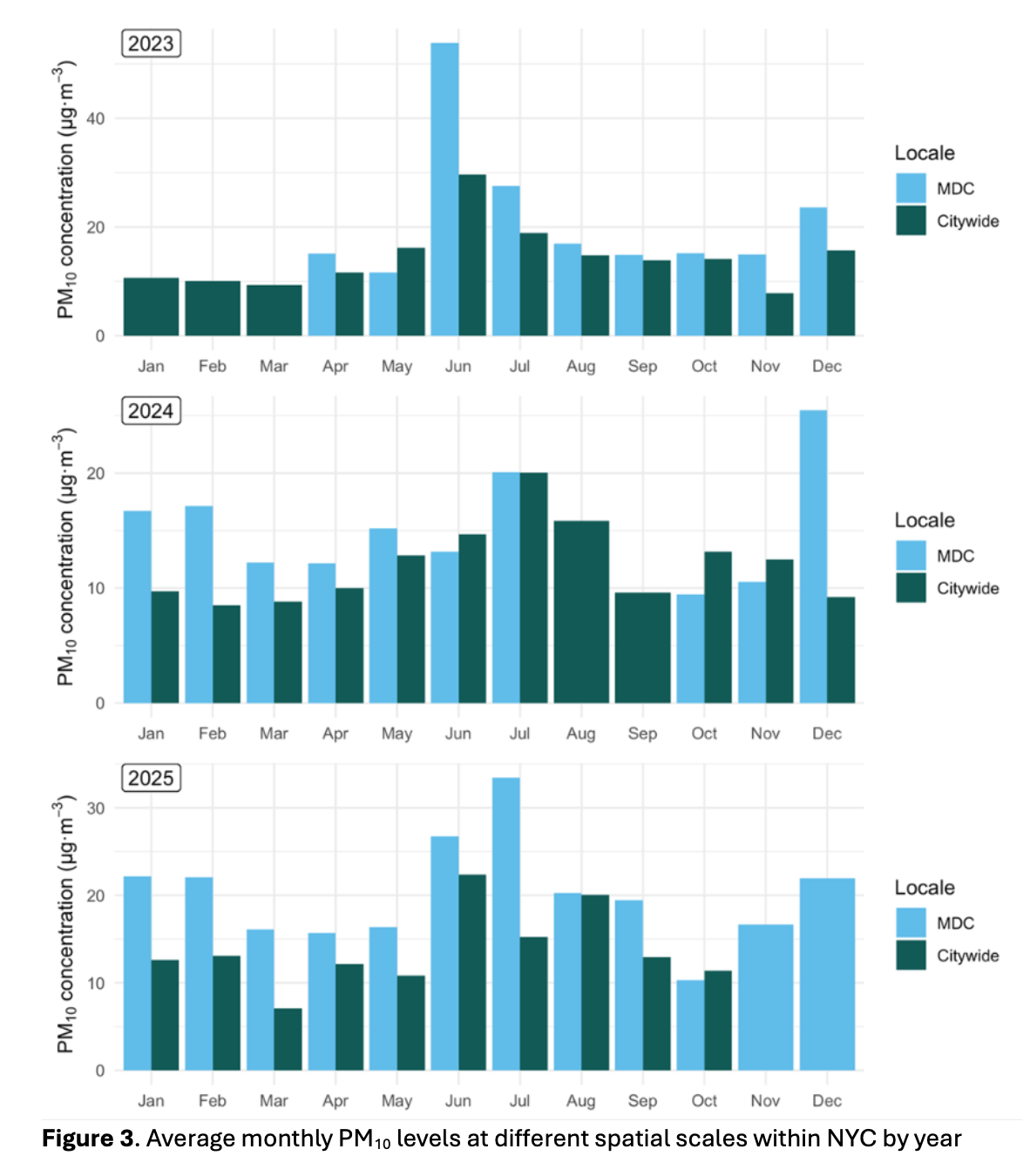
The researchers found that particulate matter levels, which are key indicators of dust exposure, near the MDC site in 2025 were consistently higher than levels recorded in the broader Chinatown area and across New York City. Elevated concentrations were recorded across multiple months and seasons, even after the most intensive dismantling activities had ended.
According to the report, in 2024, when activity at the site was at its peak, block-level PM10 concentrations — small, inhalable particulate matter or pollution that tends to come from local sources including construction, and can lead to respiratory illness, cardiovascular issues, chronic conditions and even death — were frequently higher than citywide averages, particularly during the winter and spring, when demolition and dismantling activities were most active.
More concerning to researchers were some gaps in the city’s air-quality data that occurred around the same time that independent sensors recorded spikes in pollution.
A comparison with independent monitoring data showed that, during several months in 2023, periods when official air-quality data were missing coincided with elevated PM10 concentrations recorded at nearby locations, according to the report. The researchers said the pattern raises questions about whether monitoring interruptions occurred during periods of increased airborne dust.
Without access to the city’s raw datasets or clear explanations for the gaps, researchers said they could not determine whether the gaps affected the overall assessment of pollution levels near the jail site.
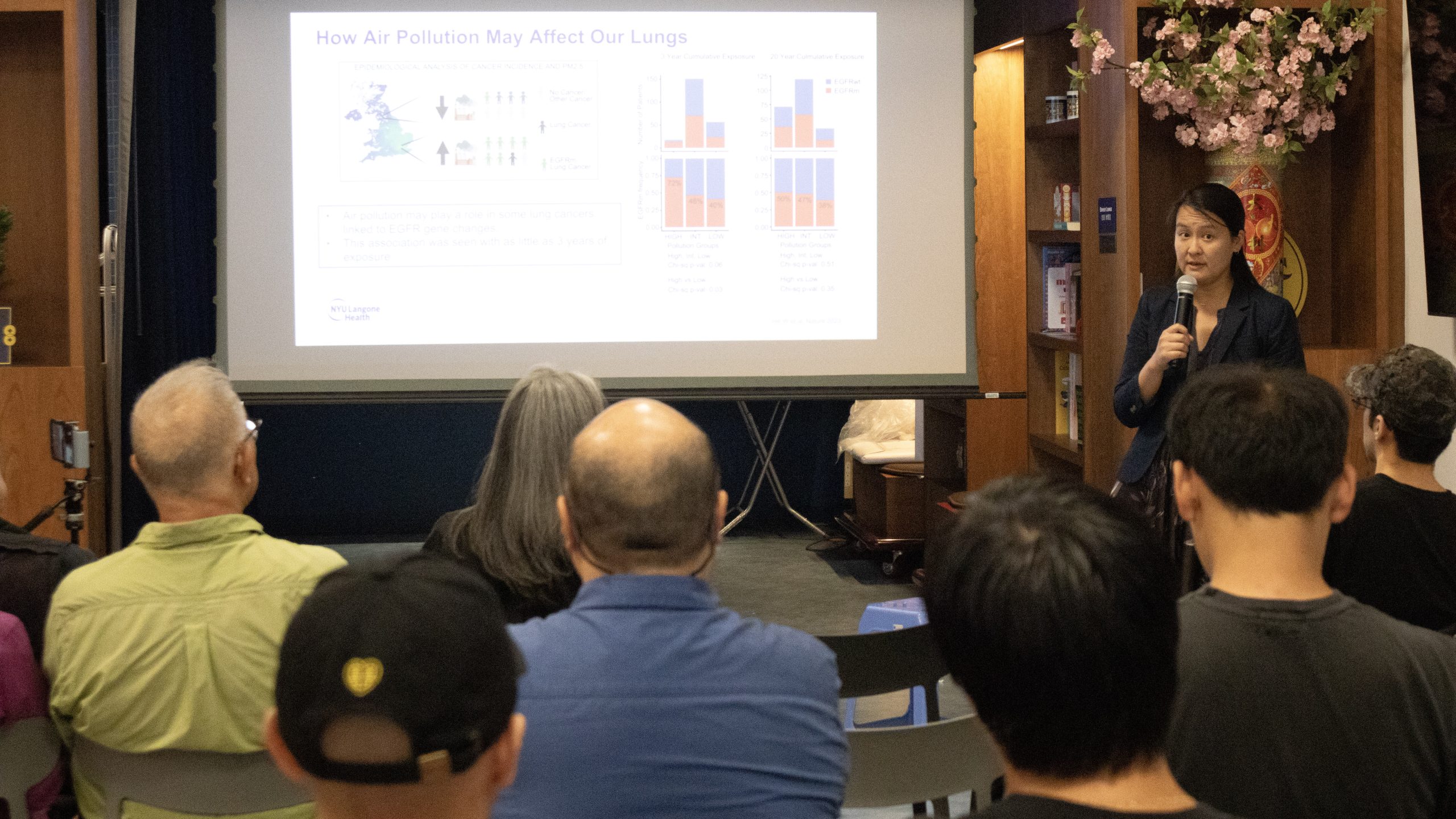
Elaine Shum, a medical oncologist specializing in lung cancer at NYU Perlmutter Cancer Center, noted at the town hall the high incidence of lung cancer among Asian Americans who have never smoked. She said some studies have found that certain lung cancers are linked to changes in specific genes. These genetic changes have been found in 20 to 30% of non-small cell lung cancer patients globally, but at much higher rates among Asian populations. Air pollution may also play a role in some lung cancers associated with these genetic changes, she said.
Shum said the available data does not conclusively link the jail’s construction with lung cancer, “But what we have is very suggestive trends, and that’s something we can already act on.”
“We do see elevated air pollution in this neighborhood much higher than in the rest of the city,” Shum said at the town hall. “We see a trend of incomplete monitoring and data reporting. Pulling those two together, gives us more impetus to ask for more monitoring resources or strengthen mitigation strategies.”
Community advocates and researchers said they hope the research will draw the city’s attention to the health risks that prolonged jail construction could pose to vulnerable groups, including older adults. They also called for the city to address these concerns during upcoming phases of construction by adopting mitigation strategies such as prioritizing early and continuous monitoring, providing full transparency of real-time data, and strengthening independent, community-centered oversight.
New York City Department of Design and Construction (DDC) did not respond directly to questions about the reasons for the missing data identified in the report. A spokesperson for the DDC said the city “takes air quality concerns very seriously” and has a monitoring program in place for the Borough-Based Jails project at all four sites.
“All available data from the dismantle phase of the project in Manhattan is posted publicly on the [jails project] website,” the spokesperson said in a statement shared with Documented. “DDC and the dismantle contractor attended regular meetings with the community during that phase of the project and responded to questions regarding data and monitoring.”
The spokesperson also said DDC recently onboarded an independent environmental monitor that will remain involved through the project’s substantial completion phase. The monitor attends public meetings with community members and posts reports online, the spokesperson said.
A representative for Gramercy Group, the jail’s demolition contractor, did not respond to a request for comment.
At the town hall, community members expressed frustration and anger accumulated over years of fighting the city over the jail project.
“I think we can all make the leap that this community is in huge danger with this jail,” said Triple Edwards, a resident who has lived in Chinatown for more than 20 years, citing concerns over other potential impacts, including changes to the water table and leaching from buildings surrounding the jail site. “To all of this empirical data, that’s cumulative, that it almost feels to me undeniable.”
Elaine Wong, who has lived most of her life on Mott Street in Chinatown, said she remembered protests by community members in the 1980s against the first jail built there and said she felt the same pattern was repeating with the new borough-based jail. She said the jail project was “deliberately targeting” lower-income residents who did not have enough political clout to fight back.
“We are not a wealthy, affluent community,” Wong said at the town hall, “and until it’s reaching maybe someone who’s wealthy that cares about this, which they clearly don’t because they don’t live here. It’s always going to be this way because it’s happened time and time and again.”
Jan Lee, co-founder of Neighbors United Below Canal, a community organization opposing the megajail construction, said the community will continue monitoring air pollution near the jail site and is seeking sponsorship to install additional monitors to track dust levels.
“That’s not going to be one week or two weeks. It’s going to be the duration of the construction if they move forward with this mega jail,” Lee said at the town hall. “That’s because of town halls and because of our community standing up for itself and saying we demand more scrutiny.”