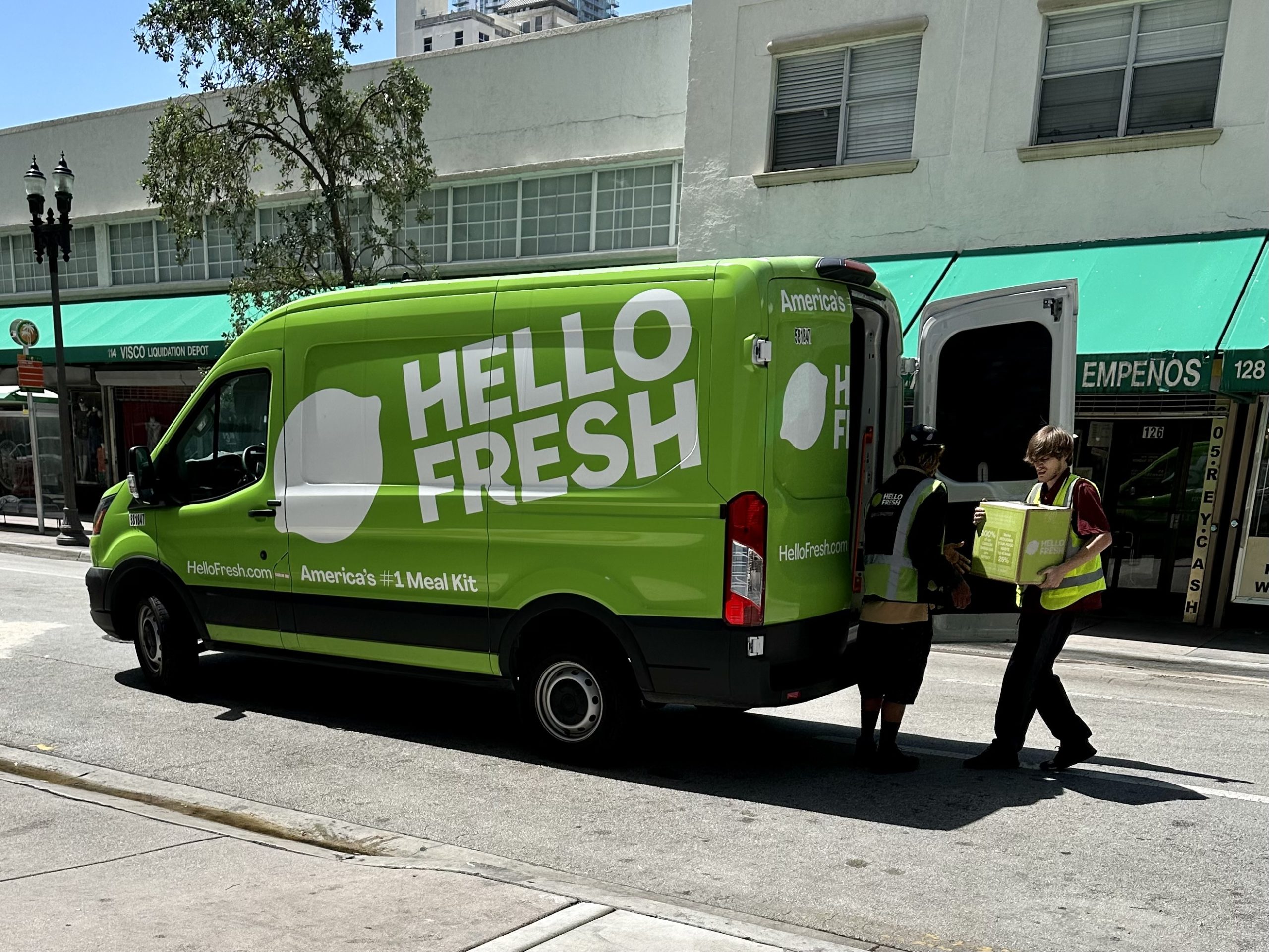


HelloFresh’s promise of convenient, healthy food has made its green boxes a ubiquitous fixture in apartment building mailrooms. But behind its lime logo and the company’s self-described mission to “change the way people eat, forever,” immigrants claim that working at HelloFresh meant enduring a workplace rife with racism, sexual harassment and unsafe working conditions.
In a class-action lawsuit filed Sept. 23, former workers at HelloFresh’s Newark, New Jersey, warehouse allege they were the victims of “discrimination, harassment, and forced labor.”
According to the lawsuit, supervisors at the facility used racial slurs and threats of violence particularly against Latino and immigrant workers, in multiple instances denying they use the bathroom or threatening to call U.S. Immigration and Customs Enforcement (ICE) on workers if they disobeyed. On a few occasions, the lawsuit alleges, a HelloFresh manager “menaced Hispanic workers with a baseball bat to limit their time in the bathroom and force them to return to work on HelloFresh’s production line.” Workers were so restricted that several were forced to urinate on themselves after supervisors blocked them from using the bathroom, the lawsuit alleges.

“If we needed a bathroom break, we were not allowed to take a bathroom break,” P., an immigrant from Ecuador who worked at the Newark facility between 2021 and 2023, told Documented in Spanish. “They would only permit us to when they thought it was necessary. We had to bear it, and many times many of us wound up with urinary tract infections.”
P. said that while working at the Newark facility, her supervisor refused to allow her to use the bathroom during one of her shifts on the assembly line packing pre-prepared meals while she was on her period.
“My supervisor at that time would not allow me to go to the bathroom,” P. said. “My flow stained my clothing, and that entire night I had to work under that condition,” P. asked to use only her last initial because of her immigration status.
Because of the threats of violence, P. said she tried not using the bathroom at all during her entire eight-hour shift.
P.’s experience was far from unique. The lawsuit represents hundreds of workers who alleged improper labor conditions at the HelloFresh facility in Newark involved in preparing and shipping pre-made meals. Many of them shared similar anecdotes, ranging from being harassed by managers at work to working without the proper safety equipment. Most of the workers were, like P., immigrants and employed by a third-party contractor, while their supervisors were direct employees of HelloFresh — adding additional hurdles to reporting mistreatment.
This is not the first time HelloFresh has come under fire for its labor practices. In 2024, the Germany-based company was implicated in a child labor investigation by the U.S. Department of Labor at its Illinois plant. The teenagers were hired by a temp agency that staffed the HelloFresh plant.
Workers in HelloFresh’s Richmond, California, and Aurora, Colorado, plants also raised alarm bells about safety issues at their workplaces. At Richmond, which was the site of a workplace COVID-19 outbreak that led to 171 documented cases and one death in 2020, California’s Occupational Safety and Health Administration issued the company an $8,435 fine in 2021 for violating COVID-19 prevention safety protocols.
According to the lawsuit, HelloFresh outsources much of the hiring at its warehouses to third-party agencies, a common practice by companies to reduce costs and liability and to weaken the influence of organized labor. Because of this, the workers in this class-action suit were not employed by HelloFresh directly, but instead hired as temporary workers through three different staffing agencies: Action Staffing Group, On Target Staffing LLC, and ProStaff Solutions Inc. These companies were also named in the lawsuit as joint employers. None of the staffing agencies responded to Documented’s request for comment.
In a statement, Abigail Dreher, HelloFresh’s associate director of corporate communications, said the company conducted its own internal investigation about the complaints and found no wrongdoing.
“Our frontline workforce is the foundation of our company, and ensuring a safe, fair, and respectful workplace is our highest priority,” she said in a statement to Documented. “Upon learning of these allegations, which date from 2023 and years prior, we conducted a thorough internal investigation and found these claims to be entirely without merit. We vehemently denied these allegations when this lawsuit was filed over two years ago, and we continue to vehemently deny them today.”
According to Dreher, HelloFresh maintains robust anti-discrimination and anti-harassment policies which include a 24/7 confidential hotline for anonymous complaints.
“We take every concern seriously and remain fully dedicated to upholding a culture of integrity and accountability,” she said.
‘A Pattern of Force and Coercion’
Workers who faced harassment at HelloFresh’s Newark facility said they faced further abuse for reporting their mistreatment.
P. said that when she would complain to her supervisors about working conditions, they would yell at her. “Many times we complained because they would shout at us,” she said. “They would tell us to move faster. They would insult us, shout at us ‘stupid people,’ things like that.”
According to the lawsuit, insults, slurs, and verbal harassment were commonplace. Supervisors would call Latino workers “fucking Latinos,” “pure shit,” “trash,” “fucking bitches,” and “fucking sons of bitches,” the lawsuit alleges.
If workers objected to their working conditions, both HelloFresh supervisors and Staffing Agency supervisors would threaten to report immigrant workers to U.S. Immigration and Customs Enforcement, the lawsuit alleges, adding that in some instances, supervisors would tell workers they had to endure the abuse to avoid being deported.
Employees also claimed HelloFresh instituted a policy that required they only speak English on the job. Workers who were caught speaking Spanish were verbally reprimanded and told to “Speak English, this is America” and “Don’t speak Spanish, speak English,” according to the lawsuit.
Female workers faced additional abuses, with some alleging that managers and co-workers routinely propositioned them for sex on the job and also constantly made sexually explicit comments.
The challenges were made even more difficult by the staffing structure. With workers staffed through third-party agencies, and supervisors employed by HelloFresh directly, there was confusion about how mistreatment could be reported and which company would be responsible for addressing concerns.
“There were a lot of threats, and a lot of uncertainty,” said P. “The agencies would wash their hands of any culpability. They said that that was the responsibility of HelloFresh, and HelloFresh blamed the agency, so they would pass the blame onto each other.”
Lauren Herman, legal director for Make the Road New Jersey and one of the principal attorneys representing the workers in the case, said the company was “using a pattern of force and coercion.”
“So, many of the workers talk about how they were assigned to work on the most difficult tasks, like putting the ice in each of the boxes. They were not given gloves,” she said. “They weren’t given any other protective equipment. So it was incredibly difficult and painful labor that this particular group was forced to do, and essentially they were told that if they complained, they would face consequences.”
To add insult to injury, many of the workers who had endured years of poor working conditions found themselves abruptly out of a job.
On Aug. 4, 2023, one day before the New Jersey Temporary Workers’ Bill of Rights was set to go into effect, which would guarantee temporary workers stronger labor rights such as increased wages and a pathway to a permanent position, the lawsuit alleges that HelloFresh laid off about 400 temporary employees with barely any advance notice.
Some workers learned that they were out of a job through messages sent in a WhatsApp group on the day they were fired, despite New Jersey state law requiring employers to give workers 90 days’ advance written notice before they are laid off.
HelloFresh did not address the layoffs in its statement to Documented.
By coming forward, workers like P., who is a single mother of four, hope they can help play their part in ending workplace exploitation.
“I’m hoping that this does not repeat itself,” she said. “Many people arrive at these jobs hoping to have a dignified form of work for them to support their families. I want to create a change for my own children who are growing up here, and I just hope that they do not have to encounter or go through the things that we have gone through.”