


More than 65,000 immigrants were being held in detention by Immigration and Customs Enforcement (ICE) by July 11, 2026, according to government data. The detentions not only impact the individuals — facing precarious situations inside the detention centers — but also the family members who are often tasked with communicating with their loved ones inside the centers to coordinate legal assistance, add funds for commissary and offer emotional support.
While the process of communicating with someone inside an ICE detention center can vary by facility, here is what you need to keep in mind if you plan to contact a loved one inside detention centers.
Disclaimer: This information is not a substitute for legal advice from a qualified attorney or accredited representative. The content was last updated October 2026.

Step 1: Locate your loved one using the ICE locator tool
There are more than 200 detention centers around the country. Finding where a family member or friend is being detained is crucial for sending commissary and adding funds to their communication account.
ICE’s Online Detainee Locator System (ODLS) is an online tool that can be used to find the location of someone that has been detained by the agency or who has been in the custody of Customs and Border Protection for more than 48 hours.
The ODLS excludes information for immigrants under the age of 18. To locate unaccompanied minors call the Office of Refugee Resettlement (ORR) at 1-800-203-7001, or the local ICE Field Offices.
You can search the locations of your loved one in two ways:
- Using the country of birth and Alien Number (A-Number): a nine-digit number assigned to immigrants by the government to consolidate all immigration forms, visas, and cases into a single record.
OR
- Complete name, date of birth, and country of birth.
Note: Sometimes the program might not return any results if the person has multiple last names; adding a hyphen between the last names might lead to a result. See our guide for more information on how to use the ICE locator tool.
Step 2: Contact the detention center to get information about communication
If you have entered the A-number or the biographical information of your loved one correctly, the ODLS should return the name of the facility and the phone number to reach them. You can also click on the name of the facility to see more information, such as the hours of operation and the items that can be sent to your loved one, if any.
Calling the center does not only confirm where the loved one is detained, but the personnel can also provide your loved one’s A-Number, which can be used for communication and for monitoring the case in immigration court.
The center can also provide information on what software — if any — is being used by the detention center to allow communication between family members and detained individuals.
Step 3: Add funds for phone calls and communication accounts
Detainees cannot receive incoming calls.
Each facility has their own procedures, therefore it is important to check the “Contacting a Detainee” tab under the facility information where your loved one is detained. There you will find out if the facility gives detainees access to tablets, and what the methods of communication are available.
At least 48 ICE facilities provide detainees with tablets for messaging, video calls and other limited activities. Other centers may provide tablets through contractors.
For example, Delaney Hall Detention Facility, New Jersey, uses the application myViaPath (formerly known as GettingOut) to add money for phone calls and tablet usage. On the other hand, Washoe County Jail uses iWebVisit.
In general, you will need the full name and A-number or booking number to add a contact. Both of these numbers can be obtained by calling the detention facility obtained from the ICE locator tool. Sometimes an application might require the date of birth and country of origin.
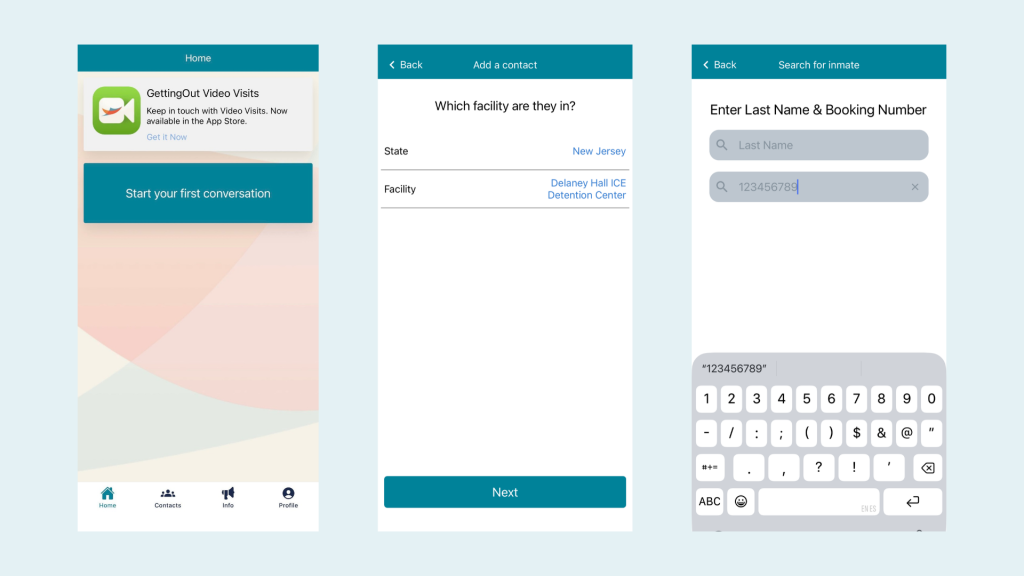
(Screenshot of the GettingOut application.)
It is best not to guess what app or software is being used by the facility. Instead, the information can be found by accessing the detention center information here or calling them directly.
Keep in mind: all calls between detainees and family members and friends are recorded. Therefore it is important not to discuss private information or anything sensitive related to immigration cases or criminal investigations.
Step 4: Add commissary funds for purchases
Commissary accounts, often called Trust Accounts, are different from communication accounts, and they are used for detainees to purchase items such as food, coffee, hygiene products, and sometimes even clothing.
Some facilities may allow family members to use applications, like Connect Network, to add money to a detainee’s commissary account. People can also use Western Union or the Access Corrections website to deposit money.
In general, you will need the name and the A-number of the person detained to add funds to the commissary. Some facilities might have specific commissary account numbers. It is best not to guess and inquire directly from the family member or the detention facility personnel.
Most commissary accounts have a limit of how much money you can add. Certain applications, like Connect Network, may charge a processing fee for using a credit card to add funds to the commissary.
FAQ
Would providing personal or billing information to a detention center or its phone service create any additional risk?
Melissa Chua, Director of New York Legal Assistance Group’s Immigrant Protection Unit, told Documented, “As a general matter, it is potentially safer if a U.S. citizen or legal permanent resident can provide their information.” She explained that NYLAG is unaware of any enforcement actions being taken from providing credit card or billing information to add funds on these types of applications.
Conversations with people in detention are often recorded. Could these conversations be used against someone who has a pending case with USCIS or in immigration court?
Chua explained that while there haven’t been cases where conversations with family members inside detention centers have been used against individuals, “Anyone communicating with individuals in detention should continue to remember that their calls are recorded and not confidential when sharing any information with loved ones in detention.”
More broadly, what should noncitizens and their family members keep in mind when communicating with people in detention or interacting with detention centers and their communication services?
Chua said that they are often asked if non-citizens should visit detention centers, and they aren’t aware of any enforcement actions being taken against non-citizens who visit detention centers. “We still generally advise against visiting detention centers if someone does not have secure immigration status,” she said.


