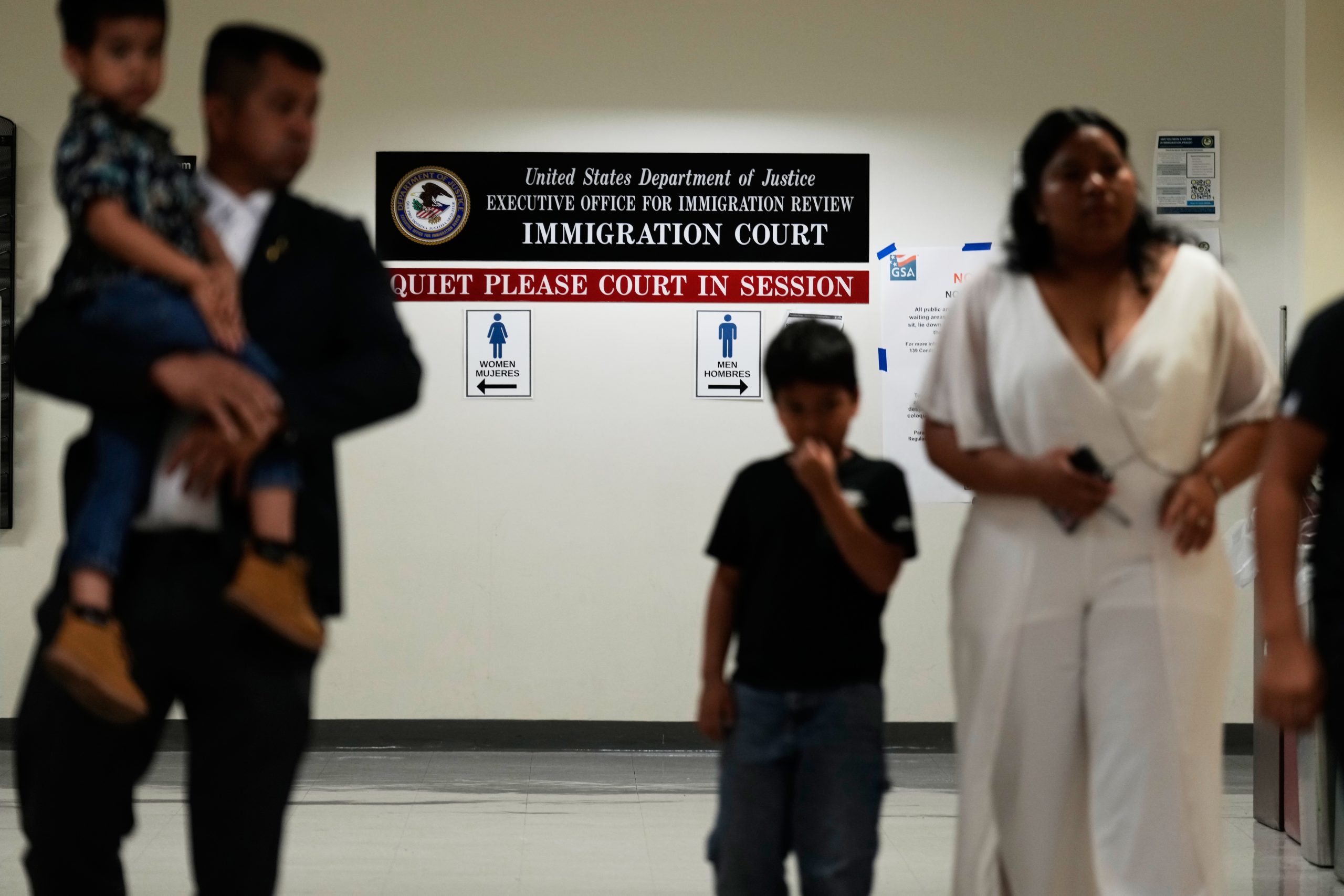


When Flushing resident Haiguang Zheng appeared before an immigration judge for his bond hearing, it looked as if he’d cleared the biggest obstacle to his release: the Trump administration’s mandatory detention policy.
A federal judge had ruled, like hundreds of others, that the Trump policy requiring noncitizens who’ve lived in the U.S. for years be detained as if they’d just arrived at the border, was unconstitutional. As a result, immigration detainees like Zheng were entitled to a bond hearing, which would allow him to be freed while his deportation case was decided.
But when Zheng appeared before Newark Immigration Judge Maria Akalski on Nov. 19, she ruled — at the urging of the Department of Homeland Security attorney — in direct contradiction of the federal court, holding that mandatory detention still applied to him. She denied bond.

In response, U.S. District Court Judge Christine O’Hearn, who had ordered Zheng’s bond hearing, wrote that the immigration court had “brazenly disregarded” her order. The order “was clear and unambiguous and left no room for interpretation,” she wrote.
She also faulted DHS because it had invited the immigration judge “to simply disregard this Court’s Order as if it did not exist.” She then ordered the government to release Zheng, reasoning that it “would serve little purpose” to hold another bond hearing. He was released on March 11.
In more than 100 cases across the country, federal judges found that the immigration courts had failed to provide the fair and timely bond hearings that they’d ordered to ensure the constitutional right to due process, according to a Documented analysis of federal court records and a compilation by the law and policy journal Just Security.
In some cases Documented reviewed, immigration judges defied the federal court order blatantly. More often, they failed to follow the federal court’s instructions, such as considering alternatives to detention or putting the burden of proof on the government. Immigration judges were found to have issued “rubber stamp” denials of bond without any indication that they’d analyzed the detainee’s arguments. In other cases, bureaucratic malfunction tainted the process because detainees are sometimes brought to hearings only to find their lawyers weren’t given required notice to appear.
Moreover, in many of the cases this year in which bond was granted, immigration judges set it at $20,000 or above — significantly higher than previous years — making it much harder for detainees to win freedom even if granted bond, Documented found.
Hovering over all this are concerns expressed by some federal judges and by the United Nations Human Rights commission that the Trump administration has intimidated immigration judges into complying with its hardline policies by firing more than 100 of them.
Beyond the chaos this has caused for the thousands of people Immigration and Customs Enforcement (ICE) has jailed, this has intensified questions about whether courts that are an extension of the Department of Justice — and not part of the independent federal court system — are genuinely capable of providing the neutral forum that both immigration law and the Constitution require them to be.
In her March 23 decision, O’Hearn took note of the impact of the Justice Department’s mass firing of immigration judges, writing: “These developments, among others, raise a serious question as to whether the constitutional guarantee of an impartial decision maker is being honored in any case brought before an IJ [immigration judge].”
Zheng’s attorney, Veronica Cardenas, said the immigration judge’s decision against her client was especially egregious. She said Zheng, 44, has no criminal record and is a Chinese Christian seeking asylum on grounds he would be persecuted for his religion in China.
“I think after seeing that, it’s really hard to argue that the immigration judges are neutral parties,” said Cardenas, who was an attorney for ICE for more than a decade before entering private practice in 2023. She added that it’s become very difficult to win release on bond without intervention from the federal court.
Given the firing of so many judges, including dismissal or transfer of former President Joe Biden’s appointees to the Board of Immigration Appeals, advocates have contended that the system is far more biased than in the past. Immigration attorneys have also argued that judges are issuing far-fetched findings to justify continued captivity for those who’d asked the federal court to intervene.
The Executive Office for Immigration Review (EOIR), the Justice Department unit that runs the immigration court, declined to comment on specific cases Documented asked about, and stated that the Trump administration is complying with court orders and returning integrity to the system. The Trump administration has steadily denied that EOIR has directed judges to deny bond.
“If rogue judges followed the law in adjudicating cases and respected the Government’s obligation to properly prepare cases, there wouldn’t be an ‘overwhelming’ habeas caseload or concern over the Department of Homeland Security following orders,” a spokesperson for EOIR said in a statement issued to Documented said.
The agency declined to comment about whether the “rogue” judges included those serving on federal courts of appeals that found the Trump administration’s policy of mandatory detention for noncitizens who already entered the country was illegal. Nine of the federal appeals courts have ruled against the policy; two have upheld it.
Navigating Release for Detainees
Increasingly, federal judges are deciding to remedy an illegal immigration detention by ordering the immediate release of anyone who has no criminal record — or has a minimal one — rather than require a bond hearing in immigration court. That was so for Zheng; the judge wrote that there was no “reason to believe that a second hearing would be fundamentally fair.”
This has especially been the case recently in New Jersey, where many New York detainee cases are tried after ICE confines them in jails in the Garden State or Pennsylvania.
According to Documented’s survey of federal court records, more than 100 habeas suits in New Jersey were closed this way in August. Detainees in these cases were typically released within a few days after the lawsuit was filed, in some cases, with the U.S. attorney’s agreement.
Data from EOIR reveals how difficult it’s become to win release from an immigration judge:
- New York and New Jersey immigration judges granted bond in 23% of their decisions in the first seven months of 2026, down from 44% in 2024.
- The average bond amount that judges set increased 118% over the same period. The cumulative rate of inflation was 6.4%.
- The number of bonds set at $20,000 or above in New York and New Jersey courts also shot up to 134 this year through July, or 16% of all granted bonds. In 2024, there were only five cases of bond set at $20,000 or above, under 1% of all bonds that year.
Erroneous Rulings
Flushing nail salon worker Haozhan Ren was held in mandatory detention by ICE on Jan. 21 even though he has no criminal record. He filed a habeas lawsuit in Newark federal court one week later, asking for a chance to request release on bond.
U.S. District Court Judge Jamel Semper ordered a bond hearing. On Feb. 4, Akalski, the Newark immigration judge, denied Ren’s release. But the federal court found on Feb. 6 that Akalski conducted the hearing “erroneously” by applying the wrong legal framework that was “contrary to this Court’s order.”
Ren’s next bond hearing, on Feb. 11, was assigned to Immigration Judge Ramin Rastegar, who contended that his colleague Akalski had “fully complied” with Semper’s original order. Rastegar refused to rule one way or the other, insisting that Akalski’s order still stood, and that Ren could appeal within the immigration court system.
At that point, Semper decided it would be “futile” to send the case back for a third bond hearing. He ordered Ren’s release from the Delaney Hall Detention Facility in Newark on June 4,explaining that he wanted to ensure federal court rulings were “not rendered illusory by noncompliance.” Ren was incarcerated for 134 days.
“I haven’t actually encountered a situation where a federal district judge ordered something and the immigration judge just decided on the record that it was because the federal district judge misunderstood what happened,” said attorney Jed Wasserman, who represents Ren.
Wasserman added that he generally finds the hearings are conducted unfairly. “For whatever reason, they always find someone is a flight risk or a danger to the community.”
Snags within the government bureaucracy are another hazard for people seeking release from immigration jails; in a number of local cases, attorneys weren’t notified when and where a hearing would be held, leaving detainees without representation or the ability to file evidence.
In four cases Documented identified in federal court records, Immigration Judge Shana Chen accused immigration lawyers of wasting her time and then rushed into decisions that federal judges ruled had violated the constitutional rights of detainees at Delaney Hall. In one of those cases, a federal judge ordered “a new bond hearing before a different judge to avoid the appearance of bias.” (Emphasis in original.)
Flight Risk and Denied Bond
Delaney Rohan, a supervising attorney in the Legal Aid Society Immigration Law Unit, is among the lawyers who contend that immigration judges have adopted a kind of upside-down reasoning to justify denying bond to detainees.
He asserted that’s what happened to his client Ivan Ramos Espinoza, 46, a Hempstead, New York, resident from Mexico and father of two U.S. citizen children. Ramos Espinoza was detained in June 2025. In a March 31 hearing, New York Immigration Judge Charles Conroy ruled he was a flight risk and denied bond. Judge Ramón Reyes, Jr., of federal court in Brooklyn faulted the decision because, he wrote, Conroy had not followed his order to consider alternatives to detention.
Conroy’s questioning of Ramos Espinoza also raised the federal judge’s eyebrows. Conroy asked him what would happen to his family if he were deported. “I cannot even think about it,” he replied. “It will be more devastating than what they are going through right now. So I cannot think what will happen to them and that’s what I’m afraid of.”
Conroy continued: “Sir, is it correct to say you would do anything you could to stay here with your family?”
“Yes,” he answered.
At the hearing’s conclusion, Conroy used Ramos Espinoza’s dedication to his family against him, saying “All of that leads me to believe he’s an extremely high flight risk.”
The federal judge said it showed just the opposite: that those strong family ties were “the very reason he would attend any future proceedings.”
Judge Reyes ordered Ramos Espinoza’s immediate release on June 5, after nearly a year of incarceration.
Rohan, the Legal Aid Society attorney, said this was typical of the “inverted logic” springing up in immigration court bond decisions.
Factors that typically favor release on bond — deep roots in the community, long-time residency, or U.S. citizen relatives — are being turned around to deny bond, attorneys have told Documented.
That was on display during a morning of bond hearings that Documented observed at the Elizabeth Immigration Court in New Jersey on June 4.
In one case, 51-year-old Mexican immigrant Mauro Perez-Cortez told Immigration Judge Tamar Wilson that he wouldn’t flee because he has his three children in the U.S., and has lived in the country for 31 years. “That indicates to me you are a flight risk,” the judge said. The DHS lawyer didn’t need to say more than a few sentences. Wilson denied bond.
A few minutes later, Wilson ruled that a Dominican immigrant who came to the U.S. in 2022 and filed for asylum was a flight risk because of how recently he arrived. Further, she said, his asylum application looked weak — and having “now been informed” of this, he was even more likely to flee. She denied bond.
Shortly afterward, Wilson used a Bolivian immigrant’s cancer as a basis to deny him bond. His disease gave him an incentive to flee so he could find medical attention in the U.S., the judge said. Wilson then asserted that the man’s 25 years in the U.S. worked against him — and bond was denied once more.