



With the FIFA World Cup 2026 set to kick off next Thursday, the New York metropolitan area is expected to draw more than 1.2 million visitors. As the region prepares to host one of the world’s largest sporting events at New Jersey’s MetLife Stadium, officials say the moment will test — and showcase — the capacity of a region already home to more than 19 million people.
New York City Mayor Zohran Mamdani and Gov. Kathy Hochul announced Thursday sweeping, multiagency plans to keep residents and visitors safe, informed and moving throughout the tournament. Here’s what to know about transportation, infrastructure and emergency preparedness, especially on match days.
Match Days

Match days are designated as “Gridlock Alert Days”. For the New York–New Jersey region, match days are scheduled for June 13, 16, 22, 25, 27, and 30, and July 5 and 19. Click here to find more information.
Public Transportation
Officials are encouraging residents and visitors to use public transit whenever possible, especially in Midtown Manhattan on match days.
- Customer service staff will be stationed at major hubs — including Grand Central, Times Square and 59th Street–Columbus Circle — to help with directions.
- The Metropolitan Transportation Authority (MTA) will run full service on all match days.
- Additional subway and rail service will be added, including more frequent trains on the 1, C, F and 7 lines.
- On weekend match days, 1 and C trains will run more frequently between 10 a.m. and 10:30 p.m.
- Extra 7 train service will run on high-demand days to improve access to the Fan Zone at the USTA Billie Jean King National Tennis Center in Flushing.
- The Long Island Rail Road and Metro-North will operate full schedules with added capacity at Penn Station and Grand Central. Both commuter rail systems will provide connections to stadium shuttle buses.
- Planned subway work in and around Midtown Manhattan will be suspended on match days to minimize disruptions.
Traffic & Street Changes
On match days, officials strongly advise avoiding Midtown Manhattan and limiting unnecessary driving.
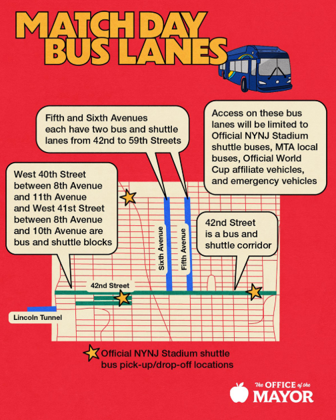
- Street restrictions will be in place along 42nd Street and parts of Fifth and Sixth avenues, as well as 40th and 41st streets:
- Only stadium shuttles, MTA buses, official World Cup vehicles and emergency vehicles will be allowed in restricted areas.
- Restrictions will be in effect from six hours before kickoff to three hours after the match.
- The city will work with businesses to limit truck deliveries during peak travel periods.
- Over 100 NYC Department of Transportation staff will be deployed to manage traffic and adjust signals in real time.
- Expect heavy congestion and limited deliveries throughout Midtown Manhattan.
Full details on bus lanes, street closures and travel guidance are available in the Mayor’s Midtown Transportation Plan.
Emergency Alerts & Safety
New York City Emergency Management has activated a citywide coordination system, including the Emergency Operations Center, to respond to potential issues such as extreme heat, flash flooding or large crowd incidents.
A Joint Information Center will provide clear, multilingual updates to the public.
Residents and visitors are encouraged to sign up for real-time alerts through Notify NYC by texting:
- SUMMER26 (English)
- SUMMER26ESP (Spanish)
- SUMMER26FRE (French)
to 692-692.
NYC Mayor’s Press Office
Updates are also available through the Notify NYC WhatsApp Channel at on.nyc.gov/NNYCWhatsApp.
Health & Medical Services
City agencies are preparing for increased demand during the World Cup, particularly due to large crowds and summer heat.
- Hospitals and EMS are staffed for higher call volumes and emergency response needs.
- Cooling centers will be activated during extreme heat emergencies (Code Red days).
- Health officials are monitoring for infectious diseases and public health risks associated with large gatherings, including wildfire smoke events.
- The NYC Department of Sanitation (DSNY) will increase cleaning operations around transit hubs and major event locations throughout the tournament.
Other tips:
- Use licensed taxis or rideshare services only.
- Avoid anyone offering rides without a meter or fixed app price.
- Report scams or overcharging via 311.


