

As the U.S. marks its 250th spin around the sun, the country continues to circle around and around old debates on immigration.
In broad strokes, the history of America’s immigration policy can be understood as an ongoing, racialized debate over who can belong here — one that has responded to shifts in the country’s economic situation, migration flows, global conflicts and technological progress.
Take this week as an example. On Tuesday, the Supreme Court ruled to uphold the 14th Amendment’s birthright citizenship clause, ratified 158 years ago, and challenged by the Trump administration in an executive order last year. The decision, and its proximity to the nation’s semiquincentennial, acts as a reminder that America’s history of grappling with its identity is very much alive and present with us today.
“It’s just remarkable, the echoes of the past and how they play out in immigration debates,” said Bryan Zehngut-Willits, a historian of U.S. immigration and global migrations, to Documented.

Though immigration is never directly mentioned in the Constitution, the naturalization clause clearly shows the founders wanted to create a pathway for foreign-born individuals to become American citizens, said Zehngut-Willits.
“It was pretty well understood that immigration was a net good,” Zehngut-Willits said. “That is why there is this rule in the Constitution. It assumed people were going to come and become citizens. We just had to figure out what the rules were, and what the mechanisms were, and what the restrictions might be.”
Congress first answered those three questions in the Naturalization Act of 1790, which stated that only “free, white persons” of “good character” could become citizens. The act further limited naturalization to men who were property owners. The racial limitations on who could become a U.S. citizen lasted for a whopping 162 years — only repealed in 1952 with the passage of the Immigration and Nationality Act, which established modern immigration law.
“These were racially coded systems from the start,” Zehngut-Willits said.
In the Reconstruction era, following the formal end of chattel slavery in the U.S., the debate centered on whether Black people could be considered citizens. That led to the 14th Amendment’s birthright citizenship clause and the overturning of the infamous Dred Scott decision, in which the Supreme Court previously ruled that no Black people in the U.S. could ever be recognized as citizens.
Then, there was a rise in anti-Asian xenophobia in the late 19th century — a time of rapid industrialization — that led to the passage of the Page Act of 1875, which specifically targeted Chinese women under the presumption they were entering the country as sex workers, as well as the passage of the Chinese Exclusion Act, which banned Chinese laborers from entering the country and prohibited Chinese residents from becoming naturalized citizens.
In the 1920s, the country implemented a racial quota regime (that excluded the Western hemisphere), deported Mexican migrants during the Great Depression, and for over two decades from the 1940s to ‘60s offered temporary agricultural work to Mexicans without a pathway to citizenship, under the Bracero Program. Jumping to the early 2000s in the wake of 9/11, there was a rise in anti-Muslim immigration policy under the guise of national security.
This may all sound familiar — and it should. During Trump’s second term, restrictive and racist immigration policies have targeted Latino communities as well people from Muslim-majority and African nations, and are being enforced in the name of protecting borders and fighting crime.
Vincent Cannato, associate professor of history at the University of Massachusetts Boston and author of several books including “American Passage: The History of Ellis Island,” said there are many historical parallels.
“In terms of a national debate, it was like that 100, 120 years ago,” he told Documented. “Constantly in newspapers, in legislatures, debating who should arrive, how many people should arrive, ‘Are the people coming over inferior or not?’ Great discussions about the quality of immigrants coming about, whether America is full, whether it actually needs more people, whether it needs the kind of people we’re getting.”
That said, there are some key differences between the current state of immigration policy and what has happened in the country’s history.
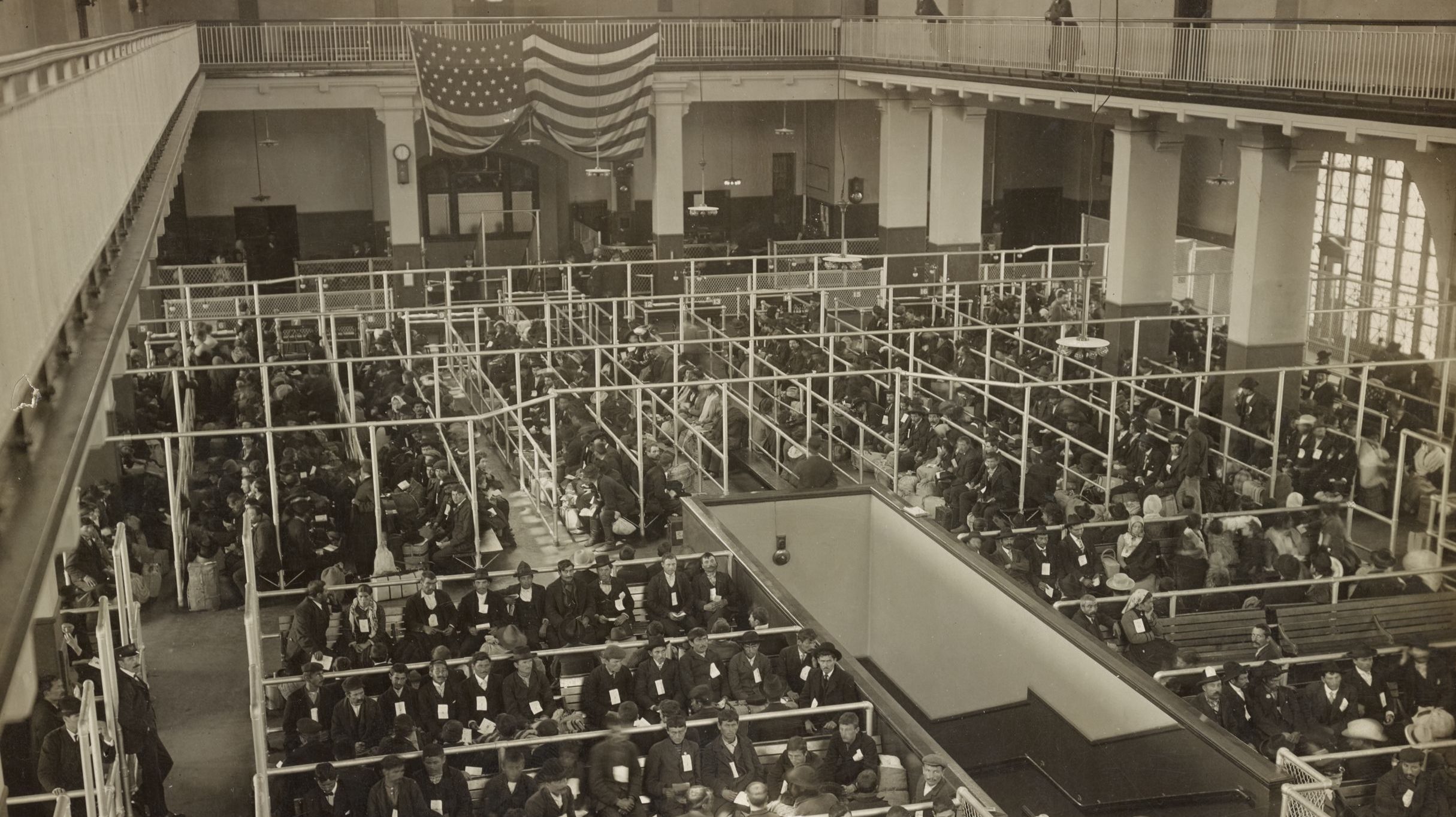
Cannato highlighted one major difference that is evident when looking at the history of Ellis Island, the first federal immigration station in the United States. More than 12 million people were processed there between its opening in 1892 and closing in 1954.
Three quarters of the immigrants coming to the U.S. during this period of peak migration came through Ellis Island, Cannato said, and less than 2 % were turned away.
“One of the things that people don’t realize is that most people who got to Ellis Island eventually got in,” he said. “It was very traumatic for those who got turned away, but for the most part, 98 plus percent of immigrants ended up getting into the country.”
U.S. Citizenship and Immigration Services (USCIS), the federal agency that oversees the country’s immigration processing, put a spotlight on the historic site in a recent post on X, stating: “Ellis Island became one of the most recognized symbols of America’s federal immigration system. As we approach America’s 250th anniversary, it reminds us that America’s promise has always been strongest when protected by order, law, and responsibility.”
In response to the USCIS post, Cannato pointed out that the federal government established Ellis Island in an effort to centralize the nation’s immigration system, and respond to a surge of migration from Europe around the turn of the century. “Ellis Island means many things to many people. That’s the truth about almost any historical site, any historical monument.”
And that plurality of meanings also reveals nuance in its history, Zehngut-Willits said, especially as U.S. policies have always been contested and in flux, and an individual’s entry or denial has often depended on the subjectivities of administrators in the system — a pattern we continue to see playing out today in immigration courts and in USCIS’ administrative rules.
“To suggest that what was happening at Ellis Island was like this set of altruistic rules and laws that were very clear and consistent throughout its existence is a complete misreading of that history,” he said, adding that there is always a gap between how a law is written, and how it is administered. “How did an immigrant, in other words, experience the laws as practice versus how they were written on the books? That’s all something that had to be negotiated and worked out over time.”
The idea that order or law has guided federal immigration policy, then, is a narrow understanding. One that ignores America’s history of internal clashes over race and belonging, and the realities of how policy plays out on the ground, which continue to define who is afforded rights, safety and a home here — even after 250 years.